 Back
BackElectric Dipoles, Torque, and Gauss's Law: Study Notes
Study Guide - Smart Notes
 Tailored notes based on your materials, expanded with key definitions, examples, and context.
Electric Dipoles and Torque
Electric Dipole Moment
An electric dipole consists of two equal and opposite charges separated by a distance. The electric dipole moment is a vector quantity defined as:
Definition: The electric dipole moment \( \vec{p} \) is given by \( \vec{p} = q \vec{d} \), where q is the magnitude of each charge and \( \vec{d} \) is the displacement vector from the negative to the positive charge.
Direction: The direction of \( \vec{p} \) is from the negative to the positive charge.
Torque on an Electric Dipole in a Uniform Electric Field
When an electric dipole is placed in a uniform electric field \( \vec{E} \), it experiences a torque that tends to align the dipole with the field.
Formula: The torque \( \vec{\tau} \) on the dipole is given by:
Magnitude: , where \( \phi \) is the angle between \( \vec{p} \) and \( \vec{E} \).
Physical Meaning: The torque tends to rotate the dipole so that \( \vec{p} \) aligns with \( \vec{E} \).
Vector Operations: Cross Product and Right-Hand Rule
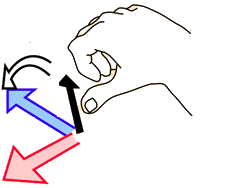
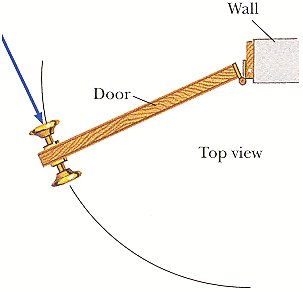
The cross product is used to calculate torque and follows the right-hand rule.
Right-Hand Rule: Point your fingers in the direction of the first vector (\( \vec{l} \) or \( \vec{p} \)), curl them toward the second vector (\( \vec{F} \) or \( \vec{E} \)), and your thumb points in the direction of the torque.
Electric Flux and Gauss's Law
Electric Flux
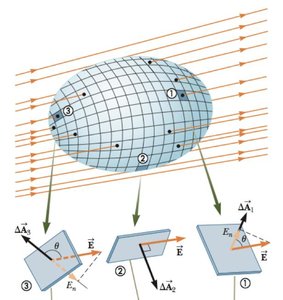
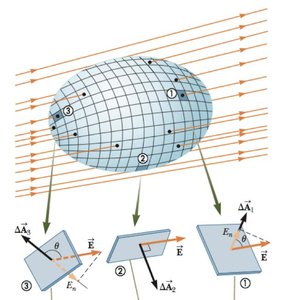
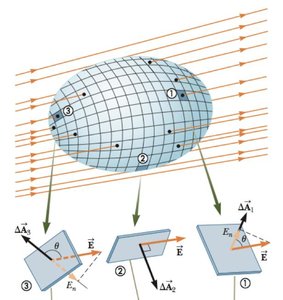
Electric flux quantifies the number of electric field lines passing through a given surface. It is a measure of the field's effect over an area.
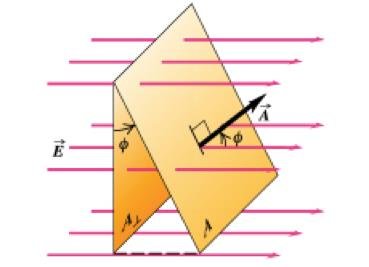
Uniform Field: For a uniform electric field \( \vec{E} \) passing through a flat surface of area A at an angle \( \phi \) to the normal, the electric flux is:
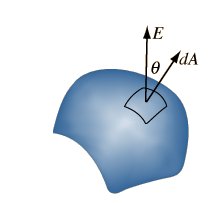
General Case: For a non-uniform field or curved surface:
Direction of Area Vector: The area vector \( d\vec{A} \) is perpendicular to the surface.

Example: Electric Flux Through a Tilted Disk
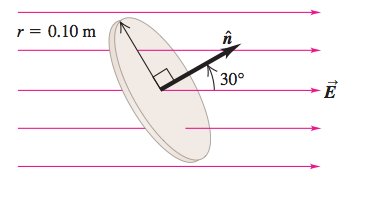
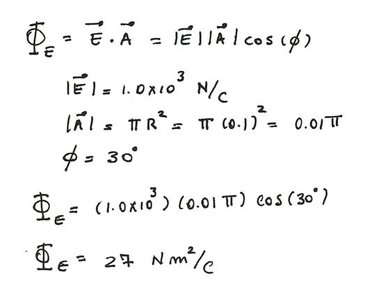
Consider a disk of radius 0.10 m in a uniform electric field of magnitude \(1.0 \times 10^3\) N/C, with the normal to the disk making a 30° angle with the field.
Calculation:
Open vs. Closed Surfaces
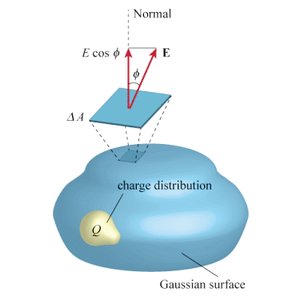
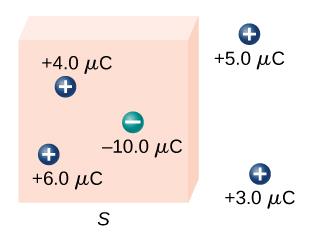
An open surface (like a disk) has boundaries, while a closed surface (like a sphere or cube) completely encloses a volume. Gauss's Law applies to closed surfaces, also called Gaussian surfaces.
Positive and Negative Electric Flux
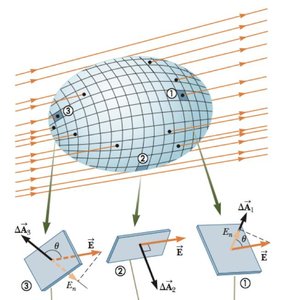
The sign of electric flux depends on the orientation of the electric field relative to the surface normal:
Positive Flux: Field lines exiting the surface (outward normal).
Negative Flux: Field lines entering the surface (inward normal).
Zero Flux: Equal number of lines entering and exiting, or field perpendicular to area vector.
Gauss's Law
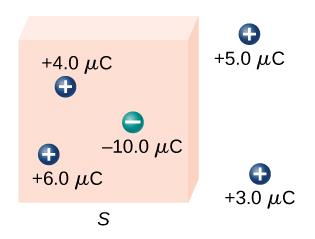
Gauss's Law relates the net electric flux through a closed surface to the net charge enclosed by that surface:
\( \varepsilon_0 \) is the permittivity of free space: \( \varepsilon_0 = 8.85 \times 10^{-12}\ \mathrm{C^2/(N\,m^2)} \).
Application: Gauss's Law is especially useful for calculating electric fields of highly symmetric charge distributions (spheres, cylinders, planes).
Summary Table: Electric Flux and Gauss's Law
Concept | Formula | Description |
|---|---|---|
Electric Flux (Uniform Field) | Field through flat surface at angle \( \phi \) | |
Electric Flux (General) | Field through any surface | |
Gauss's Law | Net flux through closed surface |
Additional info:
These notes cover topics from Chapter 21 (Electric Charge, Electric Field, Electric Dipoles) and Chapter 22 (Gauss's Law) of a typical college physics course.
Understanding vector operations and the right-hand rule is essential for calculating torque and cross products in physics.
