 Back
Electric Field and Electric Forces: Physics with Calculus Study Notes
Study Guide - Smart Notes
 Tailored notes based on your materials, expanded with key definitions, examples, and context.
Electric Field and Electric Forces
Introduction to Electric Fields
The concept of the electric field is fundamental in understanding how charges interact at a distance. An electric field is a region of space around a charged object where other charges experience an electric force. This field is a vector field, meaning it has both magnitude and direction, and is independent of the presence of a test charge.
Electric Field (E): The force per unit charge exerted on a small positive test charge placed at a point in space.
Test Charge (q0): A hypothetical charge used to detect the presence and direction of an electric field.
Source Charge (Q): The charge that creates the electric field.
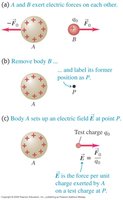
Definition: The electric field E at a point is defined as:
where F is the force experienced by the test charge q0.
Electric Field of a Point Charge
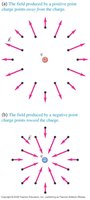
A single point charge produces an electric field that radiates outward (for positive charges) or inward (for negative charges). The magnitude of the electric field due to a point charge is given by Coulomb's law:
where q is the source charge, r is the distance from the charge, and \varepsilon_0 is the permittivity of free space.
Direction: For a positive source charge, the field points away from the charge; for a negative source charge, it points toward the charge.
Direction of the Electric Field
The direction of the electric field at a point is the direction of the force that a positive test charge would experience if placed at that point. For a negative test charge, the force is in the opposite direction to the field.
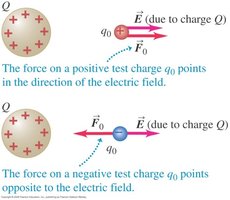
Key Point: The electric field is a property of space due to the source charge and does not depend on the test charge.
Superposition Principle for Electric Fields
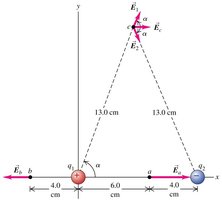
When multiple charges are present, the total electric field at a point is the vector sum of the fields produced by each charge individually. This is known as the principle of superposition:
Each field is calculated as if the other charges were not present, and then the vectors are added.
Electric Field Calculations: Example
Consider two point charges, q1 and q2, placed at specific positions. To find the electric field at a point P, calculate the field due to each charge at P and add the vectors.
Example: q1 = 7.0 \mu C at the origin, q2 = -5.0 \mu C at (0.30 m, 0), find \vec{E} at (0, 0.40 m).
Motion of a Charged Particle in a Uniform Electric Field
When a charged particle is placed in a uniform electric field, it experiences a constant force:
According to Newton's second law, the acceleration is:
The direction of acceleration depends on the sign of the charge.
For a positive charge, acceleration is in the direction of E; for a negative charge, it is opposite.
Example: Electron in a Uniform Electric Field
An electron is projected horizontally into a region with a uniform electric field directed upward. The electron is accelerated downward (opposite to the field direction) and follows a parabolic path, similar to projectile motion under gravity.
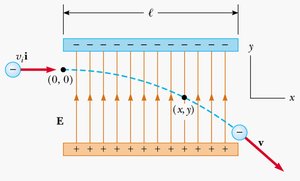
Kinematic equations can be used to describe the motion in the x and y directions.
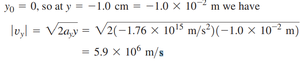
Example: Electron Between Parallel Plates
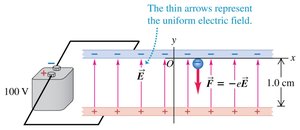
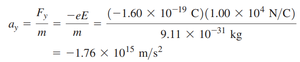
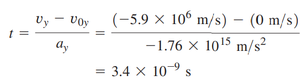
When an electron is released from rest between two parallel plates connected to a voltage source, it accelerates toward the positive plate. The acceleration, final speed, kinetic energy, and time to cross the plates can be calculated using the following equations:
Acceleration:
Kinetic Energy:
Time to cross:
Final speed:

Applications of Electric Fields
Television and Computer Screens: Old CRT screens use electric fields to accelerate and direct electrons onto a phosphorescent screen.
Radiotherapy Equipment: Uses electric fields to accelerate charged particles for cancer treatment.
Particle Accelerators: Devices like those at CERN use electric fields to accelerate particles to high energies for research in fundamental physics.


Summary Table: Key Equations and Concepts
Concept | Equation | Description |
|---|---|---|
Electric Field (point charge) | Magnitude at distance r from charge q | |
Electric Force | Force on charge q in field E | |
Superposition Principle | Vector sum of fields from all charges | |
Acceleration in E-field | Acceleration of charge q, mass m |
Additional info:
Electric field lines provide a visual representation of the field's direction and strength: lines point away from positive charges and toward negative charges; denser lines indicate stronger fields.
Electric fields are essential in understanding phenomena such as lightning, which is a large-scale discharge of electric energy in the atmosphere.
