 Back
BackElectric Field Calculations: Discrete and Continuous Charge Distributions
Study Guide - Smart Notes
 Tailored notes based on your materials, expanded with key definitions, examples, and context.
Electric Field Calculations
Discrete Distribution of Charges
In electrostatics, the electric field produced by a collection of point charges can be determined using the principle of superposition. Each charge generates its own electric field, and the total field at any point is the vector sum of the fields from all charges.
Principle of Superposition: The total electric field E at a point due to n point charges is given by:
Coulomb's Law: The electric field from a single point charge q at distance r is:
Example: Three negative point charges lie along a line. To find the electric field at a point perpendicular to the line, calculate the field from each charge and sum their vector components.
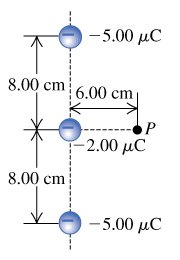
Application: This method is used to solve problems involving multiple charges, such as finding the field at a specific location due to a configuration of charges.
Electric Dipole
An electric dipole consists of two point charges of equal magnitude and opposite sign separated by a distance d. The dipole moment p is a vector pointing from the negative to the positive charge.
Dipole Moment:
Field at a Point Far from the Dipole: For , the electric field along the axis perpendicular to the dipole is:
Example: Calculating the field at a point far from the dipole using the above formula.
Continuous Distribution of Charges
For objects with charge distributed continuously, the electric field is calculated by integrating over the charge distribution. The charge may be distributed along a line, over a surface, or throughout a volume.
Charge Density Definitions:
Type | Symbol | Formula | Units |
|---|---|---|---|
Linear | λ | C/m | |
Surface | σ | C/m2 | |
Volume | ρ | C/m3 |
General Formula: The electric field at point P due to a continuous charge distribution is:
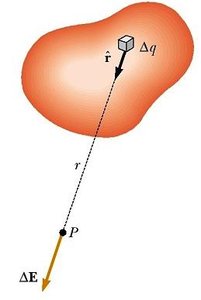
Application: This approach is used for lines, rings, disks, and plates of charge.
Case Study: Line of Charge
Consider a line of charge of length 2a and total charge Q. The linear charge density is . The electric field at a point along the x-axis is found by integrating over the length of the line.
Electric Field Calculation:
Result for Long Wire: For a very long wire (), the field simplifies to:
Example: A very long, straight wire with charge per unit length C/m. Find the distance where the field is 2.50 N/C.
Summary Table: Charge Distribution Types
Distribution | Charge Density | Field Calculation |
|---|---|---|
Point | q | |
Line | λ | Integration over line: |
Surface | σ | Integration over area: |
Volume | ρ | Integration over volume: |
Key Takeaways
Electric fields from discrete charges are calculated using superposition and Coulomb's law.
Continuous charge distributions require integration, using appropriate charge density.
Special cases (dipoles, lines, rings, disks) have characteristic field formulas.
Additional info: For more complex geometries (rings, disks, plates), refer to textbook examples for detailed integration steps.
