 Back
BackElectric Field Due to Continuous Charge Distributions
Study Guide - Smart Notes
 Tailored notes based on your materials, expanded with key definitions, examples, and context.
Electric Field Due to Charge Distributions
Overview of Charge Distributions
The electric field produced by a charge depends on the spatial distribution of the charge. Common distributions include point charges, lines of charge, planes of charge, and spheres of charge. Each configuration produces a distinct electric field pattern and requires specific mathematical treatment to determine the field at a given point.
Point Charge: The electric field radiates outward (or inward for negative charge) symmetrically from the charge.
Line of Charge: The field is strongest near the line and decreases with distance, with symmetry about the line.
Plane of Charge: The field is perpendicular to the plane and uniform near the surface.
Sphere of Charge: The field outside the sphere behaves as if all charge were concentrated at the center.
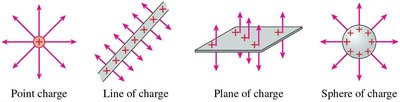
Electric Field of a Uniformly Charged Rod
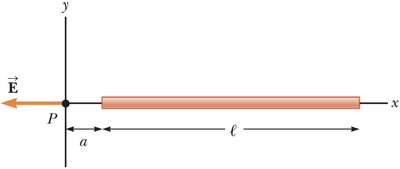
Consider a rod of length ℓ with uniform linear charge density λ and total charge Q. The electric field at a point P located a distance a from one end along the axis of the rod can be calculated by integrating the contributions from each infinitesimal segment.
Linear charge density:
Infinitesimal charge element:
Electric field from each segment: , where
Total field:
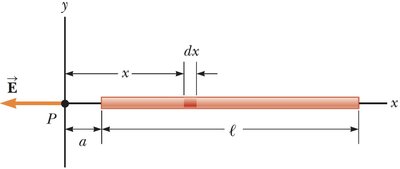
Integration for the Electric Field
To find the total electric field, perform the integral:
Substitute back to get the field:
Express in terms of total charge:
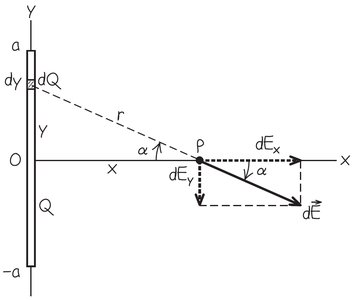
Electric Field of a Uniformly Charged Line Segment (y-axis)
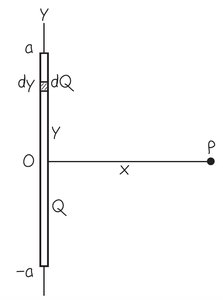
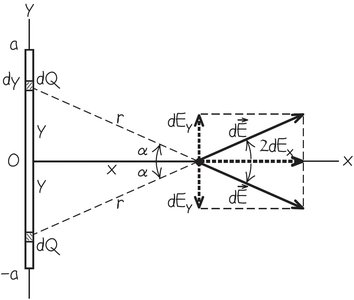
For a line segment along the y-axis from to with total charge , the field at point on the x-axis at distance is determined by integrating over the line.
Linear charge density:
Infinitesimal charge element:
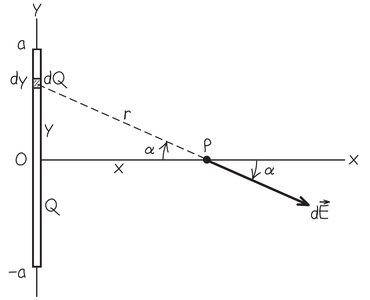
Distance from element to P:
Field from element:
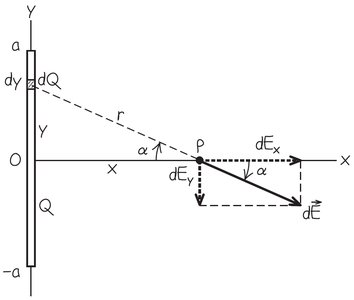
Component along x-axis:
Total field:
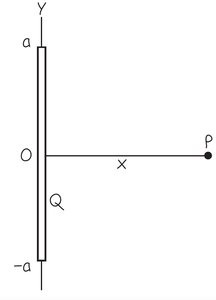
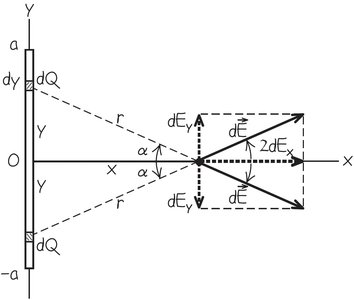
Symmetry and Integration Results
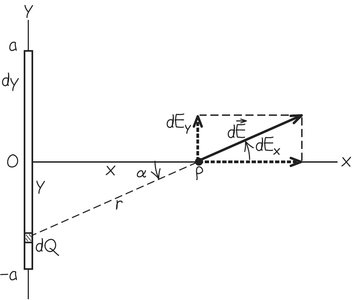
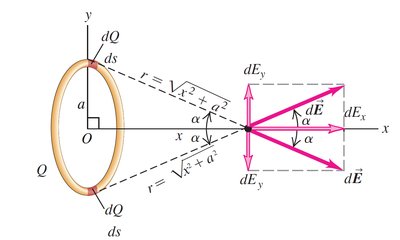
By symmetry, the y-components of the field cancel, leaving only the x-component. The integral for the x-component is:
Thus,
For , the field reduces to that of a point charge:
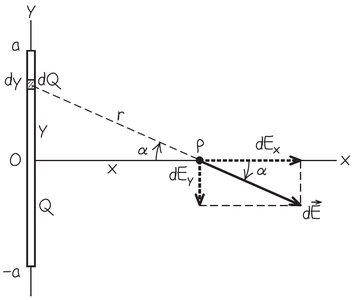
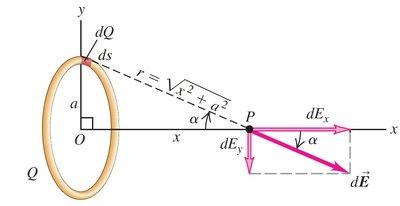
Electric Field of a Ring of Charge
Charge is uniformly distributed around a ring of radius . The field at a point on the axis at distance from the center is found by integrating over the ring.
Distance from element to P:
Field from element:
Component along axis:
Total field:
At the center (), due to symmetry.
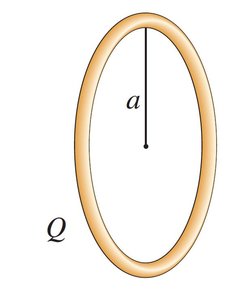
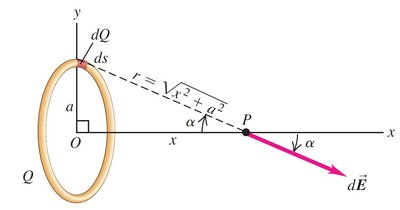
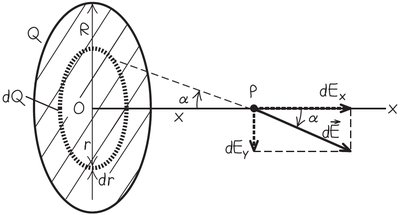
Electric Field of a Uniformly Charged Disk
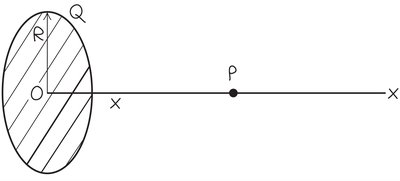
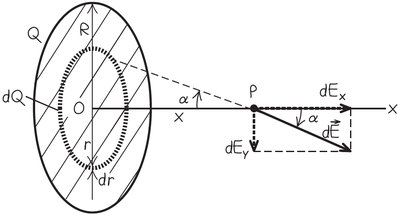
A disk of radius with uniform surface charge density produces an electric field at a point along its axis at distance from the center. The disk is divided into concentric rings for integration.
Surface charge density: ,
Infinitesimal ring element:
Field from ring:
Total field:
Result after integration:
For , (field of infinite plane sheet)
Summary Table: Electric Field of Common Charge Distributions
Distribution | Electric Field Expression | Key Features |
|---|---|---|
Point Charge | Radial symmetry | |
Line of Charge | Perpendicular to line, decreases with distance | |
Plane of Charge | Uniform, perpendicular to plane | |
Ring of Charge | Along axis, zero at center | |
Disk of Charge | Approaches plane field for large R |
Key Concepts and Applications
Superposition Principle: The net electric field is the vector sum of fields from all charge elements.
Symmetry: Used to simplify calculations and determine which components of the field survive.
Integration: Required for continuous charge distributions; common integrals include those for line, ring, and disk.
Limiting Cases: For large distances, fields often reduce to those of point charges.
Important Integrals
Summary
Understanding the electric field due to continuous charge distributions is essential for advanced studies in electromagnetism. The methods outlined here—using symmetry, integration, and the superposition principle—are foundational for solving problems involving complex charge arrangements.
Additional info: The notes cover content directly relevant to Ch 23: The Electric Field, Ch 24: Gauss' Law, and Ch 25: The Electric Potential, as well as mathematical techniques used in these chapters.
