 Back
BackElectric Field Lines, Electric Flux, and Gauss’s Law
Study Guide - Smart Notes
 Tailored notes based on your materials, expanded with key definitions, examples, and context.
Electric Field Lines
Representation and Interpretation
Electric field lines provide a visual and conceptual tool for understanding the direction and strength of electric fields. They originate from positive charges and terminate on negative charges, or extend to infinity if there is an excess of one type of charge.
Direction: Field lines point away from positive charges and toward negative charges.
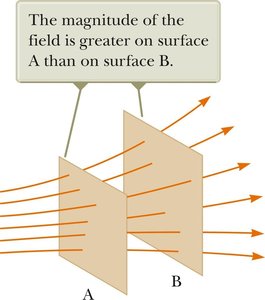
Density: The density of lines (number per unit area) indicates the magnitude of the electric field; closer lines mean a stronger field.
Non-crossing: No two field lines ever cross.
Pictorial Nature: Field lines are not physical entities but a qualitative representation of the field.
Field Lines for Point Charges
Positive Point Charge: Lines radiate outward spherically.
Negative Point Charge: Lines radiate inward spherically.
Test Charge Response: A positive test charge is repelled by positive sources and attracted to negative sources.
Electric Dipole
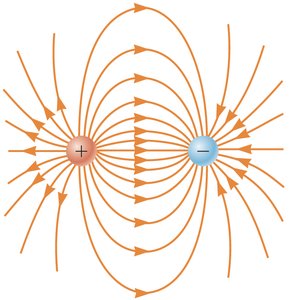
An electric dipole consists of two equal and opposite charges. The field lines emerge from the positive charge and terminate on the negative charge, forming characteristic curved patterns.
Field Lines for Like Charges
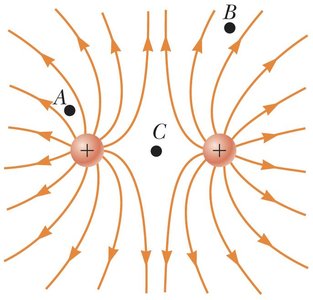
For two equal positive charges, field lines originate from both and repel each other, never crossing. The field at a distance resembles that of a single charge of twice the magnitude.
Field Lines for Unlike Charges
For charges of unequal magnitude, more lines leave the larger positive charge than terminate on the smaller negative charge. At a distance, the field resembles that of a single charge equal to the algebraic sum.
Ranking Field Strength by Line Density
The magnitude of the electric field at a point is proportional to the density of field lines at that location.
Closer lines: Stronger field.
Farther lines: Weaker field.
Motion of Charged Particles in Electric Fields
Force and Acceleration
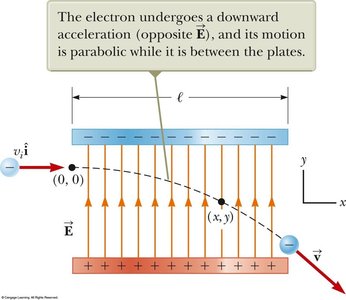
A charged particle in an electric field experiences a force given by:
Uniform Field: Acceleration is constant; kinematic equations apply.
Direction: Positive charges accelerate in the direction of the field; negative charges accelerate opposite to the field.
Electric Flux
Definition and Calculation
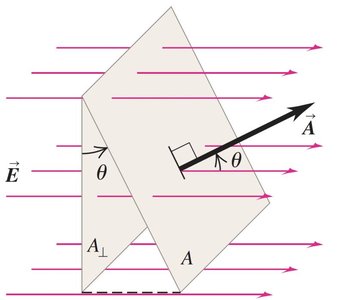
Electric flux () quantifies the number of electric field lines passing through a surface. It is a measure of the field's effect over an area.
Basic Formula: (for a flat surface perpendicular to a uniform field)
General Formula: (where is the angle between and the normal to the surface)
Vector Form:
Integral Form: (for non-uniform fields or curved surfaces)
Flux Through Closed Surfaces
For closed surfaces, the flux is calculated as:
The direction of is outward normal to the surface.
Gauss’s Law
Statement and Mathematical Form
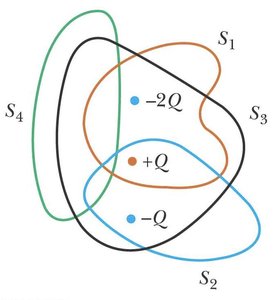
Gauss’s Law relates the net electric flux through a closed surface to the net charge enclosed by that surface:
Gaussian Surface: The closed surface used in the calculation can be real or imaginary and is chosen to exploit symmetry.
Permittivity of Free Space: is a fundamental constant.
Applications of Gauss’s Law
Spherical Symmetry: Point charges, spheres
Cylindrical Symmetry: Line charges
Planar Symmetry: Infinite planes of charge
Electric Field of a Point Charge
For a point charge at the center of a spherical Gaussian surface of radius :
Thus,

Conductors and Insulators in Electrostatics
Conductors: Excess charge resides on the surface; the internal electric field is zero.
Insulators: Charge can be distributed throughout the volume; an internal field may exist.
Electric Field of Spherically Symmetric Charge Distributions
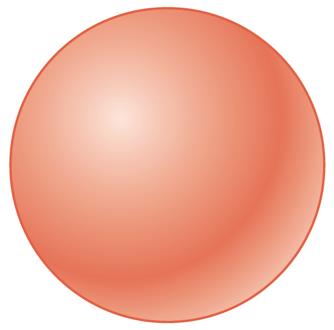
Solid Insulating Sphere
Outside the Sphere ():
Inside the Sphere ():
Insulating Spherical Shell
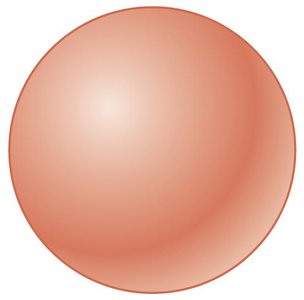
For (inside inner radius):
For (within shell):
For (outside shell):
Electric Field of Cylindrical and Planar Charge Distributions
Line of Charge (Cylindrical Symmetry)
For a long line of charge with linear charge density :
Infinite Plane of Charge (Planar Symmetry)
For an infinite plane with surface charge density :
The field is uniform and does not depend on the distance from the plane.
Summary Table: Electric Field by Symmetry
Symmetry | Charge Distribution | Gaussian Surface | Electric Field |
|---|---|---|---|
Spherical | Point charge, sphere | Sphere | |
Cylindrical | Line charge | Cylinder | |
Planar | Infinite plane | Pillbox |
Gauss’s Law: Differential Form
The differential form of Gauss’s Law is:
This is one of Maxwell’s equations, relating the divergence of the electric field to the local charge density.
