 Back
BackLec 2
Study Guide - Smart Notes
 Tailored notes based on your materials, expanded with key definitions, examples, and context.
Electric Fields and Coulomb’s Law
Coulomb’s Law
Coulomb’s Law describes the electrostatic force between two point charges. The force is proportional to the product of the charges and inversely proportional to the square of the distance between them.
Formula: , where
Direction: The force acts along the line joining the two charges. Like charges repel; unlike charges attract.
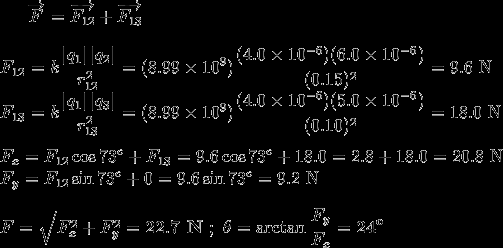
Vector Addition: When more than two charges are present, the net force on a charge is the vector sum of the forces exerted by all other charges.
Example: Calculating the net force on a charge in a system of three charges using vector components and trigonometry.
The Electric Field
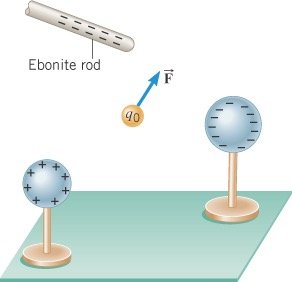
The electric field at a point is defined as the electrostatic force experienced by a small positive test charge placed at that point, divided by the magnitude of the test charge. The electric field is a vector quantity, with both magnitude and direction.
Definition:
SI Units: Newton per coulomb (N/C)
Test Charge: The test charge should be small enough not to disturb the existing field.
Direction: The direction of is the direction of the force on a positive test charge.
Example: A positively charged test charge near charged objects experiences a force due to the vector sum of the fields from all sources.
Calculating the Electric Field
The electric field due to a point charge is given by:
Formula:
Independence from Test Charge: The field depends only on the source charge and the distance from it, not on the test charge.
Superposition Principle: The net electric field from multiple charges is the vector sum of the fields from each charge.
Example: Calculating the field at a point due to a single charge, and finding the force on a test charge placed there.
Electric Field Zero Point
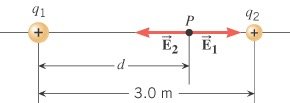
There can be points in space where the net electric field is zero due to the vector sum of fields from multiple charges. For example, between two like charges, there is a point where their fields cancel.
Method: Set the magnitudes of the fields from each charge equal and solve for the position.
Example: Two positive charges separated by a distance; find the point where their fields cancel.
The Parallel Plate Capacitor
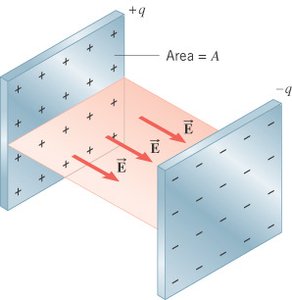
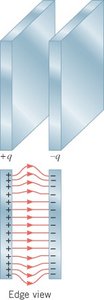
A parallel plate capacitor consists of two large, flat, conducting plates separated by a small distance. The electric field between the plates is uniform (except near the edges) and is given by:
Formula: , where is the surface charge density, is the area, and is the permittivity of free space.
Uniform Field: The field is constant in magnitude and direction between the plates, away from the edges.
Electric Field Lines
Electric field lines provide a visual representation of the electric field in space. They indicate the direction and relative strength of the field.
Properties:
Lines begin on positive charges and end on negative charges.
The density of lines is proportional to the field strength.
Lines never cross and do not stop in midspace.
Field lines are perpendicular to the surface of conductors at equilibrium.
Example: Drawing field lines for a dipole, parallel plates, or multiple charges.
The Electric Field Inside a Conductor: Shielding
Conductors in electrostatic equilibrium have unique properties regarding electric fields:
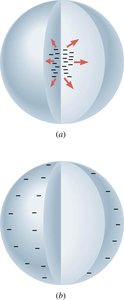
Zero Field Inside: The electric field is zero at every point inside a conductor under electrostatic conditions.
Surface Charge: Any excess charge resides on the surface.
Shielding: The conductor shields its interior from external electric fields.
Field at Surface: The electric field just outside the surface is perpendicular to the surface.
Induced Charges: A charge placed inside a hollow conductor induces equal and opposite charges on the inner and outer surfaces.
Summary Table: Key Electric Field Equations
Situation | Electric Field Formula |
|---|---|
Point charge | |
Parallel plate capacitor | |
Force on charge in field |
