 Back
BackElectric Fields and Dipoles: Principles and Calculations
Study Guide - Smart Notes
 Tailored notes based on your materials, expanded with key definitions, examples, and context.
Electric Field and Superposition
Principle of Superposition
The principle of superposition states that the net force on a given object is the vector sum of all individual forces acting upon it. This principle applies to electric forces in the same way as it does to gravitational forces.
Vector Summation: Forces are added using vector addition, considering both magnitude and direction.
Application: Used to calculate the net electric force when multiple charges are present.
Equation: The net force is given by:
Tip-to-Tail Rule: Graphical method for vector addition.
Example: If three charges are placed at points A, B, and C, the net force on C is the vector sum of the forces from A and B.
Electric Field: Definition and Properties
Physical and Mathematical Definition
The electric field is a vector field produced by electric charges. It represents the force per unit charge experienced by a test charge placed in the field.
Physical Meaning: The electric field describes the influence that a charge exerts on its surroundings.
Mathematical Definition: where is the electric force and is the test charge.
Units: Newtons per Coulomb (N/C).
Comparison with Gravitational Field
Both electric and gravitational fields are central force fields, but electric fields arise from charges, while gravitational fields arise from masses.
Gravitational Force:
Electric Force:
Electric Field Lines
Graphical Representation
Electric field lines provide a visual representation of the magnitude and direction of the electric field. The density of lines indicates the field's strength, and arrows show the direction.
Direction: Lines point away from positive charges and toward negative charges.
Magnitude: Represented by the proximity of lines; closer lines indicate stronger fields.
Rules: No field line crosses another; lines begin and end on charges or at infinity.
Proportionality: The number of lines leaving or entering a charge is proportional to the magnitude of the charge.
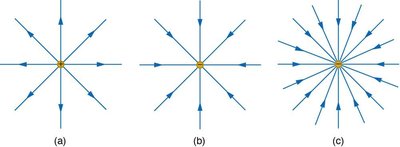
Example: Field lines for a point charge show radial symmetry, with arrows indicating direction.
Electric Dipoles
Definition and Field Lines
An electric dipole consists of two equal and opposite charges separated by a distance. The dipole moment is a vector pointing from the negative to the positive charge.
Dipole Moment: , where is the charge and is the displacement vector.
Field Lines: The field lines originate from the positive charge and terminate at the negative charge, forming characteristic patterns.
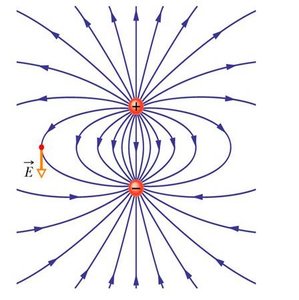
Example: The field of a dipole is important in molecular physics, such as the water molecule, which has a permanent dipole moment.
Electric Field Calculations
Discrete and Continuous Charge Distributions
The electric field can be calculated for both discrete point charges and continuous charge distributions using the principle of superposition.
Discrete Charges: Sum the fields from each charge using vector addition.
Continuous Distribution: Integrate over the charge distribution.
Equation for Point Charge:
Electric Field of a Dipole (Far Field Approximation)
For points far from the dipole (distance ), the electric field along the axis of the dipole can be approximated using the binomial expansion.
Field Calculation:
Binomial Approximation: for
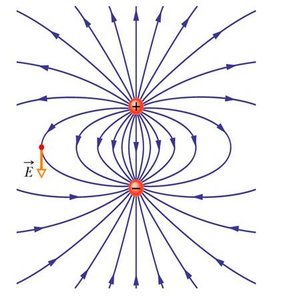
Example: The field at a point along the axis of a dipole decreases rapidly with distance, proportional to .
Summary Table: Electric Field Properties
Property | Electric Field | Gravitational Field |
|---|---|---|
Source | Charge | Mass |
Direction | From + to - | Toward mass |
Equation | ||
Field Lines | Arrows, density = strength | Arrows, density = strength |
