 Back
BackElectric Fields and Electric Forces: Fundamental Concepts and Applications
Study Guide - Smart Notes
 Tailored notes based on your materials, expanded with key definitions, examples, and context.
Electric Charge and Its Properties
Introduction to Electric Charge
Electric charge is a fundamental property of matter that gives rise to electric forces and fields. The study of electric charge forms the basis for understanding a wide range of physical phenomena, from static electricity to the behavior of atoms and molecules.
Definition: Electric charge is a physical property of matter that causes it to experience a force when placed in an electric and magnetic field.
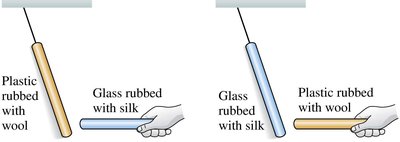
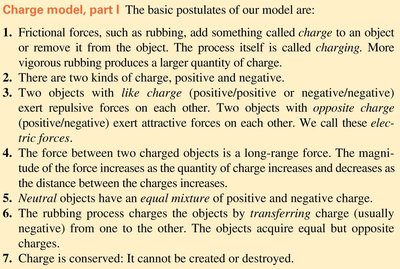
Types of Charge: There are two types of electric charge: positive and negative.
Conservation of Charge: The total electric charge in an isolated system remains constant. Charge can be transferred but not created or destroyed.
Charge Transfer: Rubbing certain materials together can transfer charge from one object to another, a process known as charging by friction.
Conductors and Insulators
Materials can be classified based on how easily electric charge moves through them.
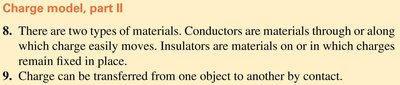
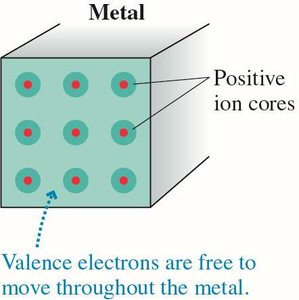
Conductors: Materials (such as metals) that allow electric charge to move freely.
Insulators: Materials (such as glass or plastic) in which electric charge is essentially immobile.
Charge Transfer by Contact: Charge can be transferred from one object to another by direct contact, especially if at least one is a conductor.

Atomic Structure and Charge
Protons, Electrons, and Ions
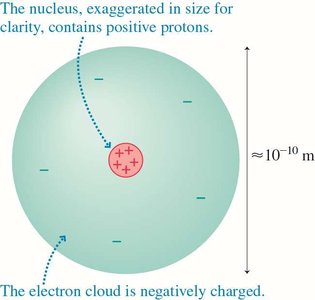
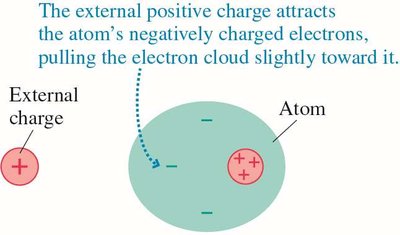
Atoms are composed of a dense nucleus containing protons and neutrons, surrounded by a cloud of electrons. The balance of protons and electrons determines the net charge of the atom.
Proton: Positively charged particle in the nucleus.
Electron: Negatively charged particle orbiting the nucleus.
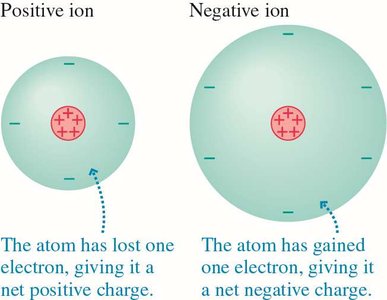
Ion: An atom that has gained or lost electrons, resulting in a net charge.
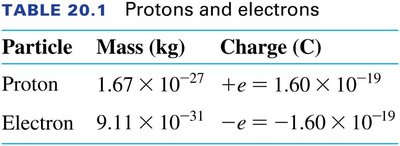
Fundamental Charge: The magnitude of the charge of a proton or electron is C.
Particle | Mass (kg) | Charge (C) |
|---|---|---|
Proton | ||
Electron |
Insulators vs. Metals at the Atomic Level
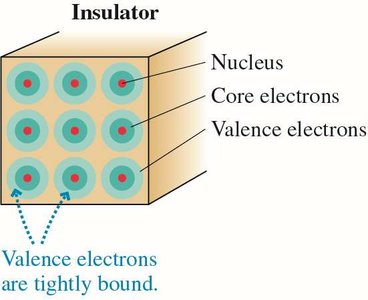
Insulators: Valence electrons are tightly bound to their atoms and cannot move freely.
Metals (Conductors): Valence electrons are free to move throughout the material, forming a 'sea of electrons.'
Charging Mechanisms and Polarization
Charging by Conduction and Induction
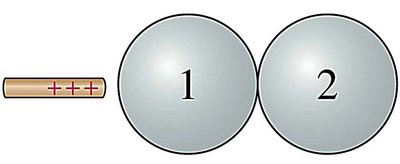
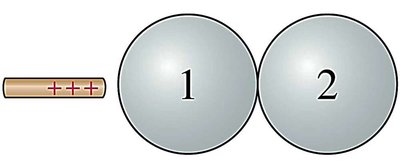
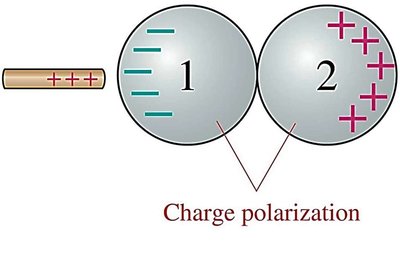
Objects can be charged by direct contact (conduction) or by the influence of a nearby charged object (induction).
Conduction: Transfer of charge by direct contact between objects.
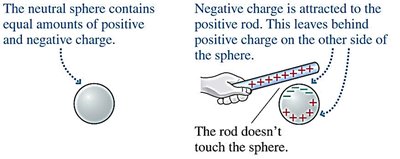
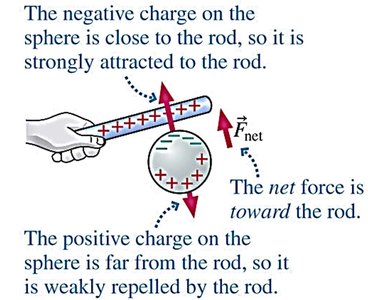
Induction: Redistribution of charges within an object due to the presence of a nearby charged object, without direct contact.
Polarization: The separation of positive and negative charges within a neutral object when a charged object is brought near.
Coulomb's Law and Electric Forces
Coulomb's Law
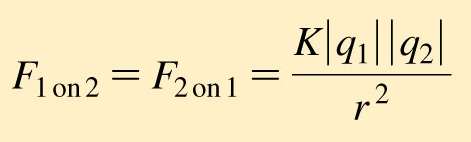
Coulomb's law quantifies the electric force between two point charges. The force is proportional to the product of the charges and inversely proportional to the square of the distance between them.
Formula:
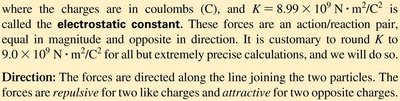
Electrostatic Constant: N·m2/C2 (often rounded to N·m2/C2)
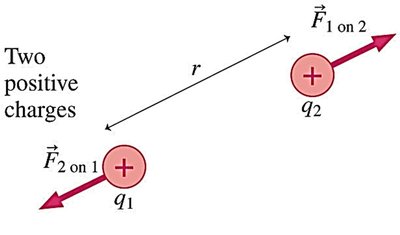
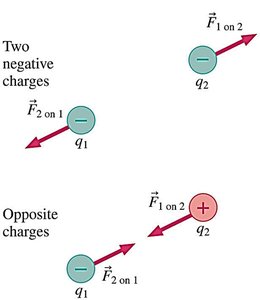
Direction: The force acts along the line joining the two charges. Like charges repel; opposite charges attract.

Superposition Principle
The net electric force on a charge due to multiple other charges is the vector sum of the individual forces exerted by each charge.
Formula:
Worked Example: Forces in One Dimension
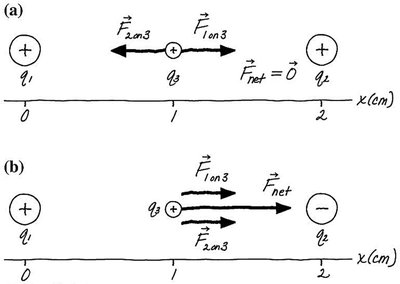
Consider two +10 nC charges 2.0 cm apart on the x-axis. What is the net force on a +1.0 nC charge midway between them?
Both +10 nC charges exert equal and opposite repulsive forces on the +1.0 nC charge, resulting in a net force of zero.
If one charge is replaced by -10 nC, both forces act in the same direction, doubling the net force.
Conceptual Applications and Problem Solving
Force Comparisons and Vector Addition
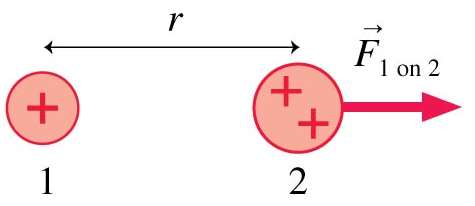
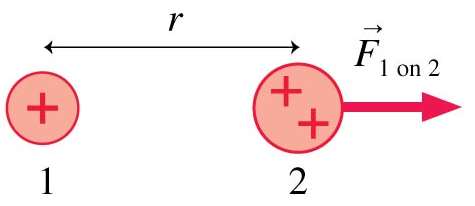
Electric forces can be compared and added using vector principles, especially in symmetric arrangements.
Forces due to multiple charges can cancel or reinforce each other depending on their directions and magnitudes.
Symmetry simplifies the calculation of net forces in many problems.

Electric vs. Gravitational Forces
Electric forces are often much stronger than gravitational forces for objects with typical amounts of charge.
Example: A charged bead can experience an electric force much greater than its weight, causing it to move against gravity.
Summary Table: Key Properties of Charge and Forces
Property | Description |
|---|---|
Charge Conservation | Charge cannot be created or destroyed, only transferred. |
Types of Charge | Positive and negative; like charges repel, opposites attract. |
Conductors | Allow free movement of charge (e.g., metals). |
Insulators | Charge is immobile (e.g., glass, plastic). |
Coulomb's Law | Force between charges: |
Superposition | Net force is the vector sum of all individual forces. |
Conclusion
Understanding electric charge, the forces between charges, and the behavior of conductors and insulators is foundational for the study of electricity and magnetism. Mastery of these concepts enables the analysis of more complex systems involving electric fields, potentials, and circuits.
