 Back
Backlec 3
Study Guide - Smart Notes
 Tailored notes based on your materials, expanded with key definitions, examples, and context.
Electric Fields
Electric Field Lines
Electric field lines, also known as lines of force, provide a visual representation of the electric field in the space surrounding electric charges. These lines help map the direction and strength of the field, indicating how a positive test charge would move under the influence of the field.
Direction: Electric field lines always begin on a positive charge and end on a negative charge. They never stop in midspace.
Strength: The number of lines leaving a positive charge or entering a negative charge is proportional to the magnitude of the charge.
Uniform Field: In regions where the field is uniform, the lines are parallel and evenly spaced.
Electric Dipole: An electric dipole consists of two equal and opposite charges, and the field lines curve from the positive to the negative charge.
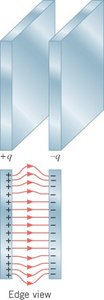
Example: The edge view of parallel plates shows uniform electric field lines between the plates, indicating a constant field strength.
Electric Field Inside a Conductor: Shielding
Conductors exhibit unique behavior under electrostatic conditions. At equilibrium, any excess charge resides on the surface, and the electric field inside the conductor is zero. This property allows conductors to shield their interiors from external electric fields.
Surface Charge: Excess charge is found only on the surface of a conductor.
Zero Field: The electric field inside a conductor is zero at equilibrium.
Shielding: Conductors shield their interiors from external electric fields.
Perpendicular Field: The electric field just outside the surface is perpendicular to the surface.
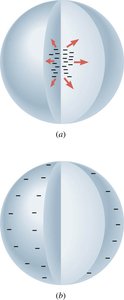
Example: A charge suspended at the center of a hollow, neutral spherical conductor induces a negative charge on the interior surface and a positive charge on the exterior surface.
Electric Potential
Potential Energy and Electric Potential
Electric potential is a measure of the potential energy per unit charge at a given point in an electric field. It is analogous to gravitational potential energy, where only differences in potential matter physically.
Definition: The electric potential at a point is the electric potential energy of a small test charge divided by the charge itself:
SI Unit: The unit of electric potential is the volt (V), where .
Potential Difference:
Conservative Force: The electric force is conservative, so the work done is independent of the path taken.
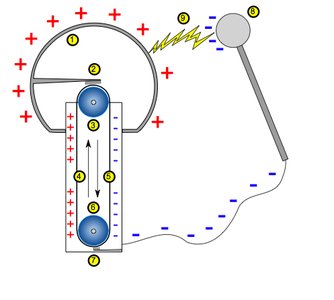
Example: Common electric potentials include 1.5 V for a flashlight battery, 12 V for a car battery, and up to millions of volts for Van de Graaff generators.
Work, Potential Energy, and Electric Potential
The work done by the electric field when moving a charge from point A to B equals the difference in electric potential energy between those points. The potential difference is calculated as:
Only differences in electric potential are physically meaningful.
Example: If a test charge of moves from A to B and the work done is , the potential difference is .
Acceleration of Charges in an Electric Field
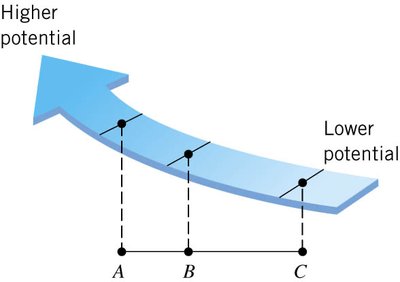
Charges accelerate in response to electric potential differences. A positive charge moves from higher to lower potential, while a negative charge moves from lower to higher potential.
Positive Charge: Accelerates toward lower potential.
Negative Charge: Accelerates toward higher potential.
Electric Potential Energy in Total Energy
Electric potential energy is one component of an object's total energy, alongside kinetic, gravitational, and elastic potential energies. The electron volt (eV) is a convenient unit for describing the energy of subatomic particles.
1 eV:
Energy Conservation:
Van de Graaff Generator Example
A Van de Graaff generator can accelerate electrons across large potential differences. The change in electric potential energy, kinetic energy gained, and final speed can be calculated using conservation of energy.
Change in EPE:
Kinetic Energy:
Final Speed:
Example: An electron accelerated across gains of kinetic energy and reaches a speed close to the speed of light.
Potential Difference in a Parallel-Plate Capacitor
The potential difference between the plates of a parallel-plate capacitor depends on the charge, plate area, and separation distance. The electric field is uniform between the plates.
Work Done:
Electric Field:
Potential Difference:
Electric Potential Created by Point Charges
Potential of a Point Charge
The electric potential at a distance from a point charge is given by:
Where
Potential difference between two points:
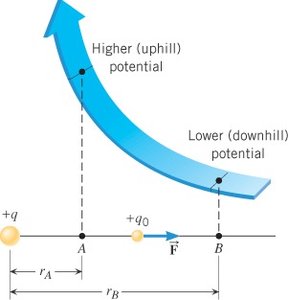
Example: A positive test charge is repelled by another positive point charge, and the potential difference is calculated using the above formula.
Potential Due to Multiple Charges
When multiple charges are present, the total electric potential at a point is the algebraic sum of the potentials due to each charge.
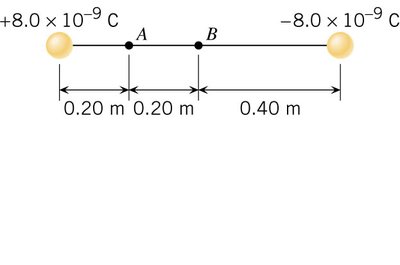
Example: For two charges, and , separated by , the potential at points A and B can be calculated by summing the individual potentials.
Potential Zero Locations
There can be points where the total electric potential is zero, especially when charges of opposite sign are present. For example, with charges and , there are two locations along the line connecting them where the potential is zero.
Set and solve for the distances from each charge.
Only physically meaningful solutions (positive distances) are considered.
Additional info: The mid-plane between equal and opposite charges (electric dipole) is a region where the potential is zero everywhere.
