 Back
Electric Fields and Forces: Structured Study Notes for Physics with Calculus
Study Guide - Smart Notes
 Tailored notes based on your materials, expanded with key definitions, examples, and context.
Chapter 20: Electric Fields and Forces
Section 20.1: Charges and Forces
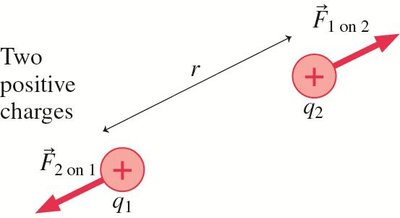
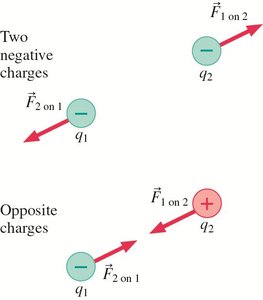
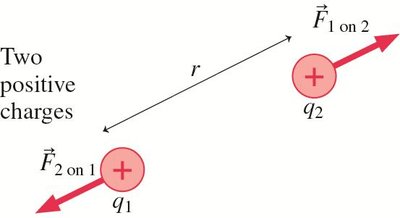
Electric charge is a fundamental property of matter that gives rise to electric forces. The law of conservation of charge states that charge is neither created nor destroyed, only transferred between objects. There are two types of charge: positive and negative. Like charges repel, and opposite charges attract, resulting in electric forces that act at a distance.
Charging: Adding or removing charge from an object.
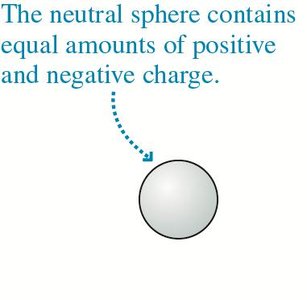
Neutral Objects: Contain equal amounts of positive and negative charge.
Electric Forces: Long-range forces whose magnitude increases with charge and decreases with distance.
Section 20.2: Charges, Atoms, and Molecules
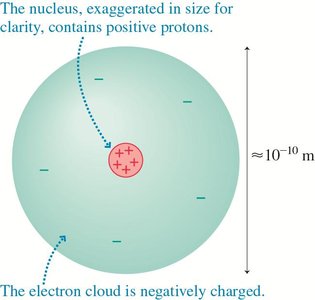
Atoms consist of a dense, positively charged nucleus (protons and neutrons) surrounded by a negatively charged electron cloud. The basic charges in matter are electrons and protons. An object is electrically neutral if it has equal numbers of protons and electrons. Charging typically involves the transfer of electrons, not protons.
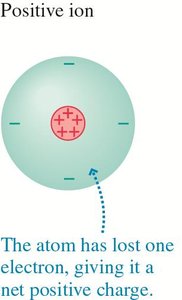
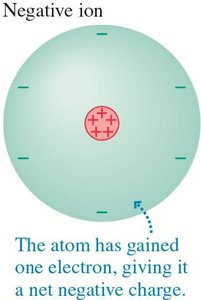
Ionization: Removing or adding electrons to an atom creates ions.
Positive Ion: Atom missing an electron.
Negative Ion: Atom with an extra electron.
Section 20.3: Insulators and Conductors
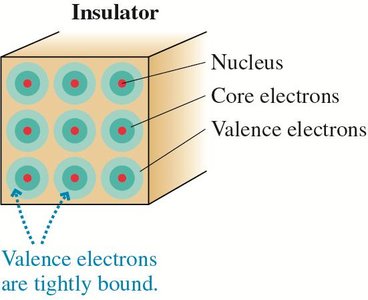
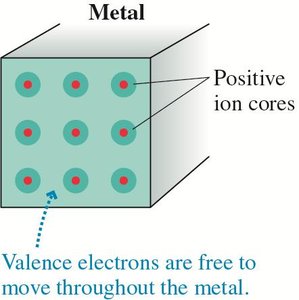
Materials are classified based on how easily charge moves through them. In conductors (e.g., metals), electrons are free to move, while in insulators (e.g., glass, plastic), electrons are tightly bound and immobile. When a conductor is in electrostatic equilibrium, charges are at rest and the electric field inside is zero.
Discharging: Removing excess charge by contact.
Electrostatic Equilibrium: Condition where charges are stationary and the internal electric field is zero.
Section 20.4: Polarization and Electric Dipoles
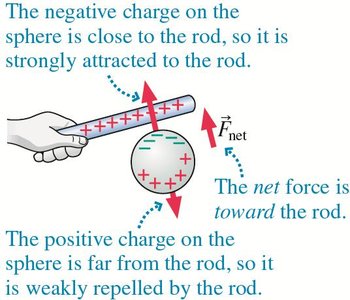
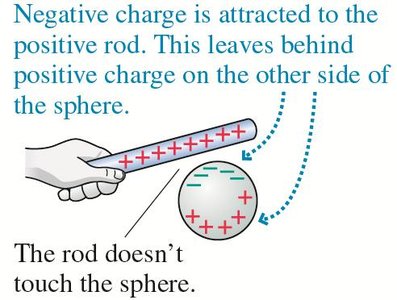
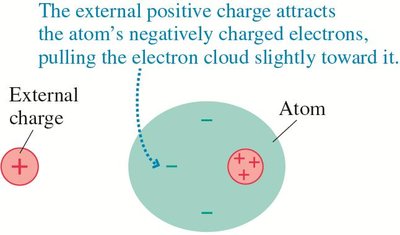
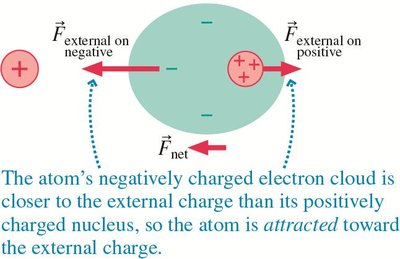
When a charged object is brought near a neutral object, it can cause charge polarization: a slight separation of positive and negative charges within the neutral object. This effect is responsible for the net attractive force between a charged rod and a neutral sphere.
Electric Dipole: Two equal but opposite charges separated by a distance.
Induced Dipole: Polarization caused by an external charge.
Section 20.5: Charge Conservation and Quantization
Charge is represented by the symbol q and measured in coulombs (C). The fundamental charge e is the magnitude of the charge of a single proton or electron: C. Charge is quantized and conserved in all processes.
Particle | Mass (kg) | Charge (C) |
|---|---|---|
Proton | ||
Electron |
Section 20.6: Coulomb’s Law
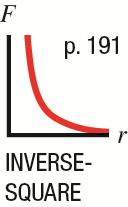
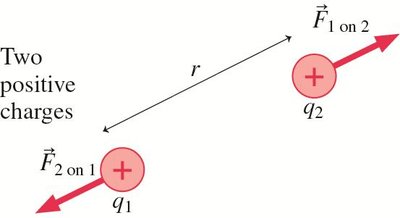
Coulomb’s law describes the electric force between two point charges. The force is proportional to the product of the charges and inversely proportional to the square of the distance between them.
Formula: , where N·m2/C2
Direction: Repulsive for like charges, attractive for opposite charges.
Superposition Principle: The net force on a charge is the vector sum of the forces from all other charges.
Section 20.7: The Concept of the Electric Field
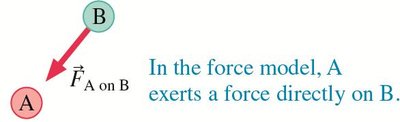
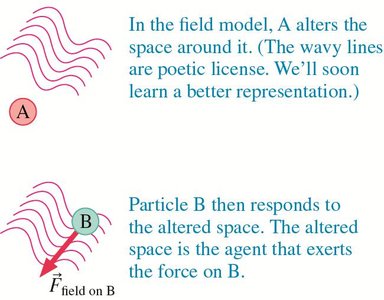
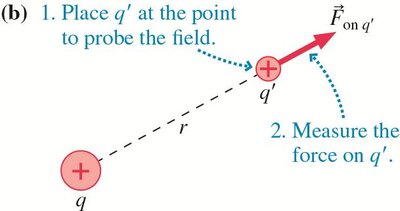
The electric field is a vector field that describes the influence a charge exerts on the space around it. The field model explains how forces are transmitted through space. The electric field at a point is defined as the force per unit charge at that point.
Formula:
Units: Newtons per coulomb (N/C)
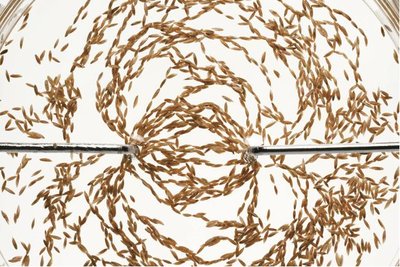
Field Lines: Imaginary lines that indicate the direction and strength of the electric field.
Section 20.8: The Electric Field of a Point Charge
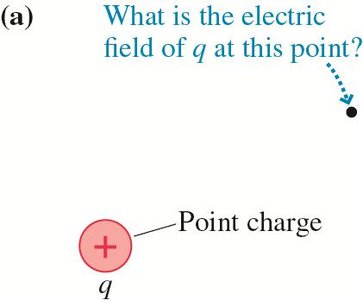
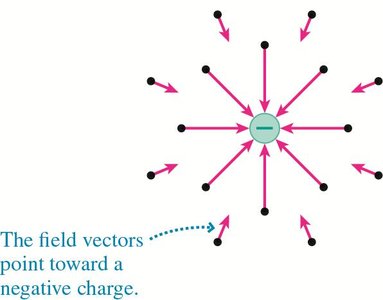
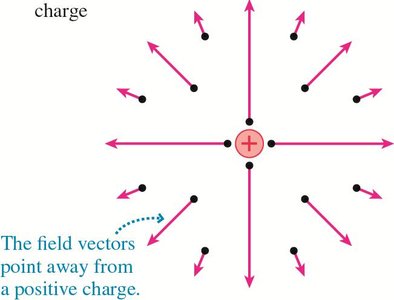
A point charge creates an electric field that radiates outward (for positive charge) or inward (for negative charge). The field at a distance r from a point charge q is given by:
Formula:
Direction: Away from positive charges, toward negative charges.
Section 20.9: The Electric Field of Multiple Charges
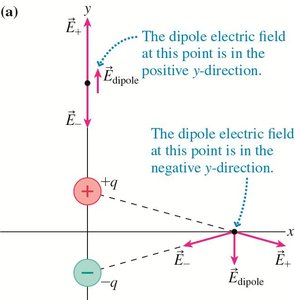
The electric field due to multiple charges is the vector sum of the fields produced by each charge. For an electric dipole, the field at any point is found by adding the fields from both charges.
Superposition Principle:
Section 20.10: Uniform Electric Fields
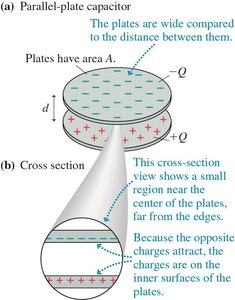
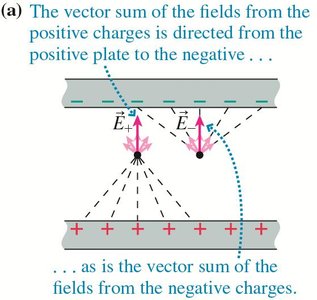
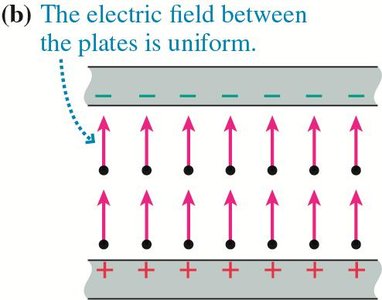
A uniform electric field is one in which the field strength and direction are constant at every point. This is typically produced between two large, parallel, oppositely charged plates (a parallel-plate capacitor).
Formula: , where is the surface charge density and C2/(N·m2).
Direction: From the positive plate to the negative plate.
Section 20.11: Electric Field Lines
Electric field lines are a visual tool to represent the direction and strength of electric fields. The tangent to a field line at any point gives the direction of the electric field. Field lines start on positive charges and end on negative charges, and never cross each other.
Density of Lines: Indicates field strength (closer lines = stronger field).
Rules: Lines never cross; they start on positive and end on negative charges.
Section 20.12: Conductors and Electric Fields
In a conductor at electrostatic equilibrium, the electric field inside is zero and any excess charge resides on the surface. The field at the surface is perpendicular to the surface. Conducting enclosures can shield their interiors from external electric fields (screening).
Charge Distribution: Higher at sharp points, leading to stronger fields (basis for lightning rods).
Section 20.13: Forces in Electric Fields
The force on a charge q in an electric field E is given by:
Formula:
Summary Table: Typical Electric Field Strengths
Field Location | Field Strength (N/C) |
|---|---|
Inside a current-carrying wire | |
Earth’s field, near surface | |
Near objects charged by rubbing | to |
Needed to cause a spark in air | |
Inside a cell membrane | |
Inside an atom |
Additional info: These notes cover the foundational concepts of electric charge, electric force, and electric fields, as well as their applications to conductors, insulators, and capacitors. The mathematical relationships and visual models provided are essential for understanding more advanced topics in electromagnetism.
