 Back
BackElectric Fields and Forces: Study Guide for Physics with Calculus
Study Guide - Smart Notes
 Tailored notes based on your materials, expanded with key definitions, examples, and context.
Electric Fields and Forces
Introduction to Electric Phenomena
Electric phenomena are explained in terms of charges, forces, and fields. Understanding these concepts is fundamental to the study of electricity and magnetism in physics.
Charges and Forces
Nature of Electric Charge
Electric charge is a fundamental property of matter. There are two types of charge: positive and negative. Objects can be charged by friction, such as rubbing a rod with wool or silk.
Neutral objects contain equal amounts of positive and negative charge.
Charged objects have an imbalance of positive and negative charge.
Like charges repel; opposite charges attract.
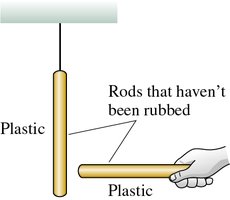

Experiments Demonstrating Charge
Rubbing two rods (plastic or glass) with wool or silk causes them to repel each other, indicating they are charged.
Bringing a charged glass rod near a charged plastic rod causes attraction, demonstrating opposite charges.
The force between charged objects decreases with increased distance and increases with greater charge.

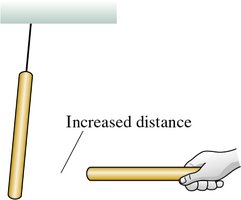
Charge Model
Frictional forces transfer charge between objects.
There are two kinds of charge: positive and negative.
Electric force is a long-range force, increasing with charge and decreasing with distance.
Charge is conserved: it cannot be created or destroyed, only transferred.
Insulators and Conductors
Properties of Materials
Materials are classified as conductors or insulators based on their ability to allow charge movement.
Conductors: Charge moves easily (e.g., metals).
Insulators: Charge remains fixed (e.g., glass, plastics).
Charge can be transferred by contact between objects.
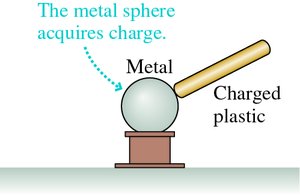
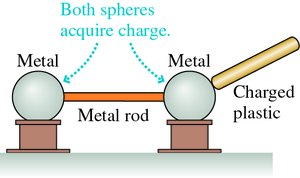
Electrostatic Equilibrium
In conductors, charge rapidly distributes itself over the surface.
Electrostatic equilibrium is the state where charges are at rest.
Polarization
Charge Polarization
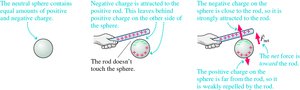
Polarization is the slight separation of positive and negative charges in a neutral object when a charged object is brought near. The polarization force is always attractive.
Charges, Atoms, and Molecules
Atomic Structure and Charging
Atoms consist of a positively charged nucleus (protons and neutrons) surrounded by negatively charged electrons. Charging occurs by transferring electrons, not protons.
Ionization: Removing an electron from an atom creates a positive ion.
Adding an electron creates a negative ion.
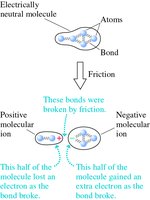
Molecular ions can form when bonds break due to friction.
Charge Conservation
Charge is represented by the symbol q.
The SI unit of charge is the coulomb (C).
The fundamental charge e is the magnitude of the charge of an electron or proton.
Coulomb’s Law
Force Between Charges
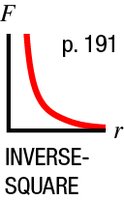
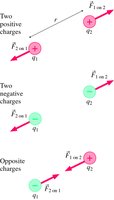
Coulomb’s law describes the force between two point charges. The force is proportional to the product of the charges and inversely proportional to the square of the distance between them.
Forces are repulsive for like charges and attractive for opposite charges.
Direction: Along the line joining the two charges.
Formula:
Where is the electrostatic constant.
The Concept of the Electric Field
Electric Field Definition
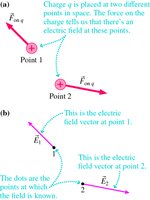
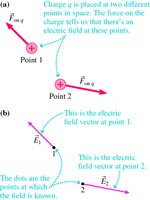
An electric field is a region of space around a charge where another charge experiences a force. The electric field is a vector quantity, measured in newtons per coulomb (N/C).
The electric field at a point is defined as:
Field Model
Source charges create an electric field.
A probe charge placed in the field experiences a force.
The electric field is independent of the probe charge; it depends only on the source charges.
Electric Field of a Point Charge
Field Due to a Point Charge
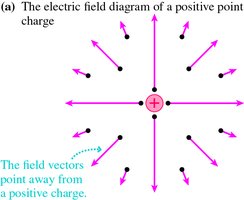
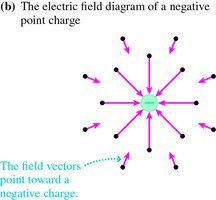
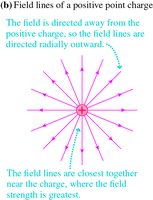
A point charge creates an electric field at all points in space. The field is directed away from a positive charge and toward a negative charge.
For a positive charge:
For a negative charge, the field vectors point toward the charge.
Electric Field of Multiple Charges
Superposition Principle
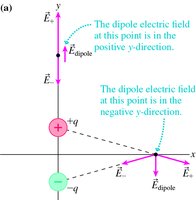
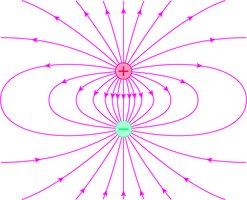
The electric field due to multiple charges is the vector sum of the fields from each charge. For a dipole, the field at any point is found by vector addition.
Uniform Electric Fields
Parallel-Plate Capacitor
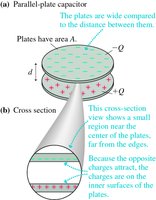
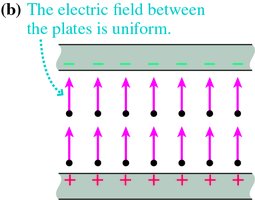
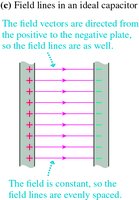
A parallel-plate capacitor consists of two closely spaced electrodes charged equally but oppositely. The electric field inside is uniform, pointing from the positive plate to the negative plate.
The field depends on the charge-to-area ratio (charge density).
The spacing between plates does not affect the field if plates are close together.
Electric Field Lines
Visualizing Electric Fields
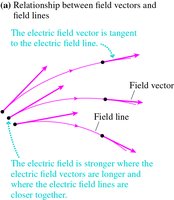
Electric field lines are imaginary lines used to visualize the direction and strength of the electric field. The tangent to a field line at any point indicates the direction of the field.
Field lines start on positive charges and end on negative charges.
Field lines are closer together where the field is stronger.
Field lines cannot cross.
Conductors and Electric Fields
Electrostatic Equilibrium in Conductors
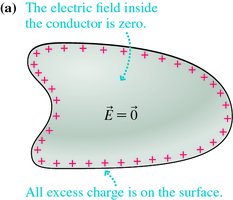
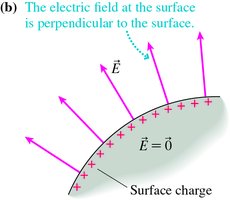
In a conductor at electrostatic equilibrium, the electric field inside is zero and any excess charge resides on the surface. The field at the surface is perpendicular to the surface.
Charge density and electric field are highest near sharp points.
Conducting enclosures can screen electric fields.
Forces and Torques in Electric Fields
Force on a Charge in an Electric Field
The force exerted on a charge in a known electric field is given by:
An electric dipole in a uniform field experiences no net force but does experience a torque, causing it to rotate.
The equilibrium position is with the dipole moment aligned with the field.
Summary Tables
Comparison of Conductors and Insulators
Property | Conductor | Insulator |
|---|---|---|
Charge Mobility | High | Low |
Charge Distribution | Surface | Fixed |
Examples | Metals | Glass, Plastics |
Summary of Key Equations
Equation | Description |
|---|---|
Coulomb's Law | |
Electric Field Definition | |
Field of a Point Charge | |
Force on a Charge in a Field |
Conclusion
Understanding electric fields and forces is essential for further study in electricity and magnetism. The concepts of charge, Coulomb’s law, electric field, and the behavior of conductors and insulators form the foundation for more advanced topics in physics.
