 Back
BackElectric Fields and Forces: Study Guide for PHYS 202 Module 07
Study Guide - Smart Notes
 Tailored notes based on your materials, expanded with key definitions, examples, and context.
Electric Fields and Forces
Introduction
This module introduces the fundamental concepts of electric forces and fields, focusing on the interactions between charged particles. It builds on prior knowledge of vectors and Newton's laws, and provides the basis for understanding electrostatics in physics.
Conductors, Insulators, and Charge Transfer
Materials are classified based on their ability to allow electric charge to move:
Conductors: Materials through which charge moves freely (e.g., metals, human body, tap water).
Insulators: Materials through which charge cannot move freely (e.g., rubber, plastic, glass, pure water).
Semi-conductors: Intermediate behavior, depending on circuit connections (e.g., silicon, germanium).
Superconductors: Perfect conductors where charge moves without resistance.
When two materials are rubbed together, electrons may transfer from one to the other, resulting in one material becoming positively charged and the other negatively charged.
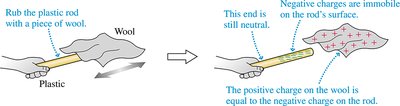
Triboelectric Series
The triboelectric series ranks materials by their tendency to gain or lose electrons during friction:
Materials higher in the series become positively charged (lose electrons).
Materials lower in the series become negatively charged (gain electrons).
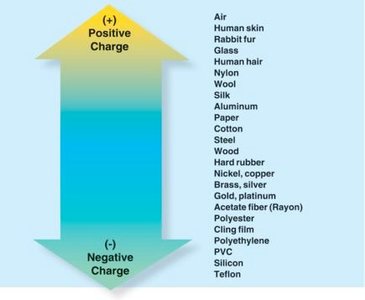
Example: Rubbing a plastic rod with wool transfers electrons from wool to plastic, making the rod negatively charged.
Electrostatic Force and Coulomb's Law
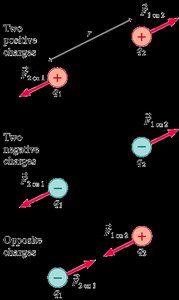
The force between two point charges is described by Coulomb's Law:
The force is proportional to the product of the charges and inversely proportional to the square of the distance between them.
The direction of the force depends on the sign of the charges (like charges repel, unlike charges attract).
Formula:
Where Nm2/C2 is the Coulomb constant.
Permittivity of Free Space
The constant (permittivity of free space) is fundamental in electrostatics:
C2/N·m2
Coulomb's constant can be expressed as
Newton's Third Law in Electrostatics
Electrostatic forces obey Newton's third law: the force exerted by charge 1 on charge 2 is equal in magnitude and opposite in direction to the force exerted by charge 2 on charge 1.
Superposition Principle
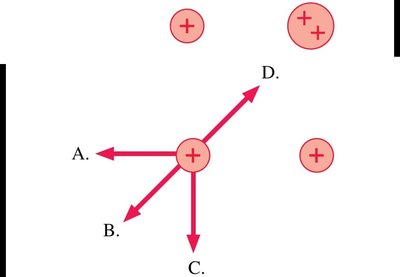
The net force on a charge due to multiple other charges is the vector sum of the individual forces from each charge. This is known as the superposition principle.
Decompose forces into components.
Add x and y components to find the resultant force.
Calculate the magnitude using the Pythagorean theorem.
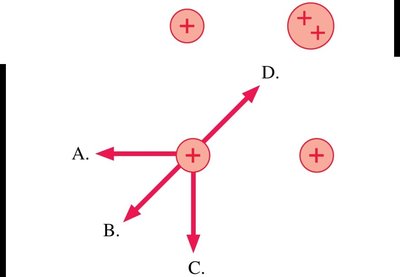
Electric Force and Equilibrium
It is possible to place a third charge between two fixed charges such that the net force on it is zero, depending on the signs and magnitudes of the charges. The position can be found by equating the magnitudes of the forces from each charge and solving for the distance.
Where and are the fixed charges, is the test charge, is the separation, and is the distance from one charge.
Comparison to Gravity
Both electric and gravitational forces can be described using field concepts:
Gravitational field:
Electric field:
Both obey inverse-square laws and act at a distance.
Electric Field Concept
An electric field is a region of space around a charged object where other charges experience a force. The field is defined as the force per unit charge:
For a point charge :
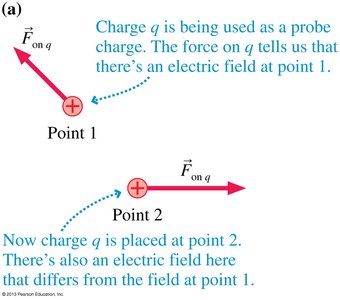
The direction of the field is away from positive charges and toward negative charges. The strength decreases rapidly with distance due to the inverse-square law.
Field Diagrams
Field diagrams visually represent the direction and magnitude of the electric field at various points in space. Arrows indicate the direction of the field, and their length represents the field strength.
Summary Table: Types of Materials and Charge Transfer
Type | Charge Mobility | Examples |
|---|---|---|
Conductor | High | Metals, tap water |
Insulator | Low | Rubber, glass |
Semi-conductor | Intermediate | Silicon, germanium |
Super-conductor | Perfect | Special alloys at low temperature |
Final Words
To master electric fields and forces, practice vector addition and review textbook problems. Understanding these concepts is essential for further study in electricity and magnetism.
