 Back
BackElectric Fields and Forces: Study Notes for College Physics
Study Guide - Smart Notes
 Tailored notes based on your materials, expanded with key definitions, examples, and context.
Unit 1: Electric Fields
1.1 Properties of Electric Charge
Electric charge is a fundamental property of matter that causes it to experience a force in the presence of other charges. There are two types of electric charges: positive and negative. Charges can be either discrete (individual particles) or distributed (spread over a material).
Conductors: Materials where charge moves freely through the material.
Insulators: Materials where charge does not move freely.
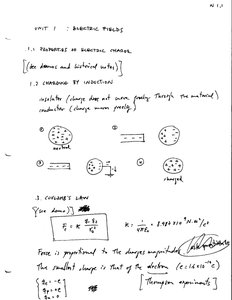
Example: Metals are conductors, while rubber is an insulator.
1.2 Charging by Induction
Charging by induction involves redistributing charges in a material without direct contact. When a charged object is brought near a conductor, it causes the free electrons to move, creating regions of positive and negative charge.
Induction: Charge does not enter, but causes polarity through the material.
Conduction: Charge moves freely.
1.3 Coulomb's Law
Coulomb's Law quantifies the force between two point charges. The force is proportional to the product of the charges and inversely proportional to the square of the distance between them.
Formula:
k: Coulomb's constant,
The smallest charge is that of the electron:
1.4 Net Force on a Charge
The net force on a charge due to multiple other charges is the vector sum of the individual forces.
Formula:
Take into account the magnitude and direction of each force.
Use vector components to resolve forces.
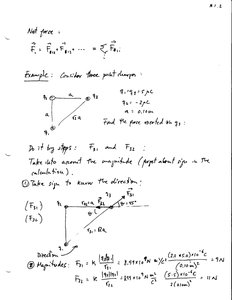
Example: Calculating the net force on a charge due to two other charges using vector addition.
1.5 Electric Field
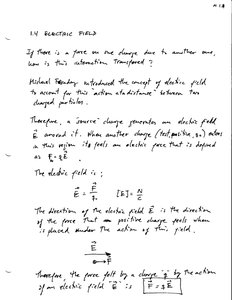
The concept of the electric field was introduced to describe the interaction between charged particles. A source charge generates an electric field in the space around it, which exerts a force on other charges placed in the field.
Electric Field Formula:
The direction of is the direction of the force on a positive charge.
The force felt by a charge in an electric field is:
1.6 Electric Field from Coulomb's Law
The electric field created by a point charge at a distance is:
If there are multiple charges, the net electric field is the vector sum of the fields from each charge.
1.7 Electric Field of Continuous Charge Distributions
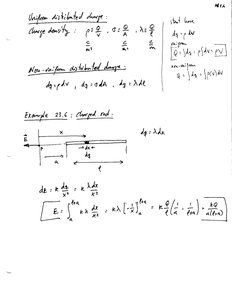
For continuous charge distributions, the electric field is calculated using integration.
Uniform charge density: , ,
Non-uniform charge density:
Example: Electric field from a charged rod:
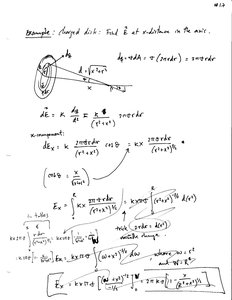
1.8 Electric Field from a Charged Disk
To find the electric field at a point on the axis of a charged disk, integrate over the disk's surface.
1.9 Electric Field Lines
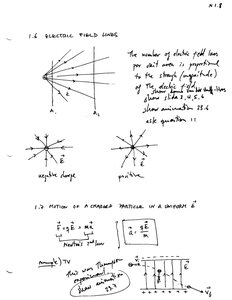
Electric field lines visually represent the direction and strength of the electric field. The number of lines per unit area is proportional to the field's magnitude.
Field lines point away from positive charges and toward negative charges.
1.10 Motion of a Charged Particle in a Uniform Electric Field
A charged particle in a uniform electric field experiences a constant force and undergoes uniform acceleration.
Newton's Second Law:
1.11 Equilibrium of Charges on a Rod
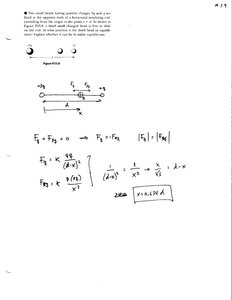
When two fixed charges are placed at the ends of a rod, a third charge can be in equilibrium at a position where the net force is zero.
Set the sum of forces to zero and solve for the position.
1.12 Electric Field at the Corner of a Square
Four charges placed at the corners of a square create a net electric field at each corner. The field is calculated by vector addition of the fields from each charge.
Calculate the magnitude and direction of each field.
Sum the components to find the net field.
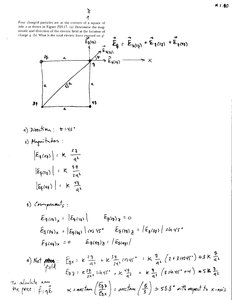
Example: Find the electric field at the location of one charge due to the other three.
Summary Table: Key Concepts
Concept | Formula | Description |
|---|---|---|
Coulomb's Law | Force between two point charges | |
Electric Field | Field at a point due to a charge | |
Superposition Principle | Net field from multiple charges | |
Charge Density | , , | Linear, surface, and volume charge density |
Motion in Electric Field | Acceleration of a charged particle |
