 Back
BackElectric Fields and Forces: Study Notes for College Physics
Study Guide - Smart Notes
 Tailored notes based on your materials, expanded with key definitions, examples, and context.
Electric Fields and Forces
Introduction to Electric Phenomena
Electric phenomena arise from the presence and movement of electric charges. This chapter introduces the fundamental concepts of electric charge, the forces between charges, and the concept of the electric field, which mediates these forces.
Charges and Forces
Nature of Electric Charge
Electric charge is a fundamental property of matter, existing in two types: positive and negative.
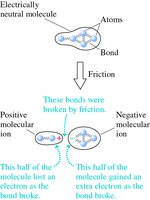
Objects can be charged by friction (rubbing), which transfers charge from one object to another.
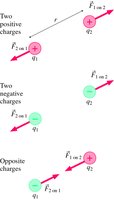
Like charges repel; opposite charges attract.
Neutral objects contain equal amounts of positive and negative charge.
Experiments with Charges
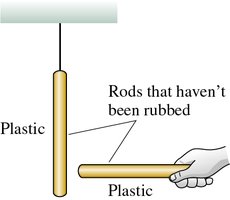
When two undisturbed plastic rods are brought near each other, no force is observed, indicating neutrality.
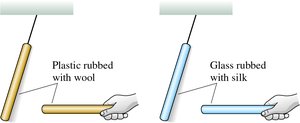
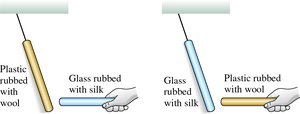
Rubbing rods with wool or silk imparts charge, causing like-charged rods to repel and oppositely charged rods to attract.
Distance and Force
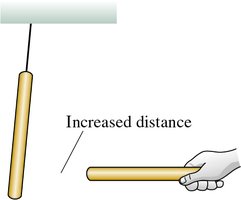
The electric force decreases as the distance between charged objects increases.
The force increases with the amount of charge on the objects.
Charge Model: Key Postulates
Frictional forces transfer charge between objects.
There are two kinds of charge: positive and negative.
Like charges repel; opposite charges attract.
The force between charges is long-range and depends on both the amount of charge and the distance between them.
Charge is conserved: it cannot be created or destroyed, only transferred.
Insulators and Conductors
Definitions and Properties
Conductors: Materials through which charge moves easily (e.g., metals).
Insulators: Materials in which charge is immobile (e.g., glass, plastic).
Charge can be transferred by contact; discharging occurs when a charged object is touched.
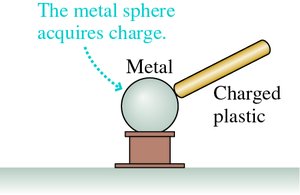
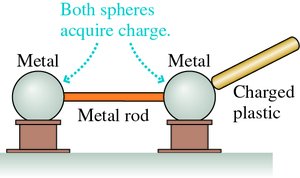
Charge Distribution in Conductors
Once charge is placed on a conductor, it rapidly distributes itself over the surface.
Electrostatic equilibrium: Condition where charges are at rest and the electric field inside a conductor is zero.
Polarization
Charge Polarization
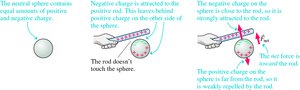
When a charged object is brought near a neutral object, the charges in the neutral object separate slightly, creating a polarization force.
This force is always attractive and does not require the objects to be oppositely charged.
Atomic Structure and Charge
Charges, Atoms, and Molecules
Atoms consist of a dense, positively charged nucleus (protons and neutrons) surrounded by negatively charged electrons.
Objects are charged if they have an unequal number of protons and electrons.
Ionization: Removing an electron from an atom creates a positive ion; adding an electron creates a negative ion.
Coulomb’s Law
Mathematical Formulation
The force between two point charges is given by:
Where N·m2/C2, and are the charges, and is the distance between them.
The force is attractive for opposite charges and repulsive for like charges.
Electric Field Concept
Definition and Properties
The electric field at a point is the force per unit charge experienced by a small positive test charge placed at that point.
Electric field is a vector quantity, with both magnitude and direction.
The field due to a point charge at distance is:
Direction: Away from positive charges, toward negative charges.
Electric Field of Multiple Charges
Superposition Principle
The net electric field at a point due to multiple charges is the vector sum of the fields due to each charge.
For a dipole (two equal and opposite charges separated by a distance), the field at a point is the sum of the fields from each charge.
Uniform Electric Fields
Parallel-Plate Capacitor
A parallel-plate capacitor consists of two closely spaced, oppositely charged plates.
The electric field between the plates is uniform and given by:
Where is the surface charge density and is the permittivity of free space.
Electric Field Lines
Visualizing Electric Fields
Electric field lines are drawn to represent the direction and strength of the field.
Lines start on positive charges and end on negative charges.
The density of lines indicates the field strength; lines never cross.
Conductors and Electric Fields
Properties in Electrostatic Equilibrium
The electric field inside a conductor is zero.
Any excess charge resides on the surface.
The field at the surface is perpendicular to the surface.
Charge density and field strength are highest at sharp points.
Forces and Torques in Electric Fields
Force on a Charge in an Electric Field
The force on a charge in an electric field is:
An electric dipole in a uniform field experiences no net force but does experience a torque, aligning it with the field.
Summary Table: Conductors vs. Insulators
Property | Conductor | Insulator |
|---|---|---|
Charge Mobility | High (free electrons) | Low (bound electrons) |
Charge Distribution | Surface only | Localized patches |
Electric Field Inside | Zero (in equilibrium) | Can exist |
Key Equations
Coulomb’s Law:
Electric Field (point charge):
Force on a charge:
Uniform field (capacitor):
Example: Calculating Electric Force
Two charges, C and C, are separated by 0.05 m. The force between them is:
N$
The force is attractive since the charges are opposite.
Additional info:
Some images and explanations have been expanded for clarity and completeness, and a summary table was added for comparison of conductors and insulators.
