 Back
BackElectric Fields and Forces: Study Notes for College Physics
Study Guide - Smart Notes
 Tailored notes based on your materials, expanded with key definitions, examples, and context.
Unit 1: Electric Fields
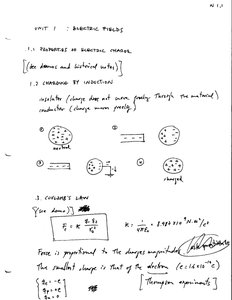
1.1 Properties of Electric Charge
Electric charge is a fundamental property of matter that gives rise to electric forces and fields. Charges are classified as either positive or negative, and they interact according to well-defined physical laws.
Key Point: There are two types of electric charges: positive and negative.
Key Point: Like charges repel, unlike charges attract.
Example: Electrons carry negative charge, protons carry positive charge.
1.2 Conductors and Insulators
Materials are classified based on their ability to allow electric charge to move freely. Conductors permit the free movement of charge, while insulators do not.
Conductor: Charge moves freely (e.g., metals).
Insulator: Charge does not move freely (e.g., rubber, glass).
Example: When a charged rod touches a metal sphere, charge spreads over the sphere.
1.3 Coulomb's Law
Coulomb's Law quantifies the force between two point charges. The force is proportional to the product of the charges and inversely proportional to the square of the distance between them.
Formula:
Constant:
Key Point: The smallest charge is that of the electron ().
Example: The force between two electrons separated by 1 meter is extremely small.
1.4 Net Force and Vector Addition
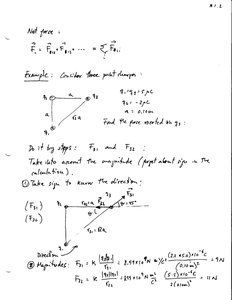
When multiple charges are present, the net force on a charge is the vector sum of the individual forces exerted by each charge.
Formula:
Key Point: Forces must be added as vectors, considering both magnitude and direction.
Example: For three point charges, calculate each force and sum their components.
1.5 Components and Magnitude of Net Force
To find the net force, resolve each force into its x and y components, sum the components, and then calculate the magnitude and direction.
Component Calculation: ,
Magnitude:
Direction:
1.6 Electric Field Concept
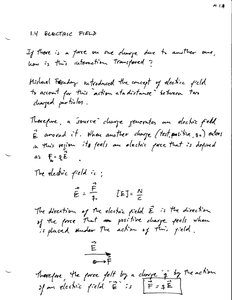
The electric field is a region of space around a charged object where other charges experience a force. Michael Faraday introduced the concept to explain action-at-a-distance between charges.
Definition:
Direction: The electric field points away from positive charges and toward negative charges.
Formula:
Example: The force felt by a charge in an electric field is .
1.7 Superposition Principle for Electric Fields
If there are multiple charges, the net electric field at a point is the vector sum of the fields produced by each charge.
Formula:
Key Point: Each field is calculated using Coulomb's law and then summed as vectors.
1.8 Electric Field of Continuous Charge Distributions
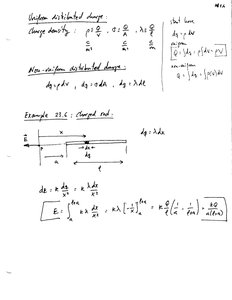
For objects with charge distributed over their volume, surface, or length, the electric field is calculated by integrating over the distribution.
Uniform Charge Density: , ,
Non-uniform Charge Density:
Formula:
Example: For a charged rod, integrate along its length to find the field at a point.
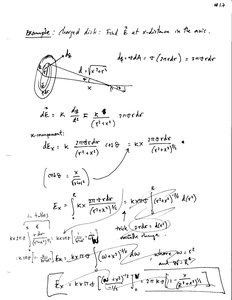
1.9 Example: Electric Field of a Charged Disk
To find the electric field at a point on the axis of a uniformly charged disk, integrate over the disk's surface.
Formula:
Key Point: Use symmetry and integration to solve for the field.
1.10 Electric Field Lines
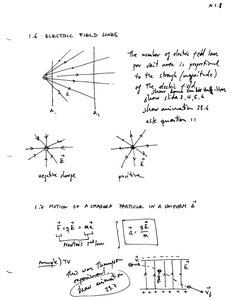
Electric field lines visually represent the direction and strength of the electric field. The density of lines indicates the field's magnitude.
Key Point: Field lines point away from positive charges and toward negative charges.
Key Point: The number of lines per unit area is proportional to the field strength.
Example: Field lines radiate outward from a positive charge and inward toward a negative charge.
1.11 Motion of a Charged Particle in a Uniform Electric Field
A charged particle in a uniform electric field experiences a constant force and accelerates according to Newton's second law.
Formula:
Key Point: The trajectory is similar to projectile motion under gravity.
Example: An electron in a cathode ray tube is accelerated by a uniform electric field.
1.12 Equilibrium of Charges on a Rod
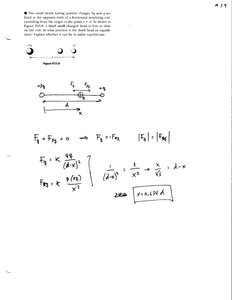
When multiple charges are fixed on a rod, a third charge can be in equilibrium if the net force on it is zero. The stability of this equilibrium depends on the configuration.
Key Point: The equilibrium position is found by setting the sum of forces to zero.
Formula:
Example: For two positive charges at the ends of a rod, a third positive charge is in equilibrium at a specific point between them.
1.13 Electric Field at the Corner of a Square
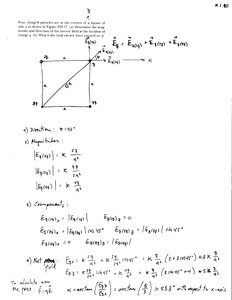
Four charges placed at the corners of a square produce a net electric field at each corner. The field is calculated by vector addition of the fields from each charge.
Key Point: Use symmetry and vector addition to find the net field.
Formula:
Example: The net force on a charge at a corner is the sum of the forces from the other three charges.
Concept | Formula | Key Application |
|---|---|---|
Coulomb's Law | Force between point charges | |
Electric Field | Field due to a point charge | |
Superposition Principle | Field from multiple charges | |
Charge Density | , , | Continuous charge distributions |
Motion in E Field | Acceleration of charged particle |
Additional info: These notes cover the fundamental concepts of electric fields, forces, and charge distributions, directly relevant to chapters on electric charges, fields, and forces in college physics.
