 Back
Electric Fields and Parallel Plate Capacitors: Study Notes
Study Guide - Smart Notes
 Tailored notes based on your materials, expanded with key definitions, examples, and context.
Electric Fields
Electric Field of a Point Charge
The electric field is a vector field that describes the force per unit charge exerted on a test charge at any point in space. For a point charge, the electric field is radially symmetric and its magnitude decreases with the square of the distance from the charge.
Definition: The electric field \( \vec{E} \) due to a point charge q at a distance r is given by:
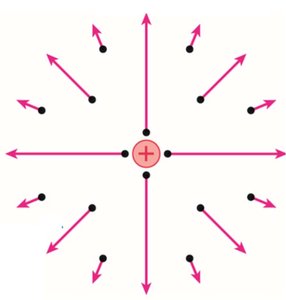
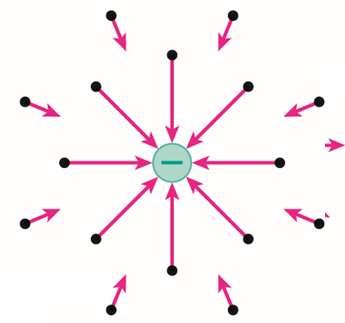
Direction: The field points away from positive charges and toward negative charges.
Units: Newtons per Coulomb (N/C).
Constant: \( K = 8.99 \times 10^9 \; \text{N} \cdot \text{m}^2/\text{C}^2 \)

Field Lines for Point Charges
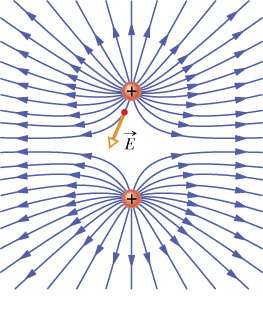
Electric field lines are a visual tool to represent the direction and strength of the electric field. The lines radiate outward from positive charges and inward toward negative charges.
Positive charge: Field lines point outward.
Negative charge: Field lines point inward.
The density of lines indicates the field's strength.
Electric Dipole
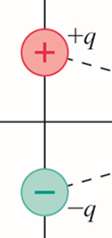
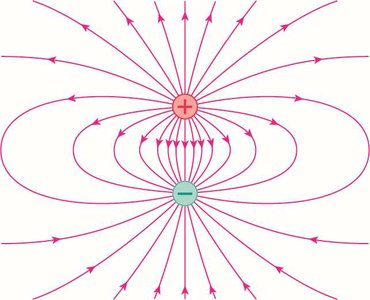
An electric dipole consists of two equal and opposite charges separated by a distance. The field lines originate from the positive charge and terminate at the negative charge, forming characteristic curved patterns.
Dipole moment: A vector pointing from negative to positive charge.
Field is strongest near the charges and weaker farther away.
Electric Field of Charge Distributions
Superposition Principle
The superposition principle states that the total electric field created by multiple charges is the vector sum of the fields produced by each charge individually.
For n point charges:
Direction and magnitude must be considered for each vector addition.
Uniform Electric Fields and Parallel Plate Capacitors
Parallel Plate Capacitor
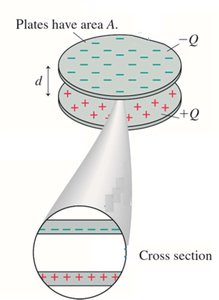
A parallel plate capacitor consists of two large, flat, conducting plates separated by a small distance. One plate carries positive charge (+Q), and the other carries an equal magnitude of negative charge (–Q).
Area: Each plate has area A.
Separation: The distance between plates is d.
Charge density:
Uniform Electric Field Between Plates
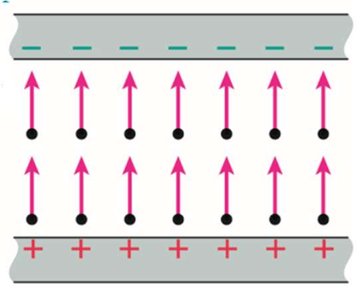
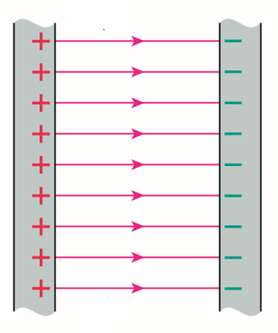
Inside a parallel plate capacitor, the electric field is uniform—it has the same magnitude and direction at every point between the plates (except near the edges).
Direction: From the positive plate to the negative plate.
Magnitude: , where is the permittivity of free space.
The field depends on the charge-to-area ratio, not the shape of the plates.
Electric Field Lines: Visualization and Properties
Properties of Electric Field Lines
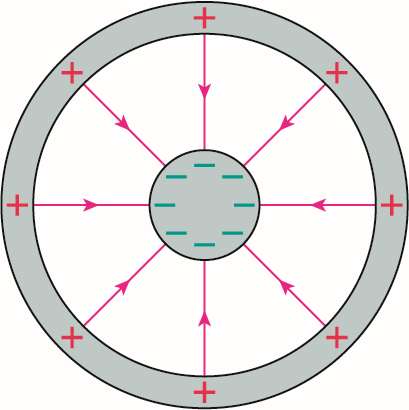
Field lines start on positive charges and end on negative charges.
The tangent to a field line at any point gives the direction of the electric field vector at that point.
Field lines never cross; the field at any point has a unique direction.
Field lines are closer together where the field is stronger.
Field Lines for Various Charge Distributions
Charged disk and ring: The field is stronger near the disk where charges are more densely packed.
Multiple charges: Field lines can be complex, but always follow the above rules.
Motion of Charges in Electric Fields
Force on a Charge in an Electric Field
A charge q in an electric field \( \vec{E} \) experiences a force:
Direction: Same as \( \vec{E} \) for positive charges, opposite for negative charges.
Example: Electron in a Uniform Electric Field
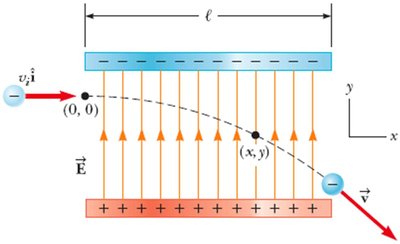
When a charged particle (e.g., an electron) enters a uniform electric field, it experiences a constant acceleration:
Acceleration:
The path of the particle is parabolic if it has an initial velocity perpendicular to the field.
Summary Table: Key Equations and Concepts
Concept | Equation | Description |
|---|---|---|
Electric field of point charge | Radial field, direction depends on sign of q | |
Superposition principle | Vector sum of fields from all charges | |
Uniform field (capacitor) | Between parallel plates, uniform field | |
Force on charge | Force experienced by charge in field |
