 Back
BackElectric Fields and Potential Energy: Study Notes for College Physics
Study Guide - Smart Notes
 Tailored notes based on your materials, expanded with key definitions, examples, and context.
Electric Potential Energy of Multiple Charges
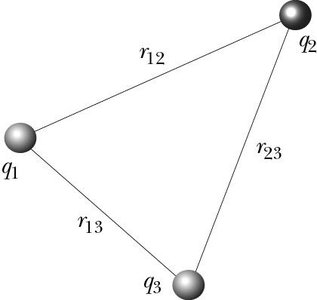
Three Point Charges and Their Interactions
When multiple point charges are arranged in space, each pair of charges interacts and contributes to the total electric potential energy of the system. The potential energy depends on the magnitude of the charges and their separations.
Pairwise Interaction: The potential energy between two point charges qi and qj separated by distance rij is given by:
Total Potential Energy: For three charges, the total potential energy is the sum of all pairwise interactions:
Example: If q1, q2, and q3 are arranged as shown, with distances r12, r23, and r13, calculate each pair's potential energy and sum them for the total.
Electric Field: Concept and Calculation
Definition and Physical Meaning
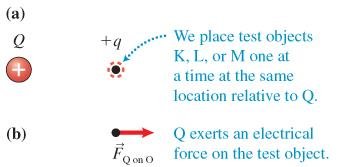
The electric field is a vector field that describes the force per unit charge exerted at every point in space by other charges. It is independent of the presence of a test charge and exists wherever charges are present.
Field as a Physical Quantity: Fields can be scalar (e.g., temperature) or vector (e.g., electric field, air flow).
Electric Field Formula: The electric field E at a point due to a source charge Q is:
Direction: The field points away from positive charges and toward negative charges.
Electric Field of a Point Charge
The electric field produced by a single point charge is radial and its magnitude decreases with the square of the distance from the charge.
Formula:
Direction: For positive charges, the field points outward; for negative charges, it points inward.
Superposition Principle
Net Electric Field from Multiple Charges
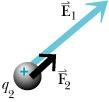
The net electric field at any point is the vector sum of the fields produced by all individual charges. This principle allows calculation of complex field configurations.
Superposition Formula:
Application: For a system of charges, calculate each field component and sum them vectorially.
Electric Field Lines
Visualizing Electric Fields
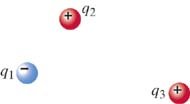
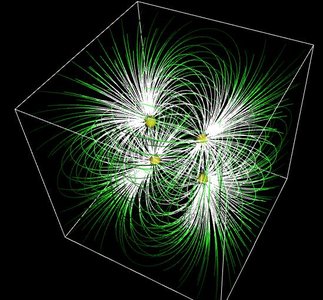
Electric field lines are a graphical tool to represent the direction and strength of the electric field. They originate from positive charges and terminate at negative charges.
Properties:
Field lines never intersect.
Density of lines indicates field strength.
Field vector is tangent to the field line at each point.
Example: Twice as many field lines leave a charge +2q as +1q.
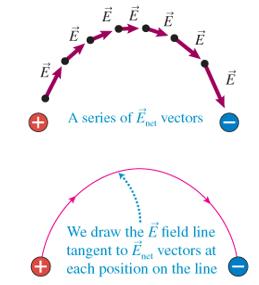
Calculating Net Electric Field: Example
Three Charges at Corners of a Square
To find the net electric field at a point due to multiple charges, calculate the field from each charge and sum the components.
Step 1: Find the field from each charge using Coulomb's Law.
Step 2: Resolve each field into x and y components.
Step 3: Sum the components to find the net field.
Step 4: Use the Pythagorean theorem to find the magnitude:
Electric Field of General Charged Objects
Continuous Charge Distributions
For objects with continuous charge distributions, divide the object into infinitesimal pieces, treat each as a point charge, and sum their fields using calculus.
Principle: Vector-sum the fields from all charged pieces.
Application: Used for calculating fields from rods, disks, or other shapes.
Uniform Electric Field and Motion of Charges
Uniform Field Between Parallel Plates
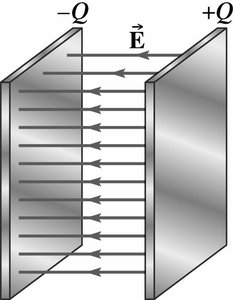
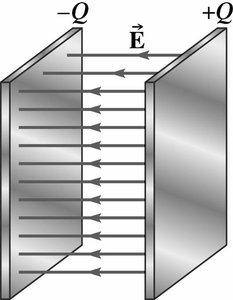
A uniform electric field is commonly created between two parallel plates with equal and opposite charges. The field is constant in magnitude and direction between the plates.
Formula:
Direction: From positive plate to negative plate.
Motion of a Point Charge in a Uniform Field
The force on a charge in a uniform electric field is constant, leading to constant acceleration. The trajectory depends on the initial velocity.
Force:
Acceleration:
Trajectory: Straight line if initial velocity is zero or along field lines; parabolic if perpendicular component exists.
Example: Electron Gun
Calculating Electron Acceleration and Speed
An electron released from a plate in a uniform electric field is accelerated by the field. The final speed after traveling a distance d can be calculated using kinematics.
Electric Field:
Force on Electron:
Acceleration:
Final Speed:
Example Calculation: For typical values, acceleration can be extremely large, but the time spent accelerating is very short.
Summary Table: Key Equations and Concepts
Concept | Equation | Description |
|---|---|---|
Potential Energy (Pairwise) | Energy between two point charges | |
Electric Field (Point Charge) | Field at distance r from charge Q | |
Superposition Principle | Sum of fields from all charges | |
Force on Charge | Force on charge q in field E | |
Acceleration | Acceleration of charge q, mass m | |
Final Speed | Speed after distance d |
Additional info: Academic context was added to clarify the physical meaning of fields, the superposition principle, and the calculation steps for electric field and potential energy. Examples and formulas were expanded for completeness.
