 Back
BackElectric Fields and Potential Energy: Study Notes for College Physics
Study Guide - Smart Notes
 Tailored notes based on your materials, expanded with key definitions, examples, and context.
Electric Potential Energy of Point Charges
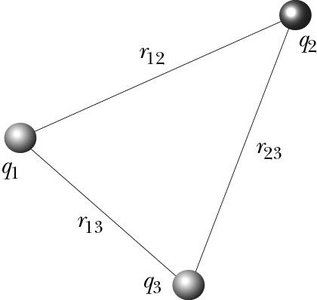
Three Point Charges and Their Interactions
The potential energy of a system of point charges arises from the pairwise interactions between each charge. For three charges, the total electric potential energy is the sum of the energies for each pair.
Pairwise Interactions: Each pair of charges (q1, q2, q3) interacts independently of the third charge.
Formula for Potential Energy: The total potential energy U is given by:
Where each term is:
Example: For three charges arranged as shown, calculate the potential energy using the above formula and the given distances.
The Concept of Electric Field
Physical Meaning and Types of Fields
An electric field is a physical quantity defined at every point in space, representing the force per unit charge exerted by other charges. Fields can be scalar (e.g., temperature) or vector (e.g., air flow, electric field).
Electric Field: A vector field, meaning it has both magnitude and direction at each point.
Field Strength: The electric field strength at a location is independent of the test charge placed there.


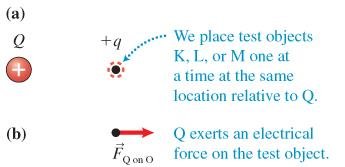
Test Charges and Electric Field Definition
To define the electric field, a test charge is placed at a location, and the force experienced is measured. The electric field is then:
Direction: The field points in the direction of the force experienced by a positive test charge.
Electric Field of a Point Charge
Coulomb's Law and Field Direction
The electric field produced by a point charge is given by Coulomb's Law:
Positive Charge: Field points away from the charge.
Negative Charge: Field points toward the charge.
Superposition Principle for Electric Fields
Vector Addition of Fields
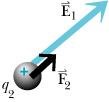
The net electric field at any location is the vector sum of the fields produced by all individual charges:
Application: Used to calculate the field from multiple charges.
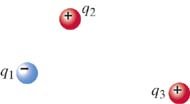
Electric Field Lines
Visualizing Electric Fields
Electric field lines are a graphical representation of the electric field. They help visualize the direction and strength of the field.
Properties:
Field lines originate from positive charges and terminate on negative charges.
Density of lines indicates field strength.
Field vector is tangent to the field line at each point.
Field lines never intersect.
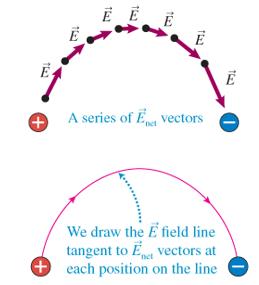
Field Strength and Line Density
The strength of the electric field is proportional to the density of field lines. Closer to the charge, the lines are denser, indicating a stronger field.
Example: Twice as many field lines leave a charge +2q as +1q.
Calculating Net Electric Field: Example
Vector Addition for Multiple Charges
To find the net electric field at a point due to several charges, calculate the field from each charge and sum their components.
Step 1: Find the field from each charge using Coulomb's Law.
Step 2: Resolve each field into x and y components.
Step 3: Sum the components to find the net field.
Step 4: Use the Pythagorean theorem to find the magnitude.
Electric Field of General Charged Objects
Principle of Superposition and Calculus
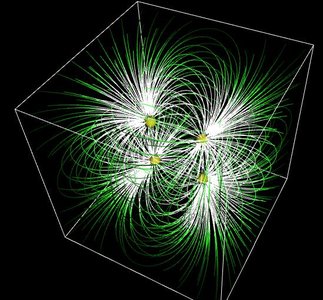
For objects with distributed charge, divide the object into infinitesimal pieces, treat each as a point charge, and sum their fields using calculus.
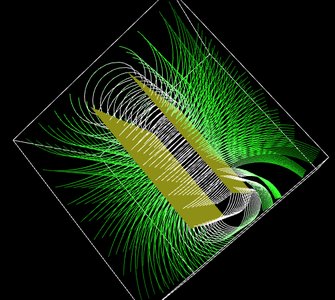
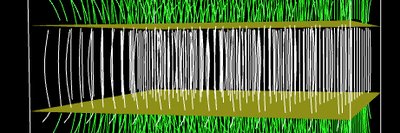
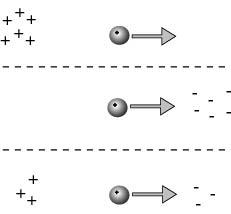
Motion of Point Charge in a Uniform Electric Field
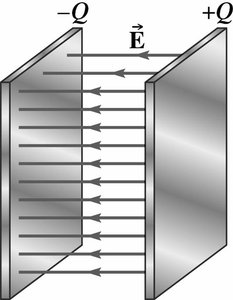
Uniform Field Between Parallel Plates
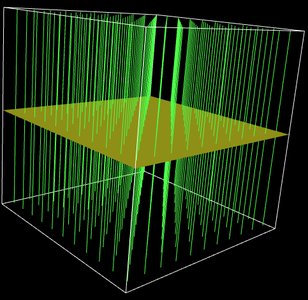
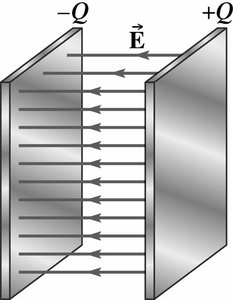
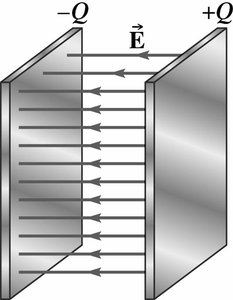
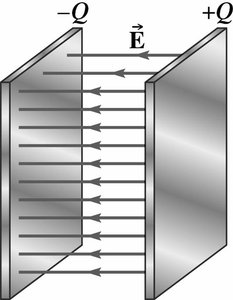
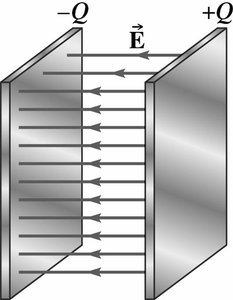
A uniform electric field is commonly created between two parallel plates with equal and opposite charges. The field between the plates is:
Force on a Charge:
Acceleration:
Trajectory: If initial velocity is zero or along field lines, motion is straight. If perpendicular, trajectory is parabolic.
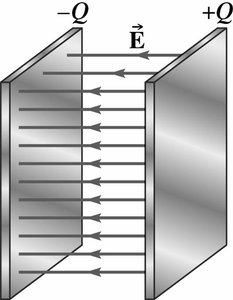
Example: Electron Gun
Calculating Electron Acceleration and Speed
An electron released from one plate in a uniform electric field is accelerated toward the other plate. The steps to analyze its motion:
Step 1: Find the electric field using plate charge and area.
Step 2: Calculate the force on the electron:
Step 3: Find acceleration:
Step 4: Find final speed after traveling distance d:
Summary Table: Key Equations and Concepts
Concept | Equation | Description |
|---|---|---|
Potential Energy (2 charges) | Energy stored by two point charges | |
Electric Field (point charge) | Field at distance r from charge q | |
Superposition Principle | Sum of fields from all charges | |
Force on Charge | Force experienced by charge q in field E | |
Acceleration | Acceleration of charge q with mass m | |
Final Speed | Speed after traveling distance d |
