 Back
BackElectric Fields, Capacitors, and Related Concepts – Step-by-Step Physics Guidance
Study Guide - Smart Notes
 Tailored notes based on your materials, expanded with key definitions, examples, and context.
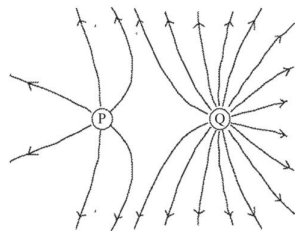
Q4. The figure shows electric field lines arising from two small charged particles P and Q. Consider the following two statements:
(i) The charge on P is smaller than the charge on Q.
(ii) The electrostatic force on P is smaller than the force on Q.
Which is true?
Background
Topic: Electric Field Lines and Electrostatic Forces
This question tests your understanding of how electric field lines represent charge magnitude and how the force on a charge relates to the electric field.
Key Terms and Formulas
Electric field lines: The number of lines emerging from a charge is proportional to the magnitude of the charge.
Electrostatic force: where is the charge and is the electric field strength.
Step-by-Step Guidance
Observe the number of field lines coming from each charge. More lines indicate a larger charge magnitude.
Recall that the force experienced by a charge in an electric field depends on both the charge and the field strength at its location.
Compare the field lines around P and Q to determine which charge is larger.
Think about whether the force on P is necessarily smaller than the force on Q, based on the field and charge values.
Try solving on your own before revealing the answer!
Final Answer: (a) Only (i) is true.
The number of field lines indicates that Q has a larger charge than P, so statement (i) is true. However, the force on a charge depends on the field at its location, not just the charge magnitude, so statement (ii) is not necessarily true.
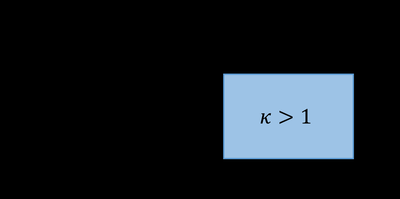
Q8. The figure shows two parallel-plate capacitors storing the same amount of charge Q. The plates of each capacitor are separated by the same distance, and their areas are identical. Capacitor 2 is filled with a dielectric material with dielectric constant κ (> 1). Consider the following statements:
(i) The capacitance of Capacitor 1 is larger than that of Capacitor 2.
(ii) The potential energy stored in Capacitor 1 is larger than that in Capacitor 2.
Which is true?
Background
Topic: Capacitance and Dielectrics
This question tests your understanding of how a dielectric affects capacitance and stored energy in a capacitor.
Key Terms and Formulas
Capacitance without dielectric:
Capacitance with dielectric:
Potential energy stored:
is the dielectric constant ()
Step-by-Step Guidance
Compare the capacitance formulas for both capacitors. Note how the dielectric constant affects .
Since both capacitors store the same charge , use the energy formula to compare the stored energy.
Analyze whether or is larger, given .
Determine which capacitor stores more energy, based on the relationship between capacitance and energy.
Try solving on your own before revealing the answer!
Final Answer: (b) Only (ii) is true.
Capacitor 2 has a larger capacitance due to the dielectric (), so statement (i) is false. Since , a larger capacitance means less stored energy for the same charge, so statement (ii) is true.
