 Back
BackWeek 1 Lec. 3
Study Guide - Smart Notes
 Tailored notes based on your materials, expanded with key definitions, examples, and context.
Electric Field: Definition and Mapping
Test Charge and Electric Field Identification
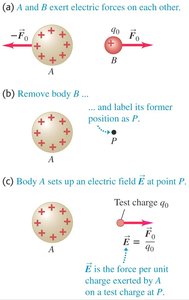
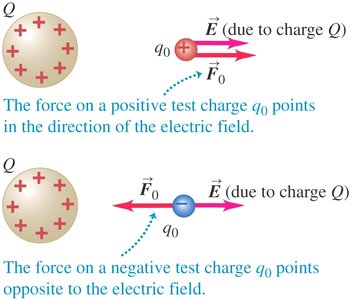
The electric field is a fundamental concept in electromagnetism, representing the force per unit charge exerted on a test charge at a given point in space. To map an electric field, a positive test charge is placed at various points, and the force experienced by the charge is measured. The direction and magnitude of this force define the electric field at each location.
Test Charge: A hypothetical charge (usually positive) used to probe the electric field without disturbing the source charges.
Electric Field Vector: Points in the direction of the force experienced by a positive test charge.
Formula: , where is the force on the test charge .
Units: Newtons per Coulomb (N/C).
Electric Field Lines and Charge Configurations
Visualizing Electric Fields
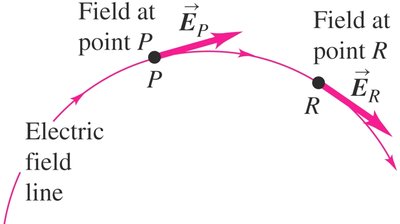
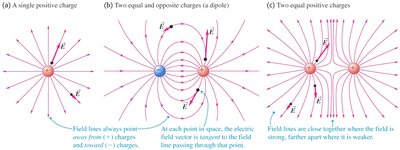
Electric field lines are graphical representations that show the direction and strength of the electric field. The tangent to a field line at any point gives the direction of the electric field vector at that point. Field lines originate from positive charges and terminate at negative charges.
Field Line Properties:
Lines never cross.
Density of lines indicates field strength.
Direction is away from positive and toward negative charges.
Common Configurations:
Single point charge: Radial field lines.
Dipole: Lines curve from positive to negative charge.
Two like charges: Lines repel and curve outward.
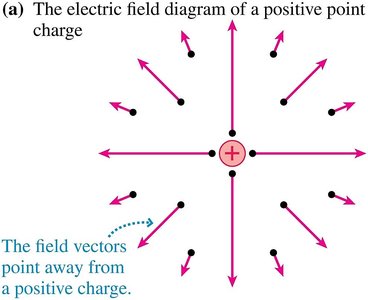
Electric Field of a Point Charge
Mathematical Expression and Example
The electric field produced by a point charge is given by Coulomb's law. The field radiates outward from a positive charge and inward toward a negative charge. The magnitude of the electric field at a distance from a point charge is:
Formula:
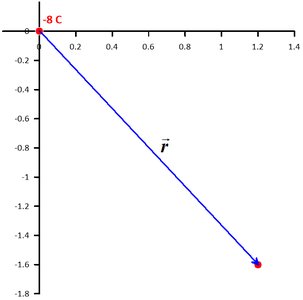
Vector Form: , where is the unit vector from the source charge to the field point.
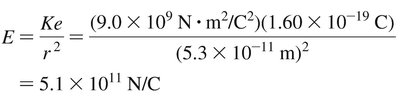
Example: The electric field at the position of an electron orbiting a proton in a hydrogen atom (radius nm) is N/C, directed outward from the proton.
Superposition Principle: Electric Field from Multiple Charges
Vector Addition of Fields
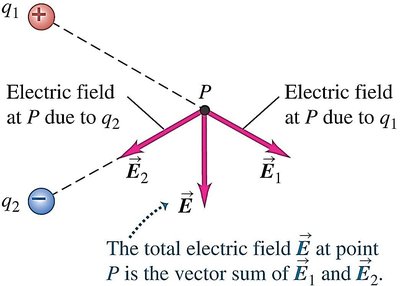
When multiple charges are present, the total electric field at a point is the vector sum of the fields produced by each charge. This is known as the superposition principle.
Formula:
Each field:
Example: For two charges and , the field at point is the sum of and .
Uniform Electric Fields: Parallel Plate Capacitor
Characteristics and Applications
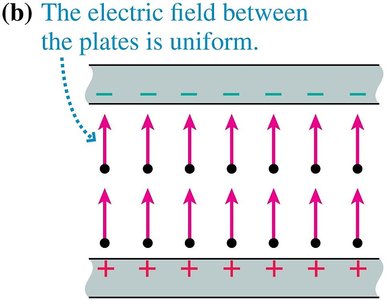
A uniform electric field is one in which the field strength and direction are constant throughout a region. This occurs, for example, between the plates of a parallel plate capacitor.
Field Direction: From the positive plate to the negative plate.
Field Strength: , where is the potential difference and is the plate separation.
Applications: Used in capacitors and particle accelerators.
Charge Density and Continuous Charge Distributions
Types of Charge Density
Charge density describes how charge is distributed over a region. There are three main types:
Linear charge density (): (C/m)
Surface charge density (): (C/m2)
Volume charge density (): (C/m3)
Electric Field from Continuous Distributions
To find the electric field from a continuous charge distribution, divide the distribution into infinitesimal elements and sum their contributions:
Formula:
Examples:
Field from a charged rod, ring, or disk.
Use symmetry and integration to simplify calculations.
Electric Dipoles: Force and Torque in an Electric Field
Translational and Rotational Effects
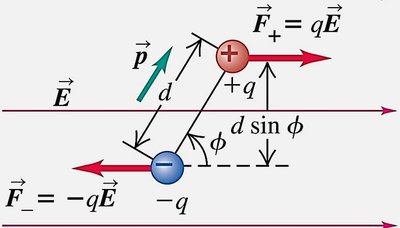
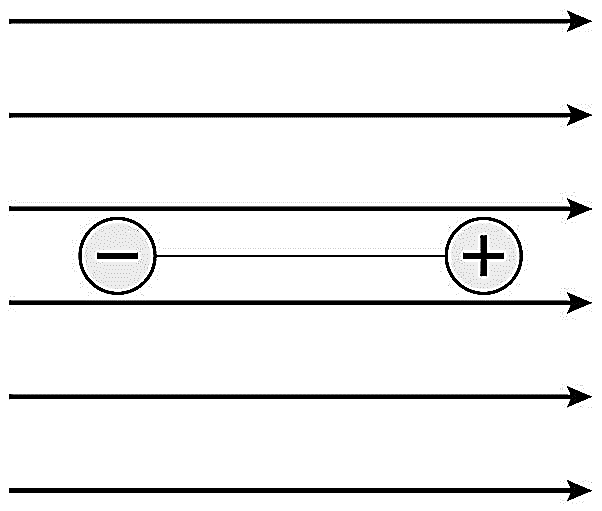
An electric dipole consists of two equal and opposite charges separated by a distance . In an electric field, a dipole experiences both a net force and a torque.
Dipole Moment:
Torque:
Force: for each charge
Motion: The dipole tends to align with the electric field direction.
Summary Table: Key Concepts
Concept | Definition/Formula | Example/Application |
|---|---|---|
Electric Field | Force on test charge | |
Point Charge Field | Field around proton | |
Superposition | Multiple charges | |
Uniform Field | Parallel plate capacitor | |
Charge Density | Rod, disk, ring | |
Dipole Moment | Torque in field |
Additional info:
Atomic structure and polarization are briefly referenced but not detailed in these notes.
Worked examples for rods, rings, and disks are summarized; full integration steps can be found in standard physics textbooks.
