 Back
BackElectric Fields, Conductors, Capacitors, and Interference: Step-by-Step Physics Review
Study Guide - Smart Notes
 Tailored notes based on your materials, expanded with key definitions, examples, and context.
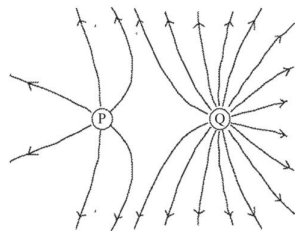
Q4. The figure shows electric field lines arising from two small charged particles P and Q. Consider the following two statements:
(i) The charge on P is smaller than the charge on Q.
(ii) The electrostatic force on P is smaller than the force on Q.
Background
Topic: Electric Field Lines and Electrostatic Forces
This question tests your understanding of how electric field lines represent charge magnitude and direction, and how the force on a charge relates to the electric field.
Key Terms and Concepts:
Electric Field Lines: The number of lines leaving or entering a charge is proportional to the magnitude of the charge.
Electrostatic Force: The force on a charge in an electric field is given by .
Step-by-Step Guidance
Examine the number of field lines associated with each charge. More lines indicate a larger magnitude of charge.
Recall that the direction of field lines (inward or outward) indicates the sign of the charge (inward for negative, outward for positive).
Consider the force experienced by each charge. The force on a charge in an electric field depends on both the charge and the field at its location.
Compare the statements given with your observations from the diagram and your understanding of field lines and forces.
Try solving on your own before revealing the answer!
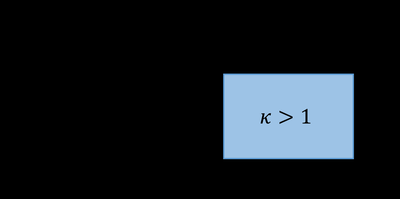
Q8. The figure shows two parallel-plate capacitors storing the same amount of charge Q. The plates of each capacitor are separated by the same distance, and their areas are identical. Capacitor 2 is filled with a dielectric material with dielectric constant κ (> 1). Consider the following statements:
(i) The capacitance of Capacitor 1 is larger than that of Capacitor 2.
(ii) The potential energy stored in Capacitor 1 is larger than that in Capacitor 2.
Background
Topic: Capacitance, Dielectrics, and Stored Energy
This question tests your understanding of how dielectrics affect capacitance and energy storage in capacitors.
Key Terms and Formulas:
Capacitance without dielectric:
Capacitance with dielectric:
Potential energy stored:
Step-by-Step Guidance
Recall that a dielectric increases the capacitance by a factor of ().
Compare the capacitance values for both capacitors using the formulas above.
Since both capacitors store the same charge , use the energy formula to compare the stored energies.
Analyze which statements (i) and (ii) are supported by your calculations and understanding.
Try solving on your own before revealing the answer!
