 Back
BackElectric Fields, Conductors, Dielectrics, and Capacitors: Study Notes
Study Guide - Smart Notes
 Tailored notes based on your materials, expanded with key definitions, examples, and context.
Charges and Fields in Conductors
Electrostatic Equilibrium in Conductors
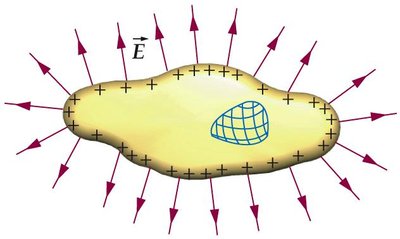
When a conductor is in electrostatic equilibrium, the free charges inside it do not move, resulting in a zero electric field throughout its interior. This leads to several important consequences for the distribution of charge and the behavior of electric fields near conductors.
Key Point 1: Electric field inside a conductor is zero in electrostatic equilibrium.
Key Point 2: Net charge resides only on the surface of the conductor; the interior contains no net charge.
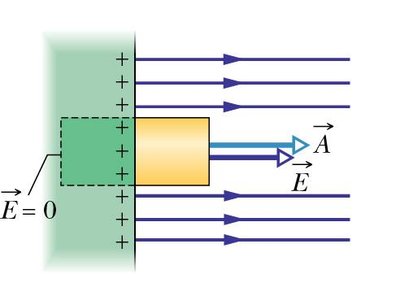
Key Point 3: The electric field just outside a conductor is always perpendicular to the surface; otherwise, surface currents would flow.
Example: A hollow metal sphere in equilibrium will have all excess charge distributed on its outer surface.
Shielding and Faraday Cage
Conductors can shield their interiors from external electric fields. When placed in an external field, free electrons redistribute until the internal field is zero. This principle is used in Faraday cages, which protect sensitive equipment from external electric fields.
Key Point: Shielding occurs because the conductor cancels the external field inside.
Example: A car acts as a Faraday cage during a lightning storm, protecting occupants from electric fields.
High Electric Field at Sharp Tips
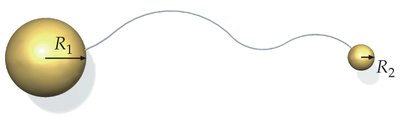
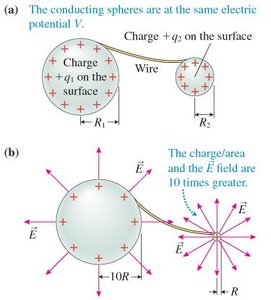
When conductors have sharp points or small radii of curvature, the electric field near these points becomes very large. This is due to the concentration of charge at these locations, which increases the local field strength.
Key Point: Electric field strength is inversely proportional to the radius of curvature: smaller radius, larger field.
Formula: for a sphere of radius R.
Example: Lightning rods use sharp tips to create high fields, promoting ionization and safe discharge of lightning.
Lightning and Grounding
Lightning is a natural example of electric field breakdown in air. The high potential difference between clouds and the ground leads to ionization and discharge. Grounding is a method to safely discharge excess charge from conductors by connecting them to the Earth.
Key Point: Lightning occurs when the electric field exceeds the breakdown threshold of air.
Key Point: Grounding allows excess electrons to flow to or from the Earth, neutralizing the object.
Example: Lightning rods and grounded buildings reduce the risk of destructive lightning strikes.

Dielectric Materials and Polarization
Polarization of Dielectrics
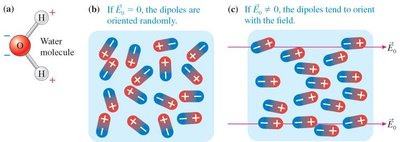
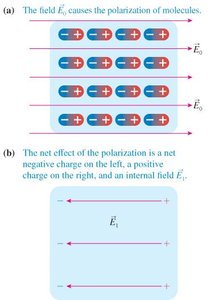
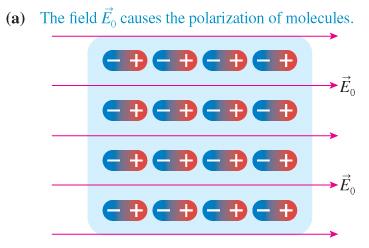
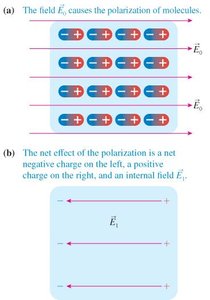
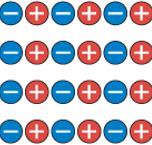
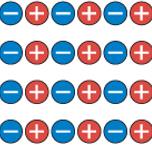
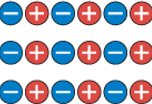
Dielectric materials are insulators that become polarized in an electric field. The field displaces atomic charges, inducing dipole moments. These dipoles align with the external field, reducing the net field inside the material.
Key Point: Polarization is the alignment of dipoles in response to an external field.
Key Point: Induced dipole fields oppose the external field, decreasing the net field.
Example: Water molecules align in an electric field due to their permanent dipole moment.
Dielectric Constant and Electric Force
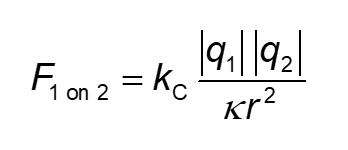
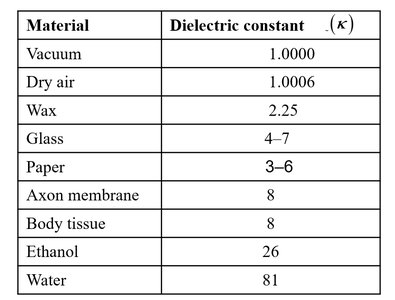
The dielectric constant (κ) quantifies a material's ability to reduce the external electric field. In a dielectric, the force between charges is reduced by κ compared to a vacuum.
Key Point: Dielectric constant (κ) is defined as .
Formula: Coulomb's law in a dielectric:
Example: Water has a high dielectric constant (κ = 81), greatly reducing electric forces between charges.
Material | Dielectric constant (κ) |
|---|---|
Vacuum | 1.0000 |
Dry air | 1.0006 |
Wax | 2.25 |
Glass | 4–7 |
Paper | 3–6 |
Axon membrane | 8 |
Body tissue | 8 |
Ethanol | 26 |
Water | 81 |
Capacitors and Capacitance
Structure and Function of Capacitors
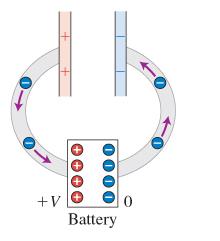
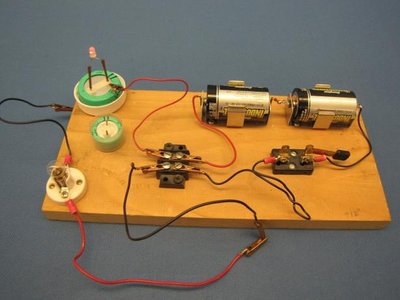
A capacitor consists of two conducting surfaces separated by a nonconducting material (dielectric) or vacuum. Its primary role is to store electric potential energy by maintaining charge separation.
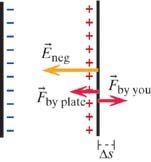
Key Point: Capacitors store energy in the electric field between their plates.
Key Point: Charging a capacitor involves moving charge from one plate to another, creating a potential difference.
Example: Capacitors are used in electronic circuits for energy storage and filtering.
Electric Field and Potential in Capacitors
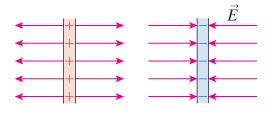
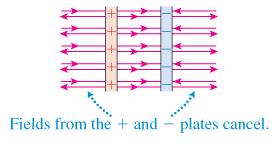
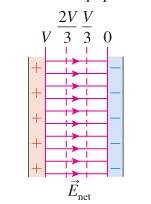
The electric field between parallel plate capacitors is uniform and can be calculated using the charge and area of the plates. The potential difference is related to the charge, area, and separation.
Formula:
Formula:
Definition: Capacitance (C) is the ratio of charge to potential difference:
Capacitance of Parallel Plate Capacitors
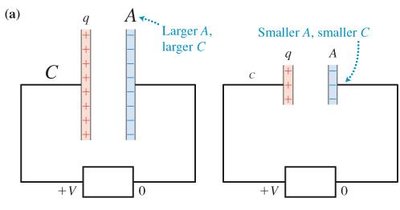
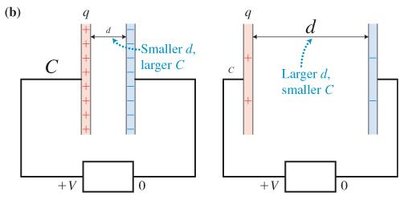
The capacitance of a parallel plate capacitor depends on the area of the plates, the separation between them, and the permittivity of the material between the plates.
Formula:
SI Unit: The farad (F), named after Michael Faraday.
Example: Increasing plate area increases capacitance; increasing separation decreases capacitance.
Capacitor Breakdown and Dielectrics
When the electric field between capacitor plates exceeds the breakdown threshold of the dielectric, the material becomes conductive, leading to discharge. Using a dielectric increases the breakdown voltage and enhances the capacitor's performance.
Key Point: Breakdown field for dry air is about N/C.
Key Point: Dielectrics weaken the electric field and allow higher potential differences before breakdown.
Capacitance with Dielectric Materials
Inserting a dielectric between capacitor plates increases the capacitance by a factor equal to the dielectric constant κ.
Formula:
Key Point: Higher κ means greater capacitance.
Capacitors in Series and Parallel
The effective capacitance of a set of capacitors depends on their configuration. In series, the reciprocal of the total capacitance is the sum of reciprocals; in parallel, the total capacitance is the sum of individual capacitances.
Formula (Series):
Formula (Parallel):
Energy Storage in Capacitors
Field Energy Density
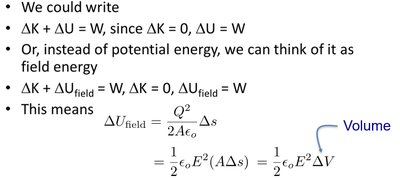
The energy stored in a capacitor is contained in the electric field between the plates. The energy density (energy per unit volume) is a useful concept for understanding this storage.
Formula:
Formula:
Units: Joules per cubic meter ()
Example: The energy stored increases with the square of the electric field.
Summary Table: Dielectric Constants
Material | Dielectric constant (κ) |
|---|---|
Vacuum | 1.0000 |
Dry air | 1.0006 |
Wax | 2.25 |
Glass | 4–7 |
Paper | 3–6 |
Axon membrane | 8 |
Body tissue | 8 |
Ethanol | 26 |
Water | 81 |
Additional info: Academic context was added to clarify the physical principles, formulas, and applications for each topic, ensuring completeness and self-contained explanations suitable for exam preparation.
