 Back
BackElectric Fields, Dipoles, and Potential: Step-by-Step Physics Guidance
Study Guide - Smart Notes
 Tailored notes based on your materials, expanded with key definitions, examples, and context.
Q1. What are the strength and direction of the electric field at the position indicated by the dot in Figure P20.30?
Background
Topic: Electric Field Due to Point Charges
This question tests your understanding of how to calculate the electric field at a point in space due to multiple point charges, including vector addition of the fields.
Key Terms and Formulas
Electric field due to a point charge:
Superposition principle: The net electric field is the vector sum of the fields from each charge.
Direction: Electric field points away from positive charges and toward negative charges.
(Coulomb's constant)
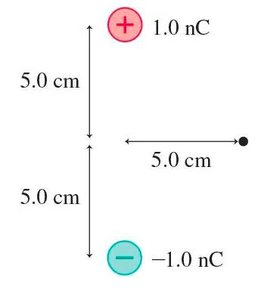
Step-by-Step Guidance
Calculate the distance from each charge to the dot. Both are horizontally and vertically, so use the Pythagorean theorem: .
Calculate the magnitude of the electric field at the dot due to each charge using , where and is the distance you just found.
Determine the direction of each field: The field from the positive charge points away from it, and the field from the negative charge points toward it. Draw vectors to visualize their directions at the dot.
Resolve each electric field into and components using trigonometry (e.g., , ), considering the correct signs for each direction.
Add the and components from both charges to find the net electric field components at the dot. (Stop here before calculating the final magnitude and direction.)
Try solving on your own before revealing the answer!
Q2. A positive charge is brought near to a dipole, as shown in Figure Q20.33. If the dipole is free to rotate, what happens?
Background
Topic: Electric Dipoles in External Fields
This question tests your understanding of how electric dipoles interact with external charges and the resulting torque or rotation.
Key Terms and Concepts
Electric dipole: Two equal and opposite charges separated by a distance.
Torque on a dipole: An external electric field exerts a torque that tends to align the dipole with the field.
Attraction and repulsion: Like charges repel, unlike charges attract.
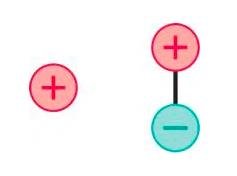
Step-by-Step Guidance
Identify the charges: The dipole has a positive and a negative end. The lone charge is positive.
Consider the forces: The positive end of the dipole is repelled by the lone positive charge, while the negative end is attracted.
Determine the resulting motion: The combination of these forces creates a torque on the dipole, causing it to rotate.
Decide the direction of rotation: Visualize which way the dipole would turn so that its negative end moves closer to the lone positive charge.
Try solving on your own before revealing the answer!
Q3. As shown in Figure P20.60, a 5.0 nC charge sits at x=0 in a uniform 4500 N/C electric field directed to the right. At what point along the x-axis would (a) a proton and (b) an electron experience no net force?
Background
Topic: Superposition of Electric Fields
This question tests your ability to find the location where the electric field from a point charge cancels a uniform external field, resulting in zero net force on a test charge.
Key Terms and Formulas
Electric field from a point charge:
Uniform electric field: (to the right)
Net force is zero when the total electric field at a point is zero.
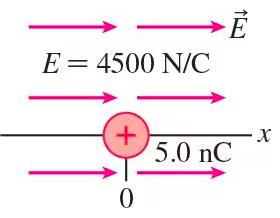
Step-by-Step Guidance
Write the expression for the electric field due to the point charge at a distance from the origin: .
Set up the condition for zero net field: (to the left) must cancel (to the right).
Solve for where .
Take the square root to solve for , and determine on which side of the origin this point must be (left or right).
Try solving on your own before revealing the answer!
Q4. An electron with an initial speed of 500,000 m/s is brought to rest by an electric field. (a) Did the electron move into a region of higher or lower potential? (b) What was the potential difference that stopped the electron? (c) What was the initial kinetic energy of the electron, in electron volts?
Background
Topic: Conservation of Energy in Electric Fields
This question tests your understanding of how electric potential energy and kinetic energy are related for a charged particle moving in an electric field.
Key Terms and Formulas
Change in electric potential energy:
Kinetic energy:
Conservation of energy:
1 electron volt (eV) = J
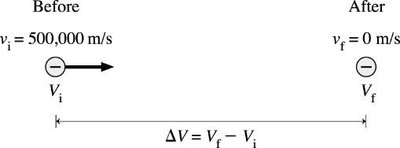
Step-by-Step Guidance
For part (a): Consider the sign of the electron and the fact that it slows down. Use the relationship between charge, potential, and energy to reason whether it moves to higher or lower potential.
For part (b): Set up the conservation of energy equation: . Since the electron comes to rest, .
Rearrange to solve for the potential difference in terms of the initial kinetic energy and the electron's charge.
For part (c): Calculate the initial kinetic energy using , and then convert this energy to electron volts.
Try solving on your own before revealing the answer!
