 Back
BackElectric Fields: Fundamentals and Applications
Study Guide - Smart Notes
 Tailored notes based on your materials, expanded with key definitions, examples, and context.
Electric Fields and Charge
Electric Charge: Basic Concepts
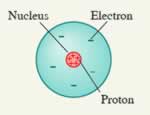
Electric phenomena are fundamentally based on the concept of electric charge. There are two types of charge: positive and negative. The basic charges of ordinary matter are carried by protons (positive) and electrons (negative), which are constituents of atoms. Charging refers to the transfer of electrons from one object to another, resulting in a net charge.
Protons reside in the nucleus and carry a positive charge.
Electrons orbit the nucleus and carry a negative charge.
Objects become charged by gaining or losing electrons.
Behavior of Charges
Charges exhibit well-established behaviors:
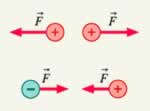
Like charges repel each other; opposite charges attract.
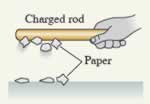
Neutral objects are attracted to either positive or negative charges.
Charge can be transferred between objects.
Charge is conserved in all interactions.
Conductors and Insulators
Classification of Materials
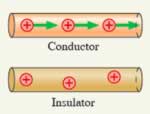
Materials are classified based on their ability to allow charge movement:
Conductors: Charge moves easily through or along these materials (e.g., metals).
Insulators: Charge is immobile in these materials (e.g., rubber, glass).
Coulomb’s Law
Fundamental Law of Electric Force
Coulomb’s law describes the electric force between two point charges. It is an inverse-square law, similar to Newton’s law of gravity:
The force is proportional to the product of the charges.
The force is inversely proportional to the square of the distance between them.
Formula:
= magnitude of force
= Coulomb's constant ( N·m/C$^2$)
, = charges
= distance between charges
Electric Field
Definition and Properties
An electric field is the region around a charged object where other charges experience a force. The field is the agent that transmits the force between charges, and it exists at all points in space.
Charges interact via electric fields.
The electric field is a vector quantity.
Electric fields can be represented by vectors or field lines.
Importance of Electric Charges
Applications in Technology
The physics of electric charges forms the foundation for modern electronic devices and communications technology. Everyday phenomena, such as static electricity, are governed by the same principles that enable computers, cell phones, and optical fiber communications.
Origin and Representation of Electric Fields
Superposition and Dipoles
Electric fields are created by charges and obey the principle of superposition:
The total electric field from multiple charges is the vector sum of the fields from each charge.
Two equal but opposite charges form an electric dipole.
Electric fields can be visualized using field lines.
Continuous Charge Distributions
Charge Density and Calculation
For macroscopic objects, charge is often distributed continuously. The charge density describes how charge is spread over length, area, or volume.
Linear charge density:
Objects are divided into small segments for calculation.
The electric field is found by integrating the contributions from each segment.
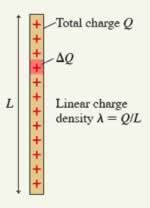
Example: Calculating the electric field of a charged rod involves summing the fields from each infinitesimal segment.
Formula for electric field from a continuous distribution:
= electric field
= infinitesimal charge element
= distance from element to point of interest
Additional info: Continuous charge distributions are essential for understanding fields from real-world objects, such as wires, disks, and planes.
