 Back
BackElectric Fields, Gauss' Law, and Capacitance: Step-by-Step Physics Guidance
Study Guide - Smart Notes
 Tailored notes based on your materials, expanded with key definitions, examples, and context.
Q1. How can we compute the components , , of the electric field for a dipole potential ?
Background
Topic: Electric Field from Electric Potential in Spherical Coordinates
This question tests your understanding of how to derive the electric field components from a given electric potential, specifically for an electric dipole in spherical coordinates.
Key Terms and Formulas
Electric potential (): Scalar field related to the electric field.
Electric field (): Vector field, components in spherical coordinates (, , ).
Key formulas:
Step-by-Step Guidance
Identify the given potential: .
Recall the formulas for the electric field components in spherical coordinates.
To find , take the partial derivative of with respect to :
To find , take the partial derivative of with respect to and divide by :
To find , take the partial derivative of with respect to and divide by :
Try solving on your own before revealing the answer!
Final Answer:
The component is zero because the potential does not depend on $\phi$.
Q2. An infinite plane is charged uniformly with charge density . Use Gauss’ law to find the electric field created by the plane.
Background
Topic: Gauss' Law and Planar Symmetry
This question tests your ability to apply Gauss' law to a symmetric charge distribution (an infinite plane) to find the electric field.
Key Terms and Formulas
Charge density (): Charge per unit area.
Gauss' law:
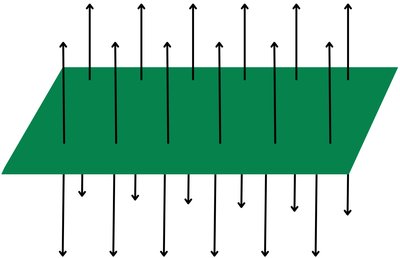
Planar symmetry: The electric field is perpendicular to the plane.
Step-by-Step Guidance
Recognize the symmetry: The electric field must be perpendicular to the plane, pointing away from or toward the plane depending on the sign of .
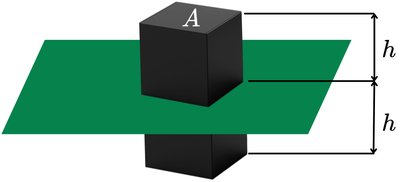
Choose a Gaussian surface: A box (or pillbox) that extends equal distances above and below the plane.
Write Gauss' law for the surface:
Calculate the flux through the box: The flux through the lateral sides is zero, and the flux through the two bases is for each base.
Express the enclosed charge:
Try solving on your own before revealing the answer!
Final Answer:
The field is constant and perpendicular to the plane, above and below.
Q3. What does it mean to connect capacitors in parallel, and how do you prove their equivalent capacitance is ?
Background
Topic: Capacitors in Parallel
This question tests your understanding of how capacitors behave when connected in parallel and how to derive the formula for their equivalent capacitance.
Key Terms and Formulas
Capacitance (): Ability to store charge per unit voltage.
Parallel connection: Same potential difference across each capacitor.
Key formula:
Step-by-Step Guidance
Understand that in parallel, each capacitor experiences the same voltage ().
The total charge stored is the sum of the charges on each capacitor: .
Use the definition of capacitance: for each capacitor.
Express each charge in terms of capacitance and voltage: , , .
Substitute these into the total charge equation and solve for .
Try solving on your own before revealing the answer!
Final Answer:
Each capacitor adds its capacitance to the total because they share the same voltage.
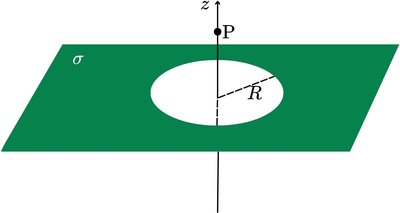
Q4. A plane has a disc of radius removed from it. The plane is charged with density . What is the electric field at point on the -axis above the hole?
Background
Topic: Superposition Principle and Electric Field of Charged Surfaces
This question tests your ability to use the superposition principle to find the electric field at a point above a punctured plane, using known results for a full plane and a disc.
Key Terms and Formulas
Superposition principle: The total field is the sum of fields from each part.
Electric field of a plane:
Electric field of a disc on its axis:
Step-by-Step Guidance
Recognize that the field at is the field from the entire plane minus the field from the disc.
Write the expression for the field from the plane and the disc at point .
Subtract the disc's field from the plane's field to get the field at :
Plug in the formulas for each field and simplify the expression.
Try solving on your own before revealing the answer!
Final Answer:
This gives the field above the plane; below the plane, the direction is reversed.
