 Back
Back1/20 Electric Fields: Point Charges, Distributions, and Field Lines
Study Guide - Smart Notes
 Tailored notes based on your materials, expanded with key definitions, examples, and context.
Electric Fields
Definition and Properties of the Electric Field
The electric field is a vector field that describes the force per unit charge exerted on a test charge at any point in space. It is a fundamental concept in electromagnetism, allowing us to analyze the influence of charges without direct contact.
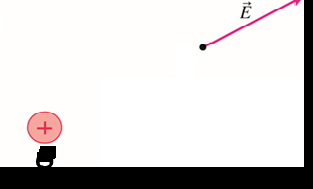
Definition: The electric field E at a point is defined as the force F experienced by a small positive test charge q' divided by the magnitude of the charge:
Units: Newtons per Coulomb (N/C)
Direction: The direction of E is the direction of the force on a positive test charge.
Electric Field of a Point Charge
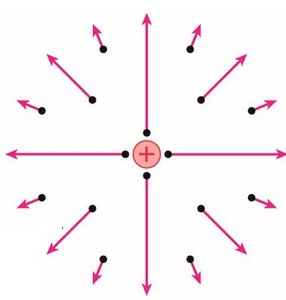
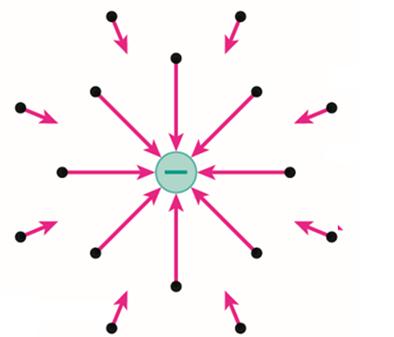
The electric field produced by a single point charge Q at a distance r is given by Coulomb's law:
k is Coulomb's constant: N·m2/C2
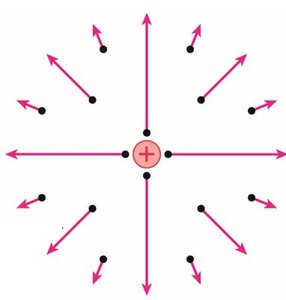
The field points away from positive charges and toward negative charges.
Electric Field of Multiple Charges: Superposition Principle
When more than one charge is present, the total electric field at a point is the vector sum of the fields produced by each charge individually. This is known as the superposition principle:
Each field is calculated using the formula for a point charge, then added vectorially.
Electric Field of a Dipole
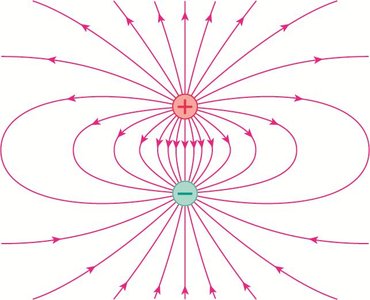
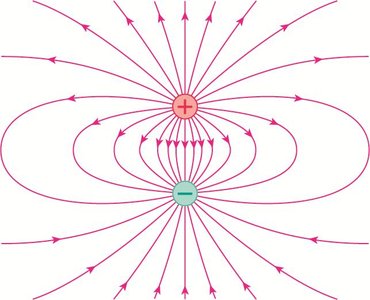
An electric dipole consists of two equal and opposite charges separated by a small distance. The field lines emerge from the positive charge and terminate at the negative charge, forming characteristic patterns.
Uniform Electric Fields and Parallel-Plate Capacitors
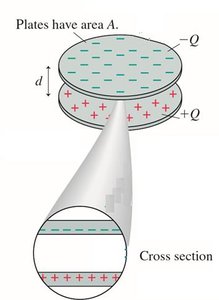
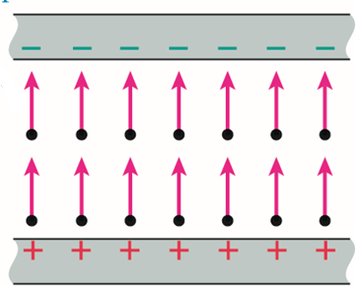
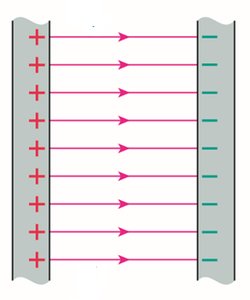
A uniform electric field is one in which the field strength and direction are constant at every point. This is typically realized between two large, closely spaced, oppositely charged parallel plates (a parallel-plate capacitor).
The field inside is given by:
Q: charge on the plates
A: area of the plates
\varepsilon_0: permittivity of free space ( C2/N·m2)
Electric Field Lines
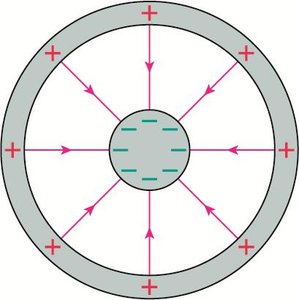
Electric field lines are a visual tool to represent the direction and strength of the electric field in space.
The tangent to a field line at any point gives the direction of the electric field vector at that point.
Field lines are closer together where the field is stronger.
Field lines start on positive charges and end on negative charges.
Field lines never cross.
Example Problems and Applications
Finding the Electric Field of a Proton: The electric field at the position of an electron in a hydrogen atom (radius 0.053 nm) due to the proton can be calculated using the point charge formula.
Typical Electric Field Strengths: Near objects charged by rubbing: – N/C; inside an atom: N/C.
Superposition Example: For two charges, the net field at a point is the vector sum of the fields from each charge.
Floating a Charged Droplet: To float a droplet of mass m and charge q in an electric field, set the electric force equal to the gravitational force: .
Summary Table: Electric Field Formulas
Configuration | Electric Field Formula |
|---|---|
Point Charge | |
Uniform Field (Parallel Plates) | |
Superposition (Multiple Charges) |
Additional info: The notes above expand on the slide content by providing definitions, formulas, and context for each concept, ensuring the material is self-contained and suitable for exam preparation.
