 Back
BackElectric Fields, Potential, Capacitance, Current, and Circuits: Core Concepts and Applications
Study Guide - Smart Notes
 Tailored notes based on your materials, expanded with key definitions, examples, and context.
Electric Fields and Forces
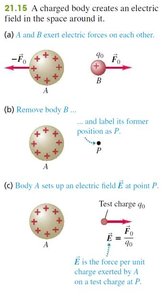
Charged Bodies and Electric Fields
Charged objects create electric fields in the space around them, influencing other charges placed within that field. The electric field at a point is defined as the force per unit charge exerted on a test charge at that point.
Electric Field (\(\vec{E}\)): The vector field representing the force per unit charge at each point in space.
Test Charge (\(q_0\)): A small positive charge used to measure the electric field without disturbing it.
Formula:
Direction: The direction of \(\vec{E}\) is the direction of the force on a positive test charge.
Electric Field of Point Charges
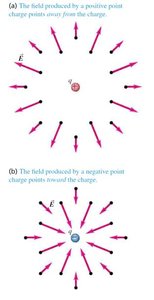
The electric field produced by a point charge radiates outward if the charge is positive and inward if the charge is negative. The field's magnitude decreases with the square of the distance from the charge.
Formula:
Direction: Away from positive charges, toward negative charges.
Electric Dipoles and Field Patterns
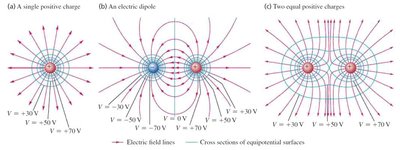
An electric dipole consists of two equal and opposite charges separated by a distance. The field lines for a dipole are characteristic and show the direction and strength of the field.
Dipole Moment (\(\vec{p}\)): Defined as \(\vec{p} = q \vec{d}\), where \(q\) is the charge and \(\vec{d}\) is the displacement vector from negative to positive charge.
Field Patterns: Field lines emerge from the positive charge and terminate at the negative charge.
Gauss's Law and Electric Flux
Electric Flux
Electric flux quantifies the number of electric field lines passing through a surface. It is a measure of the field's effect over an area.
Formula:
Units: Newton-meters squared per coulomb (N·m2/C).
Gauss's Law
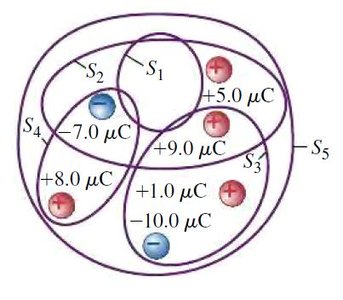
Gauss's Law relates the electric flux through a closed surface to the net charge enclosed by that surface. It is a powerful tool for calculating electric fields in cases with high symmetry.
Gauss's Law:
Application: Useful for spheres, cylinders, and planes with uniform charge distributions.
Electric Potential and Potential Energy
Electric Potential
Electric potential (V) at a point is the electric potential energy per unit charge at that point. It is a scalar quantity and is related to the work done by the electric field in moving a charge.
Formula for Point Charge:
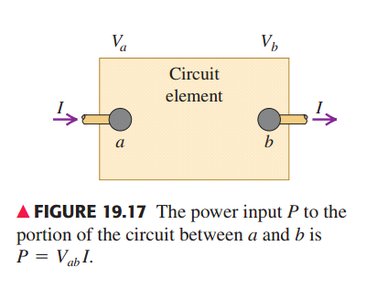
Potential Difference (\(\Delta V\)): The work done per unit charge to move a charge between two points.
Electric Potential Energy
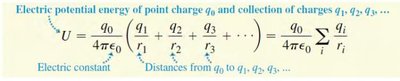
The electric potential energy of a system of point charges is the work required to assemble the system by bringing each charge in from infinity.
Formula for a Collection of Charges:
Equipotential Surfaces
Equipotential surfaces are surfaces on which the electric potential is constant. No work is required to move a charge along an equipotential surface.
Relation to Field Lines: Electric field lines are always perpendicular to equipotential surfaces.
Capacitance and Capacitors
Parallel-Plate Capacitor
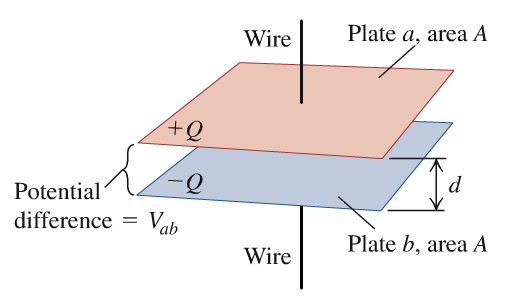
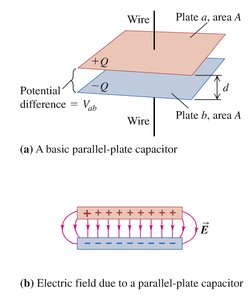
A parallel-plate capacitor consists of two conducting plates separated by a distance, with equal and opposite charges. The capacitance depends on the plate area and separation.
Capacitance Formula:
Potential Difference: is the voltage across the plates.
Capacitors in Series and Parallel
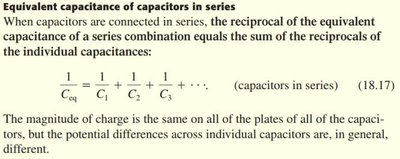
Capacitors can be combined in series or parallel to achieve desired capacitance values in circuits.
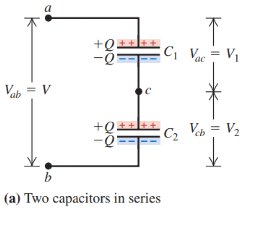
Series Combination: The reciprocal of the equivalent capacitance is the sum of the reciprocals of the individual capacitances.
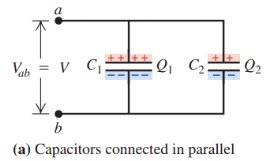
Parallel Combination: The equivalent capacitance is the sum of the individual capacitances.

Current, Resistance, and Circuits
Electric Current
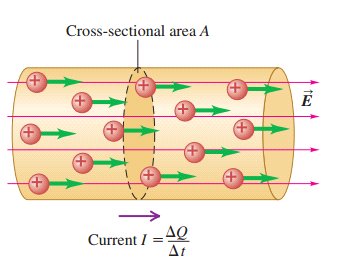
Electric current is the rate of flow of charge through a conductor. It is driven by an electric field and is measured in amperes (A).
Formula:
Direction: By convention, current is the flow of positive charge.
Resistance and Ohm's Law
Resistance is a measure of how much a material opposes the flow of electric current. Ohm's Law relates the voltage, current, and resistance in a circuit.
Ohm's Law:
Resistivity (\(\rho\)): A material property that quantifies how strongly a material opposes current.
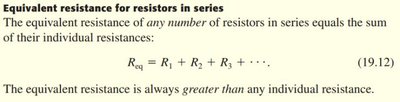
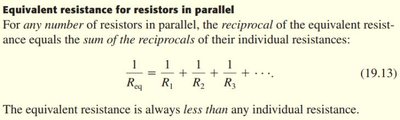
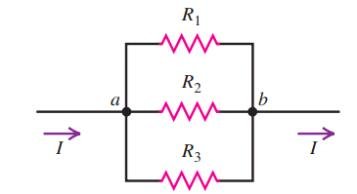
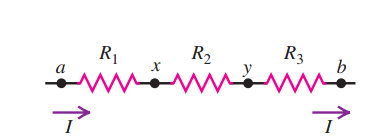
Resistors in Series and Parallel
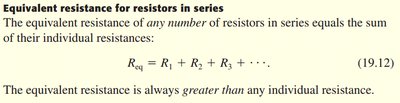
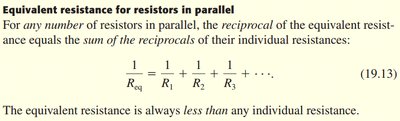
Resistors can be combined in series or parallel, affecting the total resistance in a circuit.
Series: The total resistance is the sum of individual resistances.
Parallel: The reciprocal of the total resistance is the sum of the reciprocals of the individual resistances.
Kirchhoff's Rules and Circuit Analysis
Kirchhoff's Loop Rule
Kirchhoff's loop rule states that the sum of the potential differences around any closed loop in a circuit must be zero. This is a consequence of energy conservation.
Formula:
Application: Used to analyze complex circuits with multiple loops and junctions.
Sign Conventions for Kirchhoff's Rules
When applying Kirchhoff's rules, it is important to use consistent sign conventions for emf sources and resistors.
Traveling from negative to positive terminal of an emf: +\(\mathcal{E}\)
Traveling from positive to negative terminal of an emf: -\(\mathcal{E}\)
Traveling in the direction of current through a resistor: -IR
Traveling opposite to current through a resistor: +IR
Strategy for Applying Kirchhoff's Rules
To analyze a circuit using Kirchhoff's rules:
Assign current directions and label all quantities.
Apply the junction rule at each junction (sum of currents entering equals sum leaving).
Apply the loop rule to independent loops.
Solve the resulting system of equations for unknowns.
Summary Table: Series and Parallel Combinations
Component | Series | Parallel |
|---|---|---|
Capacitors | ||
Resistors |
Additional info: This guide covers core concepts from electric fields and Gauss's law through potential, capacitance, current, resistance, and circuit analysis, with formulas and diagrams for clarity.
