 Back
BackElectric Fields, Potential, Capacitance, Current, and Circuits: Study Guide
Study Guide - Smart Notes
 Tailored notes based on your materials, expanded with key definitions, examples, and context.
Electric Charge and Electric Field
Charged Bodies and Electric Fields
Charged bodies create electric fields in the space around them, which exert forces on other charges. The electric field at a point is defined as the force per unit charge exerted by the source charge.
Electric field vector (\(\vec{E}\)): Points in the direction of the force experienced by a positive test charge.
Superposition principle: The total electric field is the vector sum of fields from all charges.
Formula: \(\vec{E} = \frac{\vec{F}_0}{q_0}\), where \(\vec{F}_0\) is the force on a test charge \(q_0\).
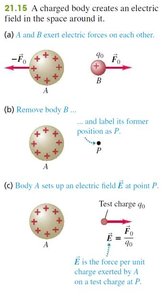
Electric Field Lines
Electric field lines are a visual representation of the direction and strength of the electric field. They provide insight into the behavior of fields around charges.
Field lines: Tangent to the electric field vector at every point.
Properties:
Closer lines indicate stronger fields.
Lines never intersect.
Lines point away from positive charges and toward negative charges.
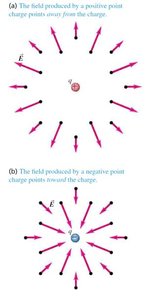
Gauss' Law and Electric Flux
Electric Flux
Electric flux quantifies the number of electric field lines passing through a surface. It is a key concept in applying Gauss' Law.
Formula: \(\Phi_E = \vec{E} \cdot \vec{A}\), where \(\vec{A}\) is the area vector.
Gauss' Law
Gauss' Law relates the electric flux through a closed surface to the net charge enclosed by that surface.
Formula: \(\Phi_E = \frac{Q_{\text{enclosed}}}{\varepsilon_0}\)
Applications: Useful for calculating fields of symmetric charge distributions.
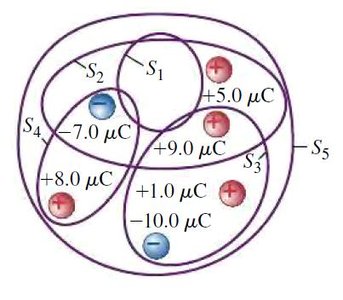
Electric Potential and Potential Energy
Electric Potential Energy
Electric potential energy is the energy a charge has due to its position in an electric field. For a collection of point charges, the potential energy is the sum of the interactions between each pair.
Formula:
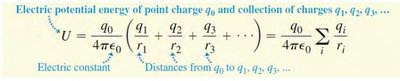
Electric Potential
Electric potential (V) is the electric potential energy per unit charge. It is a scalar quantity and is useful for calculating work done by electric forces.
Formula:
Potential difference: The work required to move a charge between two points in an electric field.
Potential of a Point Charge
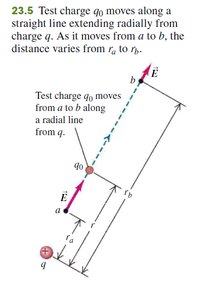
The electric potential due to a point charge decreases with distance from the charge.
Formula:
Equipotential Surfaces and Field Lines
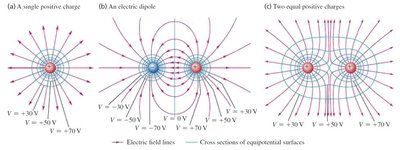
Equipotential surfaces are surfaces where the electric potential is constant. They are always perpendicular to electric field lines.
Equipotential surfaces: No work is required to move a charge along these surfaces.
Relation to field lines: Perpendicular at every point.
Potential Gradient
The potential gradient is the rate of change of electric potential with respect to distance. It is related to the electric field by \(\vec{E} = -\nabla V\).
Electric Field at Conductors
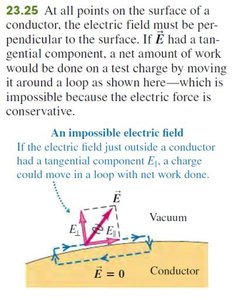
At the surface of a conductor, the electric field must be perpendicular to the surface. If there were a tangential component, it would violate the conservative nature of the electric force.
Capacitance and Capacitors
Parallel-Plate Capacitor
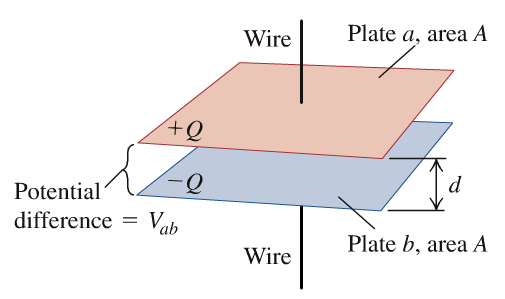
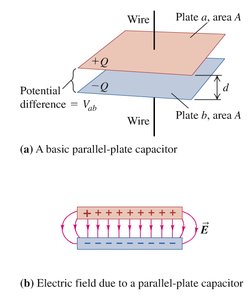
A parallel-plate capacitor consists of two plates separated by a distance, storing charge and energy in the electric field between them.
Capacitance (C): , where \(A\) is plate area and \(d\) is separation.
Potential difference: is the voltage across the plates.
Capacitors in Series and Parallel
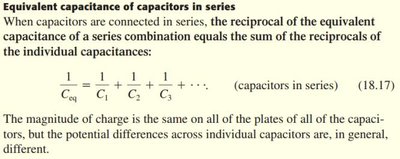
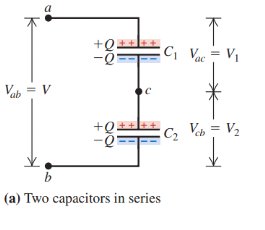
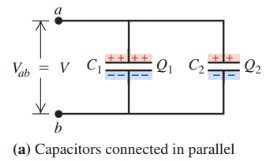
Capacitors can be combined in series or parallel to achieve desired capacitance values in circuits.
Parallel:
Series:

Current, Resistance, and Circuits
Electric Current
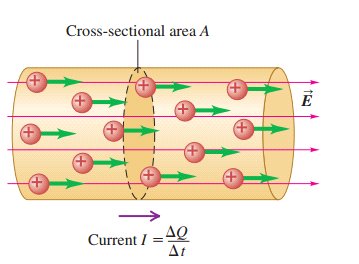
Electric current is the flow of electric charge through a conductor. It is defined as the rate of charge flow.
Formula:
Direction: Conventional current flows from positive to negative terminal.
Resistivity and Resistance
Resistivity is a material property that quantifies how strongly a material opposes current flow. Resistance depends on resistivity, length, and cross-sectional area.
Formula: , where \(\rho\) is resistivity, \(L\) is length, \(A\) is area.
Color Codes for Resistors
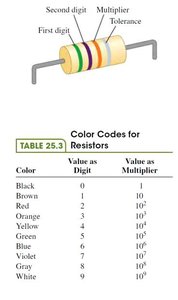
Resistors are labeled with color codes to indicate their resistance value and tolerance.
Color | Value as Digit | Value as Multiplier |
|---|---|---|
Black | 0 | 1 |
Brown | 1 | 10 |
Red | 2 | 102 |
Orange | 3 | 103 |
Yellow | 4 | 104 |
Green | 5 | 105 |
Blue | 6 | 106 |
Violet | 7 | 107 |
Gray | 8 | 108 |
White | 9 | 109 |
Ohm's Law
Ohm's Law relates voltage, current, and resistance in a circuit.
Formula:
Electromotive Force (emf)
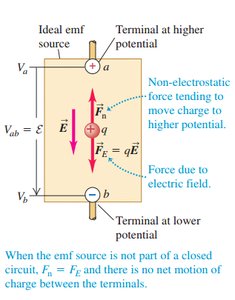
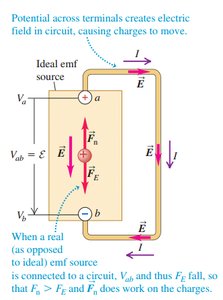
Emf is the energy provided by a source per unit charge. It drives current in a circuit, even against the electrostatic force.
Power in Electric Circuits
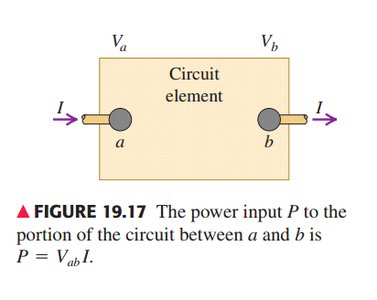
Power is the rate at which energy is transferred or converted in a circuit element.
Formula:
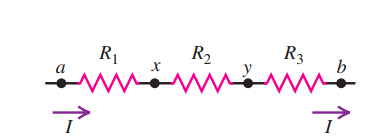
Resistors in Series and Parallel
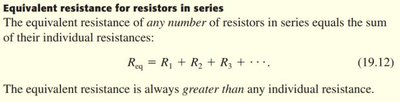
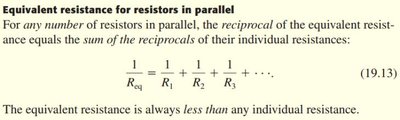
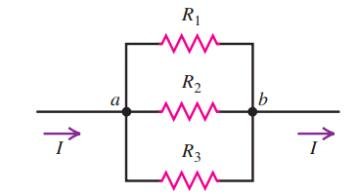
Resistors can be combined in series or parallel to control current and voltage in circuits.
Series:
Parallel:
Kirchhoff's Rules
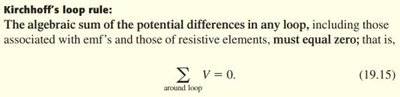
Kirchhoff's Loop Rule
Kirchhoff's loop rule states that the algebraic sum of potential differences in any closed loop is zero. This is a consequence of energy conservation.
Formula:
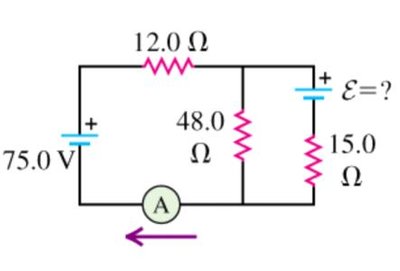
Example Circuit
Kirchhoff's rules are applied to analyze complex circuits with multiple loops and branches.
Summary Table: Series and Parallel Connections
Component | Series Formula | Parallel Formula |
|---|---|---|
Resistors | ||
Capacitors |
Additional info:
Some context and explanations were inferred to ensure completeness and clarity for exam preparation.
