 Back
BackWeek 2 Lec. 1
Study Guide - Smart Notes
 Tailored notes based on your materials, expanded with key definitions, examples, and context.
Electric Flux
Definition and Physical Meaning
Electric flux (ΦE) quantifies the number of electric field lines passing through a given surface. It is a measure of the 'flow' of the electric field through an area, analogous to the flow of water through a net. The concept is foundational for understanding Gauss' Law and the behavior of electric fields in various configurations.
Electric Flux (ΦE): The product of the electric field and the area projected in the direction of the field.
Mathematical Expression: For a uniform electric field perpendicular to a flat surface:
For a non-uniform field or curved surface:
Direction: The sign of the flux depends on the orientation of the surface relative to the field direction.
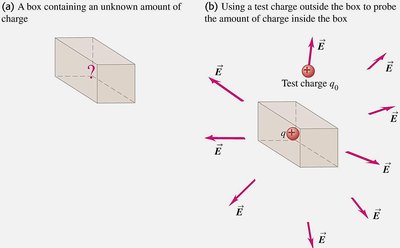
Dependence on Charge and Surface
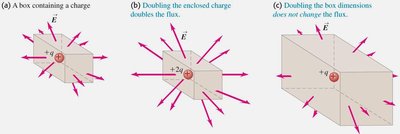
The electric flux through a surface depends on the amount of charge enclosed and the geometry of the surface. Doubling the enclosed charge doubles the flux, but changing the size of the surface (without changing the enclosed charge) does not affect the total flux.
Doubling Charge: doubles if the enclosed charge doubles.
Surface Size: Changing the surface size (while still enclosing the same charge) does not change the total flux.
Flux Through a Surface in a Uniform Field
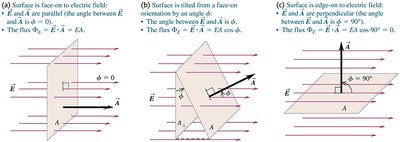
The orientation of a surface relative to the electric field affects the flux. The flux is maximum when the surface is perpendicular to the field and zero when parallel.
General Formula:
θ = 0°: Surface is perpendicular to field, maximum flux.
θ = 90°: Surface is parallel to field, zero flux.
Flux Through Closed Surfaces
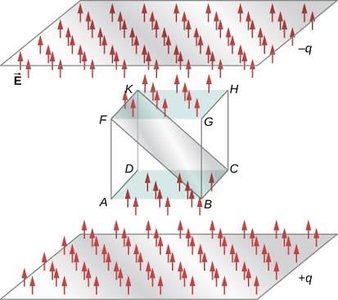
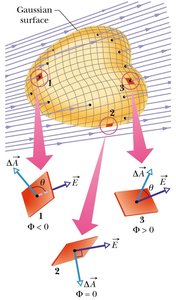
For a closed surface, the net electric flux is the sum of the flux through all its faces. The sign of the flux depends on the direction of the electric field relative to the outward normal of each surface element.
Positive Flux: Field lines exiting the surface (outward normal).
Negative Flux: Field lines entering the surface (inward normal).
Zero Net Flux: If as many lines enter as leave, the net flux is zero.
Mathematical Definition of Electric Flux
Integral Formulation
For arbitrary surfaces and non-uniform fields, electric flux is defined as the surface integral of the electric field over the area:
Where is a vector normal to the surface element with magnitude equal to the area of the element.
For closed surfaces, the integral is taken over the entire surface.
Gauss’ Law
Statement and Mathematical Form
Gauss’ Law relates the net electric flux through a closed surface to the total electric charge enclosed within that surface. It is a fundamental law in electrostatics and is especially powerful for calculating electric fields in cases with high symmetry.
Gauss’ Law (Integral Form):
is the total charge enclosed by the surface.
is the permittivity of free space ().

Physical Interpretation
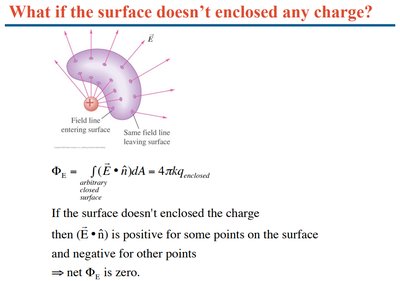
Gauss’ Law tells us that the net electric flux through any closed surface depends only on the net charge enclosed, not on the shape or size of the surface. If no charge is enclosed, the net flux is zero, even if the electric field is nonzero at points on the surface.
Enclosed Charge: Only charges inside the surface contribute to the net flux.
External Charges: Charges outside the surface do not affect the net flux through the surface.
Application to Spherical Surfaces
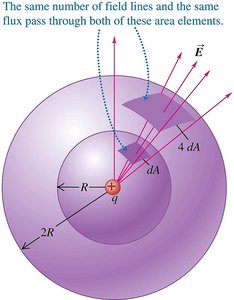
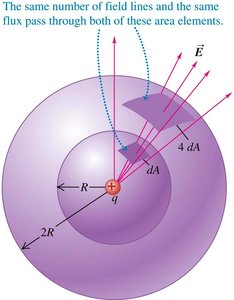
For a point charge at the center of a spherical surface, the electric flux is independent of the radius of the sphere and depends only on the enclosed charge.
The same number of field lines pass through any spherical surface centered on the charge.
Sign of the Flux
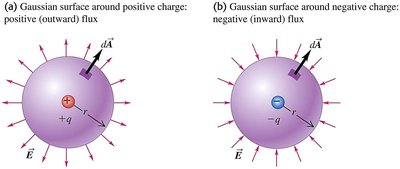
The sign of the electric flux depends on the sign of the enclosed charge:
Positive Charge: Outward (positive) flux.
Negative Charge: Inward (negative) flux.
Examples and Calculations
Gauss’ Law can be used to solve two main types of problems:
Given a charge distribution, find the electric flux through a surface.
Given the electric flux, find the total enclosed charge.
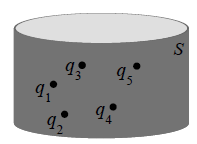
For multiple point charges inside a closed surface, the total enclosed charge is the algebraic sum of all charges:

Symmetry and Choosing Gaussian Surfaces
Gauss’ Law is most useful when applied to problems with high symmetry (spherical, cylindrical, or planar). The choice of Gaussian surface simplifies the calculation of the electric field.
Spherical Symmetry: Use a sphere for point charges or spherical charge distributions.
Cylindrical Symmetry: Use a cylinder for infinite lines of charge.
Planar Symmetry: Use a box or pillbox for infinite planes of charge.
Summary Table: Key Aspects of Gauss’ Law
Concept | Description | Formula |
|---|---|---|
Electric Flux (Uniform Field) | Field through a flat surface | |
Electric Flux (General) | Field through any surface | |
Gauss’ Law | Relates flux to enclosed charge | |
Sign of Flux | Outward for positive charge, inward for negative | Depends on |
Key Takeaways
Electric flux measures the 'flow' of the electric field through a surface.
Gauss’ Law connects the net electric flux through a closed surface to the total charge enclosed.
For highly symmetric charge distributions, Gauss’ Law allows direct calculation of the electric field.
The net flux through a closed surface is zero if no charge is enclosed, regardless of the field outside.
