 Back
BackElectric Forces and Electric Fields: Fundamental Concepts and Applications
Study Guide - Smart Notes
 Tailored notes based on your materials, expanded with key definitions, examples, and context.
Electric Forces and Electric Fields
Historical Background
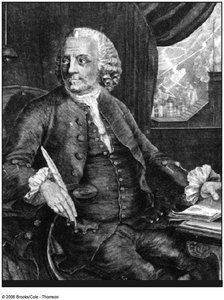
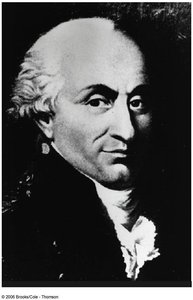
Early observations of electric and magnetic phenomena date back to the ancient Greeks, who noticed that amber, when rubbed, could attract lightweight objects. The scientific study of electricity advanced significantly in the 18th century, with contributions from Benjamin Franklin and Charles Coulomb, who helped transform scattered observations into a coherent scientific discipline.
Properties of Electric Charge
Electric charge is a fundamental property of matter, responsible for electric forces and interactions. The modern view of charge includes the following key points:
Quantization: All charge exists as integer multiples of a fundamental unit, denoted by e.
Elementary Charges: Electrons carry a charge of –e, protons carry +e.
SI Unit: The Coulomb (C) is the SI unit of charge, where e = 1.6 \times 10^{-19} \text{ C}.
Charging Methods
Charging by Conduction
Charging by conduction involves direct contact between a charged object and a neutral object. Electrons move from one object to another, leaving both objects with the same sign of charge.

Charging by Induction
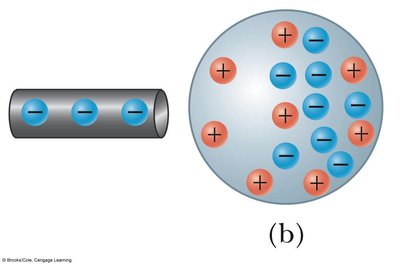
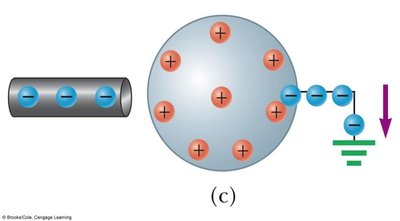
Charging by induction does not require direct contact. Instead, a charged object brought near a conductor causes a redistribution of charges within the conductor. If the conductor is grounded, electrons can leave or enter, resulting in a net charge of opposite sign to the inducing object.
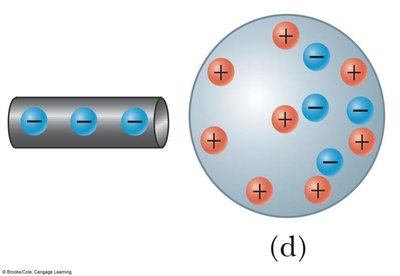
Polarization
Polarization occurs when a charged object induces a separation of charges within an insulator, causing one side to become slightly positive and the other slightly negative. This effect explains why neutral objects can be attracted to charged objects.
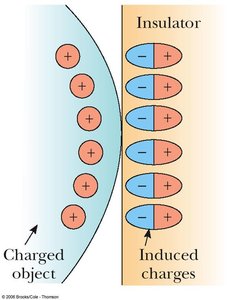

Coulomb's Law and the Nature of Electric Forces
Vector Nature of Electric Forces
Electric forces between two point charges act along the line joining the charges. Like charges repel, while unlike charges attract. The forces are equal in magnitude and opposite in direction, consistent with Newton's Third Law.
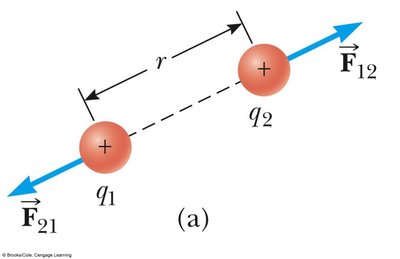
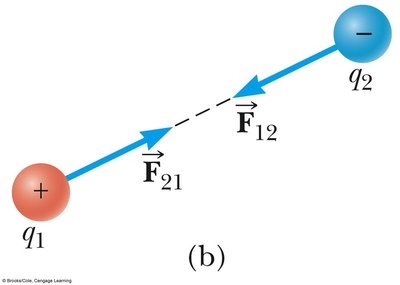
Coulomb's Law
Coulomb's Law quantifies the electric force between two point charges:
ke is the Coulomb constant:
F is the magnitude of the force, q1 and q2 are the charges, and r is the separation distance.
Force is a vector quantity and must be added as such when multiple charges are present.
Comparison with Gravitational Force
Both electric and gravitational forces follow an inverse-square law.
Electric forces can be attractive or repulsive; gravitational forces are always attractive.
Electrostatic forces are much stronger than gravitational forces for elementary particles.
Superposition Principle
The net force on a charge due to a group of other charges is the vector sum of the individual forces exerted by each charge. This principle is essential for analyzing systems with multiple charges.
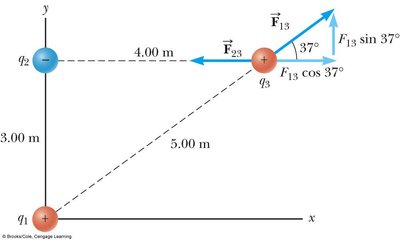
Characteristics of Particles
Particle | Charge (C) | Mass (kg) |
|---|---|---|
Electron | –1.60 × 10⁻¹⁹ | 9.11 × 10⁻³¹ |
Proton | +1.60 × 10⁻¹⁹ | 1.67 × 10⁻²⁷ |
Neutron | 0 | 1.67 × 10⁻²⁷ |
*Additional info: Table summarizes the fundamental properties of subatomic particles relevant to electric forces.* 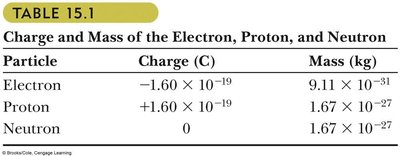
Electric Fields
Definition and Properties
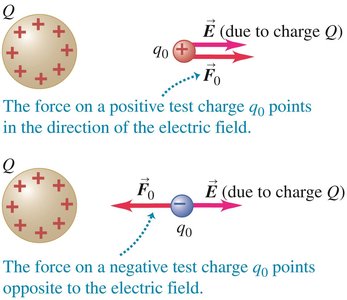
An electric field is a region of space around a charged object where other charges experience a force. The electric field E at a point is defined as the force F experienced by a small positive test charge q0 divided by the magnitude of the test charge:
SI units: Newtons per Coulomb (N/C)
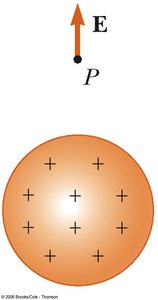
The direction of E is the direction of the force on a positive test charge.
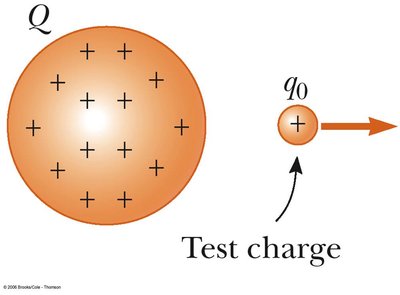
Direction of Electric Field
For a positive source charge, the electric field points away from the charge.
For a negative source charge, the electric field points toward the charge.
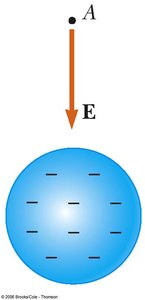
Superposition of Electric Fields
The total electric field at a point due to multiple charges is the vector sum of the fields produced by each charge individually.
Electric Field of a Point Charge
The electric field produced by a point charge Q at a distance r is given by:
The field points radially outward for positive Q and inward for negative Q.
Electric Field Lines
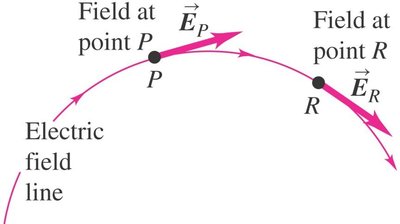
Electric field lines are a visual tool for representing the direction and strength of electric fields. They originate on positive charges and terminate on negative charges. The density of lines indicates the field's strength.
Electric Field Line Patterns
Single Point Charge: Lines radiate equally in all directions (outward for positive, inward for negative).
Electric Dipole: Lines emerge from the positive charge and terminate on the negative charge, with high density between the charges indicating a strong field.
Two Like Charges: Lines bulge outward between the charges, indicating repulsion and a weak field in the region between them.
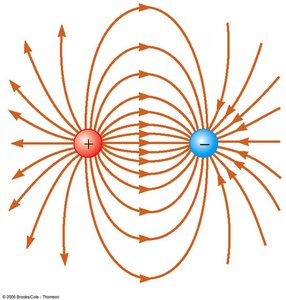
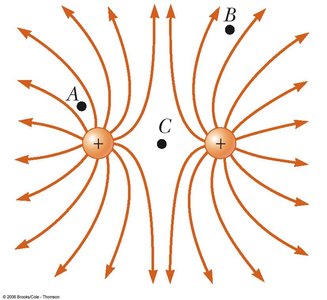 *Additional info: Electric field lines never cross, and the tangent to a field line at any point gives the direction of the electric field at that point.*
