Back
BackElectric Potential and Capacitance: Concepts, Formulas, and Applications
Study Guide - Smart Notes
 Tailored notes based on your materials, expanded with key definitions, examples, and context.
Electric Potential
Definition and Relationship to Potential Energy
The electric potential at a point in space is defined as the electric potential energy per unit charge at that point. It is a scalar quantity and is related to the work done by the electric field in moving a charge from one point to another.
Formula:
Unit: Volt (V), where
Source Charge: Only the source charge creates the electric potential in the surrounding space.
Electric Potential of a Point Charge
The electric potential due to a point charge at a distance is given by:
This formula applies to the region outside the charge distribution.
Electric Potential of a Charged Sphere
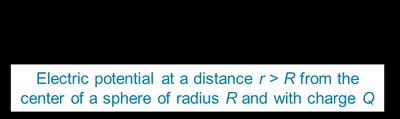
The electric potential outside a uniformly charged sphere (radius , charge ) is identical to that of a point charge:
For ,
At the surface ():
The potential decreases inversely with distance from the center.
Electric Potential Due to Multiple Charges
When several point charges are present, the total electric potential at a point is the algebraic sum of the potentials due to each charge:
is the distance from charge to the point of interest.
Connecting Electric Potential and Electric Field
Equipotential Surfaces and Field Lines
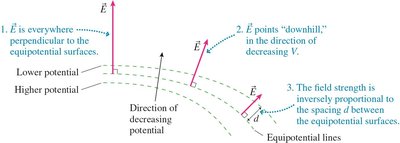
Equipotential surfaces are surfaces where the electric potential is constant. The electric field is always perpendicular to these surfaces and points in the direction of decreasing potential.
Key Properties:
is perpendicular to equipotential surfaces.
points "downhill," in the direction of decreasing .
The field strength is inversely proportional to the spacing between equipotentials.
Examples of Field and Equipotential Arrangements
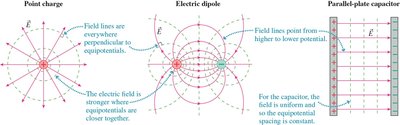
Different charge configurations produce characteristic patterns of electric field lines and equipotentials:
Point Charge: Field lines radiate outward (or inward), equipotentials are concentric spheres.
Electric Dipole: Field lines emerge from positive and terminate on negative, equipotentials are more complex.
Parallel-Plate Capacitor: Field is uniform between plates, equipotentials are evenly spaced planes.
Capacitance and Capacitors
Definition and Properties
A capacitor consists of two conductors (plates) separated by an insulator. It stores electric charge and energy.
Capacitance (): The ratio of charge on one plate to the potential difference between plates:
Unit: Farad (F), where
Capacitance depends on the geometry and separation of the plates.
Charging a Capacitor
When a capacitor is connected to a battery, charge flows until the potential difference across the capacitor equals the battery voltage.
Charge flows from one plate, through the battery, to the other plate.
The battery acts as a "charge pump."
Once , the capacitor is fully charged.
If the battery is removed, the capacitor retains its charge and voltage.
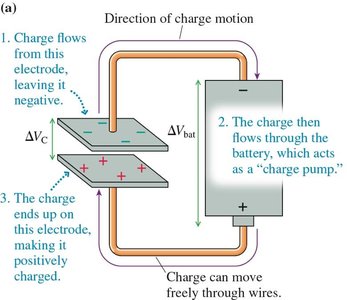
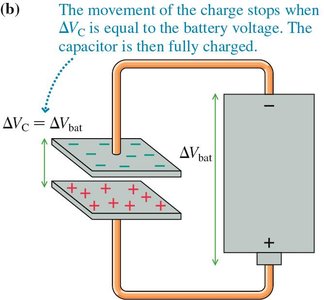
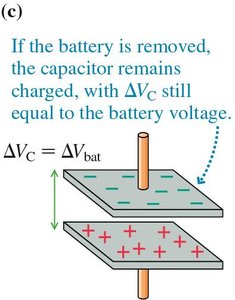
Parallel-Plate Capacitor
A common capacitor consists of two parallel plates of area separated by distance :
Capacitance:
Potential difference:
Electric field between plates:
Potential at distance from the negative plate:
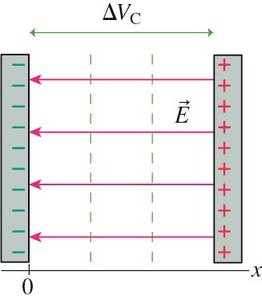
Units and Energy
Electric potential:
Electric field:
Energy: (energy gained by an electron moving through 1 V)
Energy Stored in a Capacitor
The energy stored in a capacitor is given by:
This energy is stored in the electric field between the plates.
Energy density in the field: (with dielectric constant )
Dielectrics
Inserting a dielectric material between the plates increases the capacitance by a factor (dielectric constant):
New capacitance:
The dielectric reduces the effective electric field inside the capacitor.
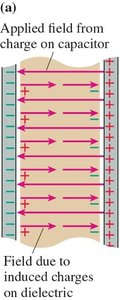
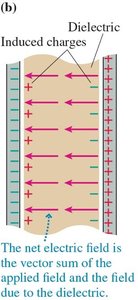
Applications and Examples
Example: Proton in a Capacitor
A proton is shot into a parallel-plate capacitor with a known initial speed. The maximum distance it travels before stopping can be found using energy conservation and the relationship between electric potential and kinetic energy.
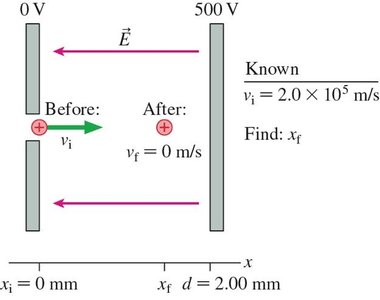
Example: Energy in a Parallel-Plate Capacitor
Given a parallel-plate capacitor with area , separation , and charged to :
Charge stored:
Energy stored:
Summary Table: Capacitance and Related Quantities
Quantity | Symbol | Formula | Unit |
|---|---|---|---|
Capacitance (parallel plates) | C | F (farad) | |
Potential difference | V (volt) | ||
Energy stored | U | J (joule) | |
Charge stored | Q | C (coulomb) | |
Energy density | u | J/m3 |
Additional info:
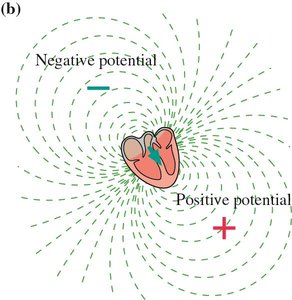
Electrocardiogram (ECG) is an application of electric potential in biology, where the heart's electrical activity creates potential differences measurable on the body surface.