 Back
BackLec 5
Study Guide - Smart Notes
 Tailored notes based on your materials, expanded with key definitions, examples, and context.
Electric Potential and the Parallel Plate Capacitor
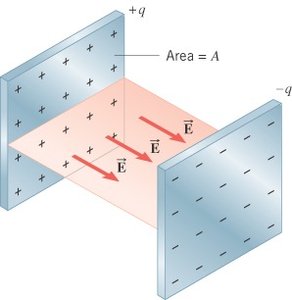
The Electric Field in a Parallel Plate Capacitor
The parallel plate capacitor consists of two large, flat, conducting plates separated by a small distance. When a voltage is applied, one plate accumulates positive charge (+q) and the other negative charge (−q), creating a uniform electric field E between the plates (except near the edges).
Surface charge density is defined as , where is the charge and is the plate area.
The electric field between the plates is , where is the permittivity of free space ().
The field is uniform as long as you stay away from the edges of the plates.
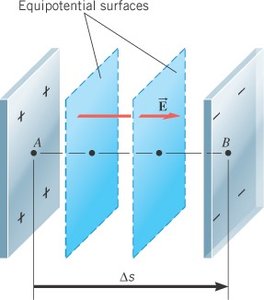
Equipotential Surfaces and Their Relation to the Electric Field
Equipotential surfaces are regions where the electric potential is constant. In a parallel plate capacitor, these surfaces are parallel to the plates and perpendicular to the electric field lines.
The relationship between electric field and potential difference is , where is the potential difference and is the separation between surfaces.
For a parallel plate capacitor, and , where is the distance between the plates.
Capacitors and Dielectrics
Introduction to Dielectrics
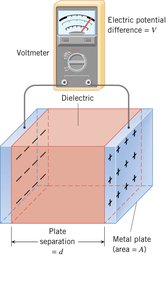
A dielectric is an electrically insulating material placed between the plates of a capacitor. Dielectrics increase the capacitor's ability to store charge and allow the plates to be placed closer together without electrical breakdown.
Dielectrics reduce the risk of breakdown (sparking) compared to air.
They increase the capacitance by a factor called the dielectric constant ().
The Relation Between Charge and Potential Difference for a Capacitor
The charge stored on a capacitor is directly proportional to the potential difference across its plates:
, where is the capacitance in farads (F).
The larger the capacitance, the more charge can be stored for a given voltage.
SI unit of capacitance: 1 farad (F) = 1 coulomb/volt.
The Dielectric Constant
The dielectric constant () is a measure of a material's ability to increase the capacitance of a capacitor compared to a vacuum. When a dielectric is inserted, the capacitance increases by a factor of :
, where is the capacitance without the dielectric.
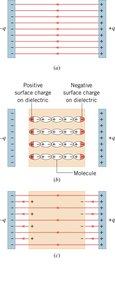
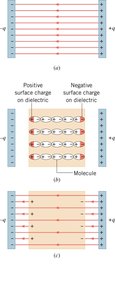
The electric field inside the dielectric is reduced: .
Since , for all materials.
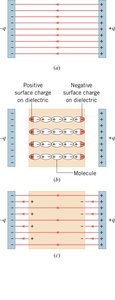
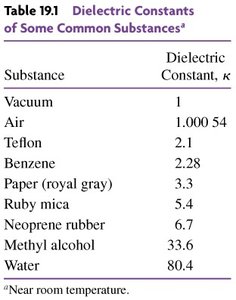
Table: Dielectric Constants of Some Common Substances
Substance | Dielectric Constant, |
|---|---|
Vacuum | 1 |
Air | 1.00054 |
Teflon | 2.1 |
Benzene | 2.28 |
Paper (royal gray) | 3.3 |
Ruby mica | 5.4 |
Neoprene rubber | 6.7 |
Methyl alcohol | 33.6 |
Water | 80.4 |
The Capacitance of a Parallel Plate Capacitor
The capacitance of a parallel plate capacitor depends on the area of the plates, the distance between them, and the dielectric material:
Without dielectric:
With dielectric:
Capacitance increases with increasing and , and decreases with increasing .
Where is the plate area, is the separation, is the permittivity of free space, and is the dielectric constant.
Dielectric Breakdown
If the electric field in a capacitor exceeds a certain value, the dielectric material may become conductive, leading to breakdown. The dielectric strength is the maximum electric field a dielectric can withstand without breaking down.
Example: Mica has a dielectric strength of V/m, while air has V/m.
Applications: Capacitance in Computer Keyboards
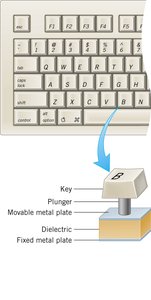
Capacitive keyboards use the principle of changing capacitance to detect key presses. Each key is associated with a movable plate and a fixed plate, forming a capacitor. Pressing the key changes the separation and thus the capacitance, which is detected electronically.
Effects of Dielectrics: Constant Charge vs. Constant Voltage
Constant Charge (Battery Disconnected)
If a dielectric is inserted after the capacitor is charged and disconnected from the battery, the charge remains constant but the voltage decreases:
Before:
After: ,
Result: (voltage decreases for )
Constant Voltage (Battery Connected)
If the capacitor remains connected to the battery while the dielectric is inserted, the voltage stays the same but the charge increases:
Before:
After:
Result: increases by a factor of
Energy Storage in a Capacitor
Formulas for Energy Stored
The energy stored in a capacitor can be expressed in several equivalent forms:
For a parallel plate capacitor: ,
Energy density (energy per unit volume):
Example: A 10 F capacitor with 3 V across it stores J of energy.
Energy Density in the Electric Field
The energy stored in the electric field can be calculated for any region, such as around a point charge:
For a point charge:
Energy density:
Example: At 2.0 cm from a C charge, J/m3
To find the total energy in a shell of radius and thickness , multiply the energy density by the shell's volume: .
