 Back
BackElectric Potential and Capacitance: Study Notes
Study Guide - Smart Notes
 Tailored notes based on your materials, expanded with key definitions, examples, and context.
Electric Potential and Electric Field
Key Quantities in Electrostatics
Electrostatics involves several fundamental quantities that describe the behavior of charges and fields:
Electric Field (\(\vec{E}\)): The force per unit charge exerted on a test charge at a point in space.
Electric Force (\(\vec{F}_{\text{elect}}\)): The force between two point charges, given by Coulomb's Law.
Electric Potential (\(V\)): The electric potential energy per unit charge at a point in space.
Electric Potential Energy (\(U_{\text{elect}}\)): The energy a charge has due to its position in an electric field.
Key equations:
\(\vec{E} = \frac{kq}{r^2}\)
\(\vec{F}_{\text{elect}} = \frac{kq_1q_2}{r^2}\)
\(\vec{F}_{\text{elect}} = q\vec{E}\)
\(V = \frac{kq}{r}\)
\(U_{\text{elect}} = \frac{kq_1q_2}{r}\)
\(U_{\text{elect}} = qV\)
Relationship Between Electric Field and Potential
The electric field and electric potential are closely related. The potential difference between two points is the negative of the work done by the electric field per unit charge:
\(\Delta U_{AB} = -W_{AB} = -\int_A^B \vec{F}_{\text{elect}} \cdot d\vec{s}\)
\(\Delta U_{AB} = -\int_A^B q\vec{E} \cdot d\vec{s}\)
\(\Delta V = -\int_A^B \vec{E} \cdot d\vec{s}\)
The electric field is the negative gradient (slope) of the electric potential:
\(\vec{E} = -\nabla V\)
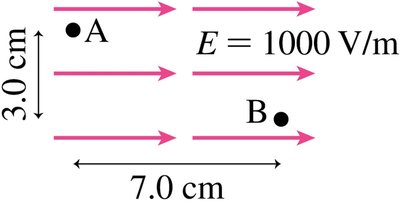
Example: For a uniform electric field \(E = 1000\ \text{V/m}\), the potential difference between two points separated by distance \(d\) is \(\Delta V = -E d\).
Equipotential Surfaces and Field Lines
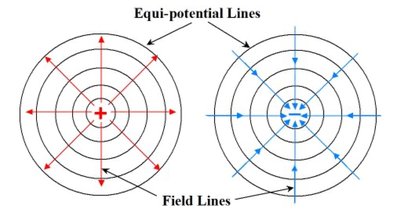
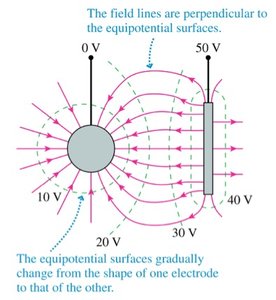
Equipotential surfaces are surfaces where the electric potential is constant. Electric field lines are always perpendicular to equipotential surfaces and point in the direction of decreasing potential.
The closer the equipotentials, the stronger the electric field.
In three dimensions, the electric field is the negative gradient of the potential.
Electric Potential in Circuits
Kirchhoff’s Voltage Loop Law
Kirchhoff’s Voltage Law states that the sum of the potential differences around any closed loop in a circuit is zero:
\(\sum \Delta V = 0\)
The potential difference between two points is independent of the path taken.
Batteries as Sources of Electric Potential
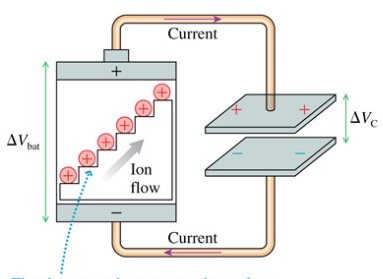
A battery provides a constant potential difference (emf) between its terminals, which drives current through a circuit. The work done per unit charge by the battery is equal to its emf:
\(\Delta V_{\text{bat}} = \text{emf}\)
\(W_{\text{chem}} = \Delta U = q\Delta V_{\text{bat}}\)
Capacitance and Capacitors
Capacitors and Capacitance
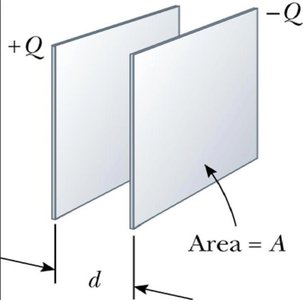
A capacitor consists of two conductors separated by an insulator. It stores electric charge and energy. The capacitance \(C\) is defined as the ratio of the charge \(Q\) on one plate to the potential difference \(\Delta V\) between the plates:
\(C = \frac{Q}{\Delta V}\)
SI unit: Farad (F) = 1 Coulomb/Volt
For a parallel-plate capacitor: \(C = \varepsilon_0 \frac{A}{d}\)
Dielectrics and Capacitance
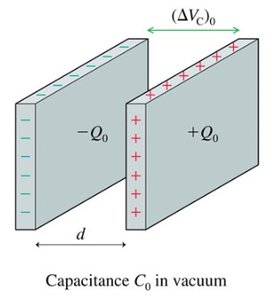
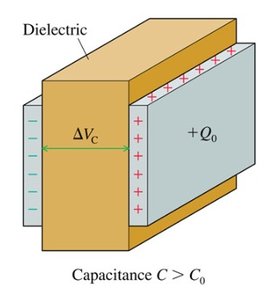
Inserting a dielectric (an insulating material) between the plates of a capacitor increases its capacitance by a factor \(\kappa\) (dielectric constant):
\(C = \kappa C_0\), where \(C_0\) is the capacitance without the dielectric.
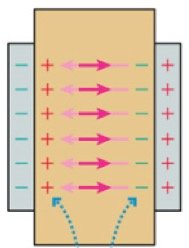
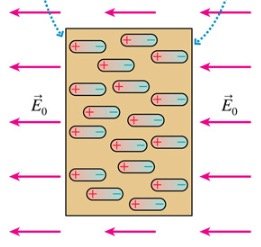
The dielectric reduces the electric field inside the capacitor, allowing it to store more charge for the same voltage.
Dielectric Properties
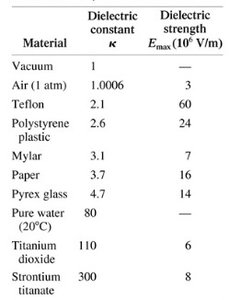
Material | Dielectric constant \(\kappa\) | Dielectric strength \(E_{\text{max}}\) (106 V/m) |
|---|---|---|
Vacuum | 1 | — |
Air (1 atm) | 1.0006 | 3 |
Teflon | 2.1 | 60 |
Polystyrene plastic | 2.6 | 24 |
Mylar | 3.1 | 7 |
Paper | 3.7 | 16 |
Pyrex glass | 4.7 | 14 |
Pure water (20°C) | 80 | — |
Titanium dioxide | 110 | 6 |
Strontium titanate | 300 | 8 |
Polarization and Dielectric Breakdown
When a dielectric is placed in an electric field, its molecules become polarized, creating an induced field that opposes the applied field. If the field exceeds the dielectric strength, the material breaks down and becomes conductive (dielectric breakdown).
Lightning: Dielectric Breakdown of Air
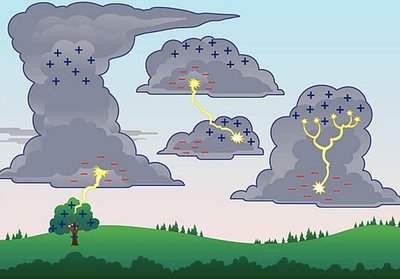
Lightning is a natural example of dielectric breakdown. When the electric field between clouds and the ground exceeds the dielectric strength of air, the air becomes conductive, allowing a massive flow of charge (lightning).
Combining Capacitors
Capacitors in Parallel
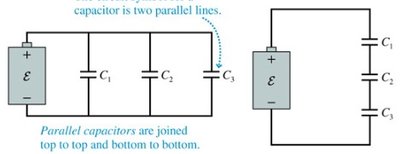
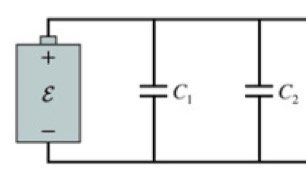
When capacitors are connected in parallel, the total (equivalent) capacitance is the sum of the individual capacitances:
\(C_{\text{eq}} = C_1 + C_2 + C_3 + \ldots\)
All capacitors have the same potential difference across them.
Capacitors in Series
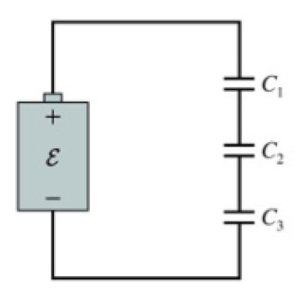
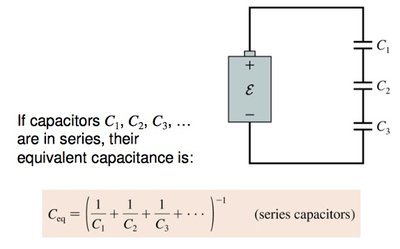
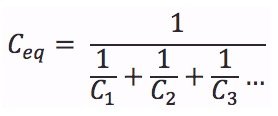
When capacitors are connected in series, the reciprocal of the total capacitance is the sum of the reciprocals of the individual capacitances:
\(\frac{1}{C_{\text{eq}}} = \frac{1}{C_1} + \frac{1}{C_2} + \frac{1}{C_3} + \ldots\)
All capacitors have the same charge.
Energy Stored in a Capacitor
Work and Energy in Charging a Capacitor
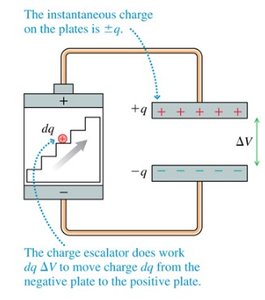
To charge a capacitor, work must be done to move charge against the electric field. The energy stored in a capacitor is given by:
\(U = \frac{1}{2} C (\Delta V)^2\)
This energy is stored in the electric field between the plates.
Applications of Capacitors
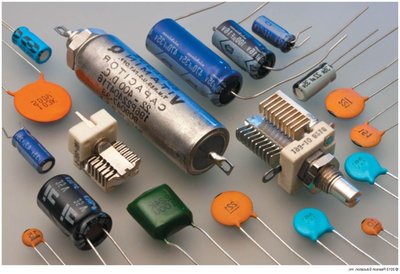
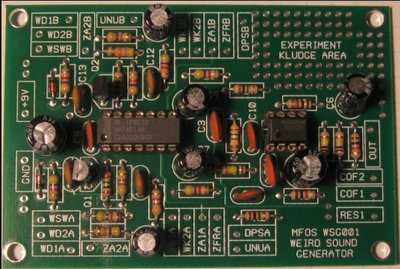
Capacitors are widely used in electronic devices for energy storage, filtering, and timing applications. Examples include camera flashes, radios, computers, and defibrillators.
Summary Table: Capacitance Formulas
Configuration | Formula |
|---|---|
Parallel | \(C_{\text{eq}} = C_1 + C_2 + C_3 + \ldots\) |
Series | \(\frac{1}{C_{\text{eq}}} = \frac{1}{C_1} + \frac{1}{C_2} + \frac{1}{C_3} + \ldots\) |
Additional info: These notes expand on the provided slides by including definitions, formulas, and practical examples for clarity and completeness.
