 Back
BackElectric Potential and Capacitance: Study Notes
Study Guide - Smart Notes
 Tailored notes based on your materials, expanded with key definitions, examples, and context.
Electric Potential
Electric Potential of Point Charges
The electric potential at a point in space due to a point charge is a measure of the potential energy per unit charge at that location. It is a scalar quantity and is defined as the work done to bring a unit positive charge from infinity to that point in the electric field.
Formula: The electric potential V at a distance r from a point charge q is given by:
Superposition Principle: For multiple point charges, the total potential at a point is the algebraic sum of the potentials due to each charge:
Potential Energy: The electric potential energy U of a charge q' at a point with potential V is:
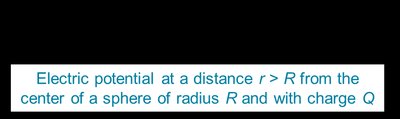
Electric Potential of a Charged Sphere
The electric potential outside a uniformly charged sphere is identical to that of a point charge located at the center of the sphere. This is a direct result of Gauss's law.
Outside the Sphere (r > R):
At the Surface (r = R):
Charge-Voltage Relationship: For a sphere of radius R charged to potential V0:
Potential Decreases with Distance: The potential decreases inversely with distance from the center.
Electric Potential of Many Charges
When multiple charges are present, the electric potential at a point is the sum of the potentials due to each charge, reflecting the principle of superposition.
Formula:
Distance ri: The distance from each charge qi to the point where the potential is being calculated.

Connecting Electric Potential and Electric Field
Relationship Between Electric Field and Potential
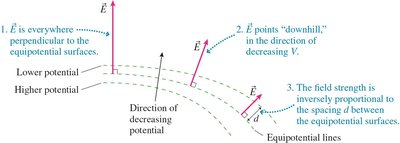
The electric field is related to the spatial rate of change of the electric potential. The field points in the direction of decreasing potential and is always perpendicular to equipotential surfaces.
Mathematical Relationship:
Equipotential Surfaces: Surfaces where the potential is constant. The electric field is perpendicular to these surfaces.
Field Strength: The field strength is inversely proportional to the spacing between equipotential surfaces; closer spacing means a stronger field.
Examples of Field and Potential Arrangements
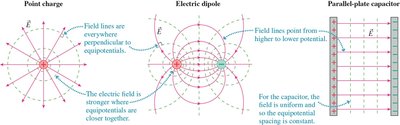
Different charge configurations produce characteristic patterns of electric field lines and equipotential surfaces.
Point Charge: Field lines radiate outward (or inward for negative charge), and equipotentials are concentric spheres.
Electric Dipole: Field lines emerge from the positive charge and terminate at the negative charge; equipotentials are more complex.
Parallel-Plate Capacitor: Field lines are uniform and parallel between plates; equipotentials are evenly spaced planes.
Capacitance and Capacitors
Definition and Properties of Capacitors
A capacitor consists of two conductors (plates) separated by an insulator. It stores electric charge and energy, and is widely used in electronic circuits.
Capacitance (C): The ability of a capacitor to store charge per unit potential difference. Defined as:
SI Unit: Farad (F), where .
Dependence: Capacitance depends on the geometry (shape, size, spacing) of the electrodes and the material between them.
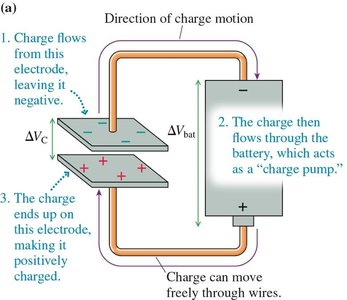
Charging a Capacitor
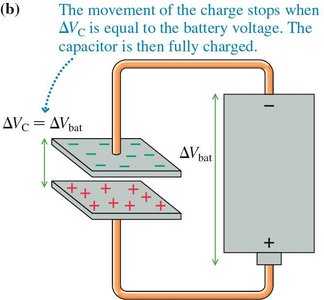
To charge a capacitor, a potential difference is applied across its plates, causing charge to accumulate on each plate. The process continues until the voltage across the capacitor equals the applied voltage.
Process: Charge flows from one plate to the other via a battery, which acts as a charge pump.
Final State: When the voltage across the capacitor equals the battery voltage, current stops and the capacitor is fully charged.
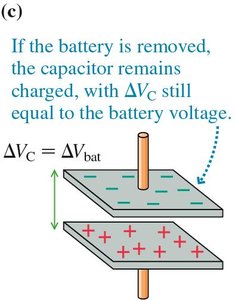
After Battery Removal: The capacitor remains charged, maintaining the same potential difference.
Parallel-Plate Capacitor
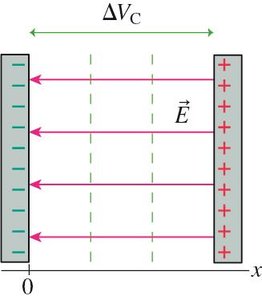
The parallel-plate capacitor is a common configuration, consisting of two large plates of area A separated by a distance d.
Capacitance Formula:
Electric Field:
Potential at Distance x:
Units and Energy
Electric Potential: 1 V = 1 J/C
Electric Field: 1 V/m = 1 N/C
Energy: 1 electron volt (eV) = J
Example: Proton in a Capacitor
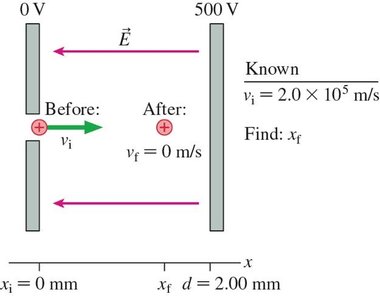
When a charged particle moves in the electric field between capacitor plates, its motion can be analyzed using energy conservation and the relationship between electric field and potential difference.
Given: Parallel-plate capacitor, plate separation d, potential difference , initial speed of proton.
Find: Maximum distance from the negative plate reached by the proton.
Dielectrics and Energy Storage
Dielectrics in Capacitors
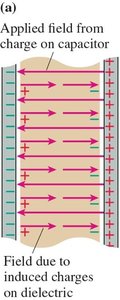
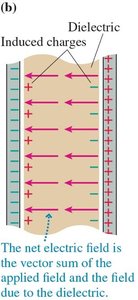
Inserting a dielectric (an insulating material) between the plates of a capacitor increases its capacitance by a factor k, the dielectric constant. The dielectric reduces the effective electric field within the capacitor.
Capacitance with Dielectric:
Energy Stored:
Energy Density:
Energy in Capacitors: Example Calculation
For an air-filled parallel-plate capacitor with plate area A, separation d, and charged to potential difference :
Charge Stored:
Energy Stored:
Permittivity of Free Space:
Electric Potential Energy of Systems of Charges
Potential Energy of Two Point Charges
The electric potential energy of a system of two point charges is given by:
Potential Energy of Multiple Charges
For a collection of more than two point charges, the total electric potential energy is the sum over all unique pairs:
$U_{elec} = \sum_{i
Example: Four charges at the corners of a square: calculate the potential energy by summing over all pairs, considering their distances.
