 Back
BackElectric Potential and Electric Potential Energy: Concepts, Applications, and Biological Relevance
Study Guide - Smart Notes
 Tailored notes based on your materials, expanded with key definitions, examples, and context.
Electric Potential and Electric Potential Energy
Introduction to Electric Potential
Electric potential and electric potential energy are central concepts in understanding how charges interact and how energy is stored and transferred in physical and biological systems. These concepts are widely applicable, from the operation of batteries and capacitors to the transmission of nerve impulses and the functioning of the heart.
Electric Potential Energy
Definition and Conservation of Energy
Electric potential energy (Uelec) is the energy a charge has due to its position in an electric field, analogous to gravitational potential energy.
For a system of charges, the total mechanical energy is conserved in the absence of external forces and dissipation:
Potential energy changes when work is done by or against electric forces:
Gravitational Analogy
Just as gravity does work on a mass, an electric field does work on a charge.
Gravitational potential energy near Earth's surface:
Electric potential energy in a uniform electric field:
Potential Energy of Two Point Charges
The potential energy of two point charges separated by distance r:
Positive for like charges (repulsive), negative for opposite charges (attractive).
Potential energy is zero only when charges are infinitely far apart.
Potential Energy of a Dipole
An electric dipole in a uniform electric field has potential energy:
Minimum energy when aligned with the field; maximum when anti-aligned.
Electric Potential (V)
Definition and Properties
Electric potential (V) at a point is the potential energy per unit charge:
Measured in volts (V), where 1 V = 1 J/C.
Electric potential is a property of the source charges and exists whether or not a test charge is present.
Relationship to Potential Energy
The potential energy of a charge q at potential V:
Electric Potential of Common Configurations
Point charge:
Uniformly charged sphere (outside):
Parallel-plate capacitor: Potential difference across plates:
Superposition Principle
The total electric potential at a point due to multiple charges is the algebraic sum of the potentials from each charge:
Visualizing Electric Potential
Equipotential Surfaces and Contour Maps
Equipotential surfaces are regions where the electric potential is constant.
The electric field is always perpendicular to equipotential surfaces and points in the direction of decreasing potential.
Closer equipotential lines indicate a stronger electric field.
Connecting Electric Field and Potential
The electric field is the negative gradient (rate of change) of the electric potential:
In three dimensions:
Sources of Electric Potential
Charge Separation
Potential differences are created by separating positive and negative charges (e.g., batteries, generators, biological membranes).
Batteries and EMF
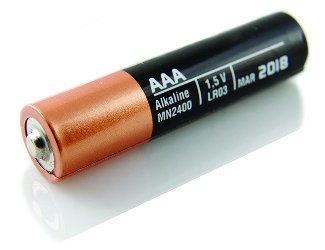
Batteries use chemical reactions to separate charge, creating a potential difference (emf) between terminals.
Emf (electromotive force) is the work done per unit charge:
Biological Applications
Membrane Potential
Cell membranes maintain a potential difference (membrane potential) due to ion pumps and selective permeability.
Typical membrane potentials range from -40 mV to -90 mV.
Electrocardiogram (ECG/EKG)
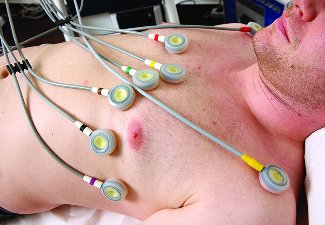
The heart generates an electric dipole moment as it beats, creating potential differences measurable on the body surface.
Electrodes placed on the skin record these potential differences, producing an ECG that reflects the heart's electrical activity.

Electric Senses in Animals
Some aquatic animals, such as sharks and rays, can detect extremely weak electric fields produced by the muscle and nerve activity of prey.

Applications and Examples
Solar Panels and Wind Turbines
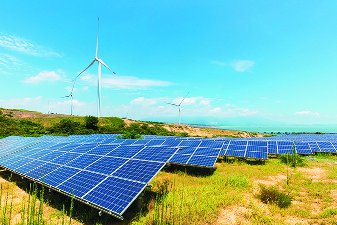
These devices generate electric potential differences (voltages) by converting solar and wind energy into electrical energy.
Electric Eel
Electric eels can generate large potential differences (up to 600 V) for predation and defense.

Plasma Ball
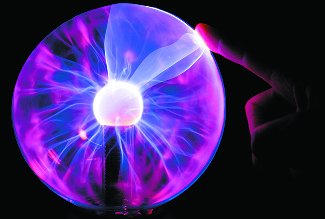
A plasma ball demonstrates electric potential and electric field breakdown in gases, creating visible plasma filaments.
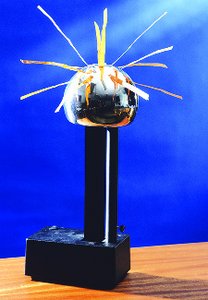
Van de Graaff Generator
This device mechanically separates charge to create very high electric potentials, often used in demonstrations and particle accelerators.
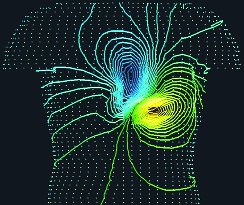
Visualizing Cardiac Electric Fields
Computer models and imaging can show the distribution of electric potential and field lines on the body surface during a heartbeat.
Summary Table: Electric Potential vs. Electric Potential Energy
Quantity | Definition | Units |
|---|---|---|
Electric Potential (V) | Potential energy per unit charge | Volt (V) = J/C |
Electric Potential Energy (Uelec) | Energy of a charge in an electric field | Joule (J) |
Key Equations
Conclusion
Understanding electric potential and electric potential energy is essential for analyzing physical, chemical, and biological systems. These concepts explain how energy is stored, transferred, and detected in both technological devices and living organisms.
