 Back
BackElectric Potential and Electric Potential Energy: Concepts, Calculations, and Applications
Study Guide - Smart Notes
 Tailored notes based on your materials, expanded with key definitions, examples, and context.
Electric Potential Energy
Definition and Fundamental Concepts
Electric potential energy is the energy stored in a system of charged particles due to their positions relative to each other. It is a form of potential energy associated with the configuration of charges in an electric field.
Change in Potential Energy: The change in potential energy, \( \Delta U = U_f - U_i \), is equal to the negative of the work performed by the conservative force (here, the electric force):
External Work: If an external force moves an object against the conservative force and the kinetic energy remains constant:
Reference Point: Potential energy is defined with respect to a reference point, which can be chosen arbitrarily (often taken as zero at infinity).
“Available energy is the main object at stake in the struggle for existence and the evolution of the world.” — Ludwig Boltzmann
Example: Setting gravitational potential energy to zero when a box rests on a table is a common reference choice.

Electric Potential Energy of Two Point Charges
The electric potential energy of a system of two point charges \( q_1 \) and \( q_2 \), separated by a distance \( r_{12} \), is given by:
This formula assumes the potential energy is zero when the charges are infinitely far apart.
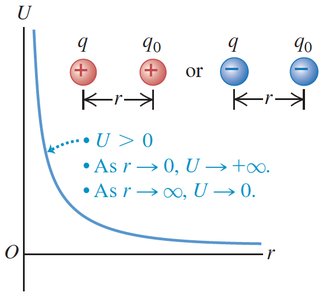
Significance of the Sign
Positive U: Like charges (both positive or both negative) have positive potential energy; they repel each other.
Negative U: Opposite charges have negative potential energy; they attract each other.

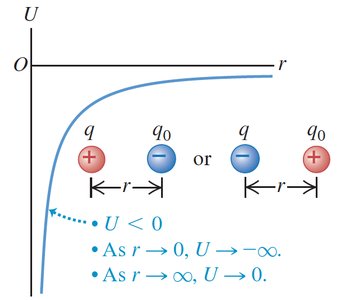
Examples
Two Protons: For two protons separated by \( d = 2 \times 10^{-15} \) m: J (positive sign indicates repulsion)
Hydrogen Atom: For an electron and proton separated by \( d = 5.29 \times 10^{-11} \) m: J (negative sign indicates attraction)
Comparison with Gravitational Potential Energy
Gravitational potential energy for an object of mass \( m \) in a gravitational field is:
Gravitational force:

Conservation of Energy
When released, potential energy converts to kinetic energy, but the total mechanical energy is conserved:

Work-Energy Theorem
For conservative forces:
Electric Potential
Definition and Key Properties
Electric potential (V) is the electric potential energy per unit charge at a point in an electric field. It is a scalar quantity and is independent of the test charge used to measure it.
Unit: volt (V), where
Potential difference (\( \Delta V \)) is the work done per unit charge to move a charge between two points.
Electric Potential Due to a Point Charge
For multiple charges, potentials add algebraically.
Relationship Between Potential and Field
The electric field is related to the spatial rate of change of the potential:
Work and Potential Energy
When a charge \( q \) moves through a potential difference \( \Delta V \):
Key Points
Electric potential and electric potential energy are related but distinct.
Only changes in potential and potential energy are physically meaningful.
The reference point for zero potential is usually taken at infinity.
Conceptual Examples
Proton in an Electric Field: A proton accelerates from high to low potential, converting potential energy to kinetic energy.
Electron in an Electric Field: An electron accelerates toward higher potential, also converting potential energy to kinetic energy.
Electric Potential and Potential Energy in Systems of Charges
Systems of Point Charges
The total electric potential energy of a system is the sum over all unique pairs:
$U = \frac{1}{4\pi\varepsilon_0} \sum_{i
The electric potential at a point due to a collection of charges is:
Example: Three Charges
To assemble three charges, bring each in from infinity, summing the work done for each pair.
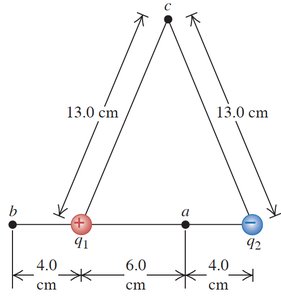
Potential Due to Charge Distributions
For a continuous charge distribution:
Examples
Finite Line of Charge: The potential at a point P due to a uniformly charged rod is found by integrating over the rod.
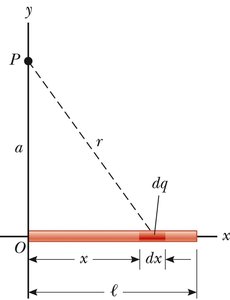
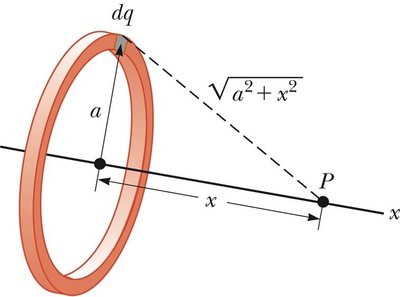
Ring of Charge: The potential at a point on the axis of a uniformly charged ring is:
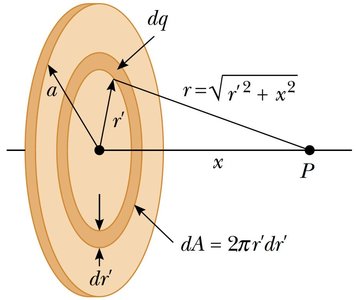
Uniformly Charged Disk: The disk is treated as a series of rings; integrate to find the potential at a point on the axis.
Electron Volt (eV)
Definition and Use
1 electron volt (eV) is the energy gained by an electron moving through a potential difference of 1 volt:
Commonly used in atomic and nuclear physics.
Equipotentials
Equipotential Surfaces and Field Lines
Equipotentials are surfaces where the electric potential is constant.
Electric field lines are always perpendicular to equipotential surfaces.
On a conductor in electrostatic equilibrium, the surface is an equipotential.
Summary Table: Key Equations and Concepts
Concept | Equation |
|---|---|
Potential energy change | |
Potential energy (two charges) | |
Electric potential (point charge) | |
Potential difference | |
Work-energy theorem | |
Electron volt |
Additional info:
All equations use SI units unless otherwise specified.
For more complex charge distributions, integration is required to find the potential at a point.
