 Back
BackElectric Potential and Equipotential Lines – Step-by-Step Physics Guidance
Study Guide - Smart Notes
 Tailored notes based on your materials, expanded with key definitions, examples, and context.
Q1. Rank the electric potentials V1, V2, and V3 at the three points in the vicinity of two point charges (one positive, one negative) as shown in the figure. (Case b)
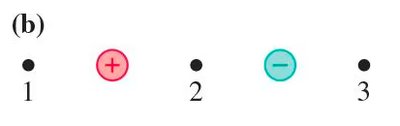
Background
Topic: Electric Potential due to Point Charges
This question tests your understanding of how to calculate and compare the electric potential at different points near multiple point charges. The electric potential is a scalar quantity and can be positive or negative depending on the sign of the source charges.
Key Terms and Formulas
Electric Potential due to a Point Charge:
Superposition Principle: The total potential at a point is the algebraic sum of the potentials due to each charge.
is Coulomb's constant ( N·m2/C2), is the charge, is the distance from the charge to the point.
Step-by-Step Guidance
Identify the sign and relative positions of the charges and the points. In this case, you have a positive charge and a negative charge, with three points (1, 2, 3) arranged in a line.
For each point, determine its distance from each charge. Assume the distances are equal or as labeled in the figure.
Write the expression for the electric potential at each point using the superposition principle: , where is the potential due to the positive charge and is due to the negative charge.
For point 1 (left of the positive charge), point 2 (between the charges), and point 3 (right of the negative charge), consider the sign of each contribution. Remember, the potential from a positive charge is positive, and from a negative charge is negative.
Set up the algebraic sum for each point, but do not compute the final values yet. Compare the expressions to determine the ranking.
Try solving on your own before revealing the answer!
Final Answer:
At point 1, you are closer to the positive charge and farther from the negative, so the potential is highest. At point 2, the potentials from both charges partially cancel. At point 3, you are closer to the negative charge, so the potential is lowest.
