 Back
BackElectric Potential and Field Study Guide (Chapter 21)
Study Guide - Smart Notes
 Tailored notes based on your materials, expanded with key definitions, examples, and context.
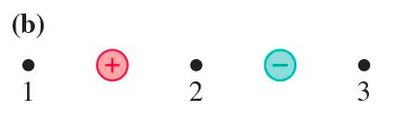
Q21.11. Rank the potentials V1, V2, and V3 at three points near two point charges of equal magnitude (case b).
Background
Topic: Electric Potential due to Point Charges
This question tests your understanding of how electric potential is determined at various points in the vicinity of multiple point charges, considering both the sign and distance from each charge.
Key Terms and Formulas
Electric potential () at a point due to a point charge:
= Coulomb's constant ( N·m²/C²)
= charge magnitude
= distance from the charge to the point
Electric potential is a scalar quantity and can be positive or negative depending on the sign of the charge.
Step-by-Step Guidance
Identify the positions of the charges and the points (1, 2, 3) relative to them. Note that the positive and negative charges are equal in magnitude.
Recall that the electric potential at each point is the sum of the potentials due to both charges: .
For each point, determine the distance to each charge and use for each charge, remembering to use for the positive charge and for the negative charge.
Add the contributions from both charges for each point to find the total potential at points 1, 2, and 3.
Try solving on your own before revealing the answer!
Final Answer:
For case (b):
Point 1 is closest to the positive charge, so it has the highest potential. Point 2 is equidistant from both charges, resulting in zero potential. Point 3 is closest to the negative charge, so it has the lowest potential.
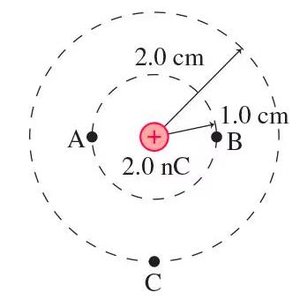
P21.19. What are the potential differences ΔVAB and ΔVBC for points A, B, and C near a point charge?
Background
Topic: Electric Potential due to Point Charge
This question tests your ability to calculate electric potential at different distances from a point charge and find the potential difference between points.
Key Terms and Formulas
Electric potential at distance from a point charge:
Potential difference:
= Coulomb's constant ( N·m²/C²)
= charge ( nC)
= distance from the charge to the point (in meters)
Step-by-Step Guidance
Convert all distances to meters: cm = m, cm = m.
Calculate the potential at point B using .
Calculate the potential at point A using .
Calculate the potential at point C using .
Set up the expressions for and using the calculated potentials.
Try solving on your own before revealing the answer!
Final Answer:
V, V
Points A and B are at the same distance from the charge, so their potentials are equal. Point C is farther away, so its potential is lower.
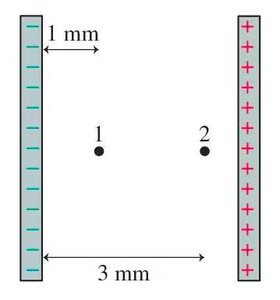
Q21.8. Two points inside a parallel-plate capacitor: What is the ratio V2/V1 and E2/E1?
Background
Topic: Electric Potential and Field in a Parallel-Plate Capacitor
This question tests your understanding of how electric potential and electric field vary between the plates of a capacitor.
Key Terms and Formulas
Electric field between plates:
Potential at distance from the negative plate:
For a uniform field, is constant between the plates.
Step-by-Step Guidance
Identify the distances of points 1 and 2 from the negative plate: mm, mm.
Write the expression for the potential at each point: , .
Set up the ratio .
Since the electric field is constant, .
Try solving on your own before revealing the answer!
Final Answer:
,
The potential at point 2 is three times that at point 1, and the electric field strength is the same at both points.
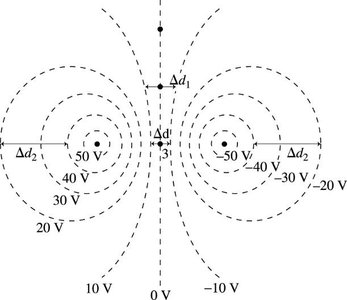
Q21.13. Rank the electric field strengths E1, E2, E3, and E4 at four labeled points based on equipotential lines.
Background
Topic: Electric Field Strength and Equipotential Lines
This question tests your ability to qualitatively compare electric field strengths at different points using the spacing of equipotential lines.
Key Terms and Formulas
Electric field strength:
Smaller (closer lines) means stronger electric field.
Equipotential lines are perpendicular to the electric field.
Step-by-Step Guidance
Identify the potential difference between adjacent equipotential lines at each point.
Measure the distance between the lines at each point.
Use to compare the field strengths qualitatively.
Rank the points based on the spacing: closer lines mean higher .
Try solving on your own before revealing the answer!
Final Answer:
The electric field is strongest where the equipotential lines are closest together.
P21.29. The electric potential at point A is −300 V. What is the potential at point B, 5.0 cm to the right of A, in a field of 1200 V/m at 30°?
Background
Topic: Potential Difference in a Uniform Electric Field
This question tests your ability to calculate the potential difference between two points in a uniform electric field, considering the angle between the displacement and the field direction.
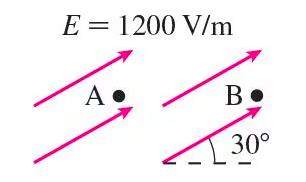
Key Terms and Formulas
Potential difference: (for displacement parallel to field)
For displacement at an angle :
Electric field points from higher to lower potential.
Step-by-Step Guidance
Calculate the shortest distance between equipotential surfaces: .
Convert the distance to meters.
Calculate the potential difference: .
Add the potential difference to the given potential at point A to find the potential at point B.
Try solving on your own before revealing the answer!
Final Answer:
The potential at point B is −352 V.
The field direction and angle are correctly accounted for in the calculation.
