 Back
Backlec 4
Study Guide - Smart Notes
 Tailored notes based on your materials, expanded with key definitions, examples, and context.
Electric Potential
Definition of Electric Potential
The electric potential at a point is defined as the electric potential energy (EPE) per unit charge at that point. It is a scalar quantity and is measured in volts (V), where 1 V = 1 J/C.
Formula:
SI Unit: Joule per Coulomb (J/C) = Volt (V)
Only differences in electric potential (ΔV) are physically meaningful, similar to potential energy.
Analogy: The definition of electric potential is analogous to the definition of the electric field, .
Electric Potential Difference
The electric potential difference (ΔV) between two points is the work done per unit charge by the electric field in moving a test charge between those points.
Formula:
Potential difference is often referred to as "voltage".
Energy Conservation: Electric potential energy is included in the total energy of a system, along with kinetic and other forms of potential energy.
Total Energy:
Electron Volt (eV)
The electron volt (eV) is a convenient unit of energy in atomic and nuclear physics. It is the energy gained by an electron moving through a potential difference of one volt.
Conversion:
Common multiples: keV (103 eV), MeV (106 eV), GeV (109 eV)
Calculating Electric Potential Difference
Work Done by Electric Field
For a uniform electric field, the work done in moving a charge q0 a distance d is:
For a parallel-plate capacitor:
Potential difference:
Example: Parallel-Plate Capacitor
Calculate the potential difference between the plates of a parallel-plate capacitor with charge , area , and separation :
Electric Potential Due to Point Charges
Potential Created by a Point Charge
The electric potential at a distance r from a point charge q is given by:
, where
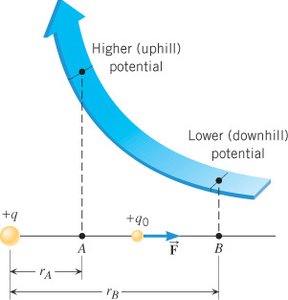
Example: Potential of a Point Charge
Find the potential at a point 1.2 m from a charge of C:
For a positive charge:
For a negative charge:
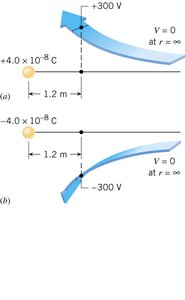
Superposition Principle for Electric Potential
When multiple point charges are present, the total electric potential at a point is the algebraic sum of the potentials due to each charge:
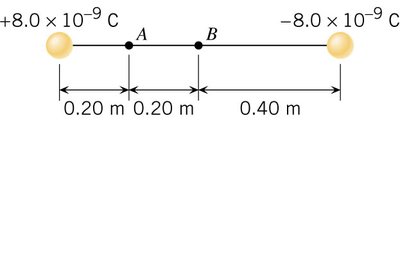
Special Case: Electric Dipole
For two equal and opposite charges separated by a distance d, the potential at the midpoint between them is zero:
Conceptual Example: Where is the Potential Zero?
For two charges, +2q and –q, fixed in place, there are two points along the line joining them where the total potential is zero. This is found by solving:
Equipotential Surfaces and Their Relation to the Electric Field
Definition and Properties
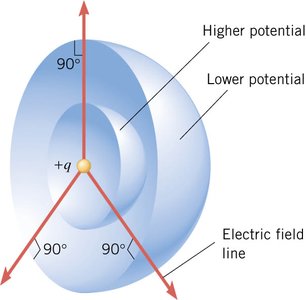
An equipotential surface is a surface on which the electric potential is constant everywhere. The electric field is always perpendicular to equipotential surfaces and points in the direction of decreasing potential.
No work is done by the electric field when moving a charge along an equipotential surface.
In equilibrium, conductors are equipotential surfaces.
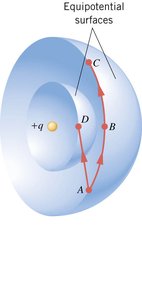
Equipotential Surfaces for Parallel Plates
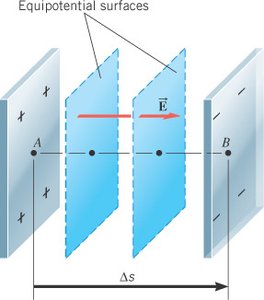
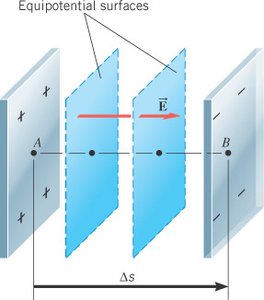
For a parallel-plate capacitor, equipotential surfaces are planes parallel to the plates. The electric field is uniform and perpendicular to these surfaces.
Relationship Between Electric Field and Potential Gradient
The electric field is related to the rate of change of electric potential with distance (potential gradient):
For a parallel-plate capacitor, this simplifies to:
Example: Spacing Between Equipotential Surfaces
Given a potential difference of –3.0 V between two equipotential surfaces and an electric field of V/m, the spacing is:
m
Summary Table: Key Equations and Concepts
Concept | Equation | Notes |
|---|---|---|
Electric Potential | Scalar quantity, units: V (J/C) | |
Potential Difference | Work done per unit charge | |
Point Charge Potential | Reference: at infinity | |
Superposition | Add potentials algebraically | |
Electron Volt | Energy unit (not SI) | |
Potential Gradient | Direction: decreasing V | |
Parallel Plate Capacitor | Uniform field between plates |
