 Back
BackWeek 3 Lec. 2
Study Guide - Smart Notes
 Tailored notes based on your materials, expanded with key definitions, examples, and context.
Electric Potential
Definition and Basic Properties
The electric potential at a point in an electric field is defined as the potential energy per unit charge. It is a scalar quantity and is independent of the test charge used to measure it. The electric potential, V, at a point is given by:
Formula: , where U is the potential energy and q_0 is the test charge.
Potential Difference: The difference in electric potential between two points, A and B, is .
Units: The SI unit of electric potential is the Volt (V), where .
Voltage: Potential difference and voltage are used interchangeably.
Reference Point: Only differences in potential are physically meaningful. The zero of potential can be chosen arbitrarily, commonly at the earth (ground) or at infinity.
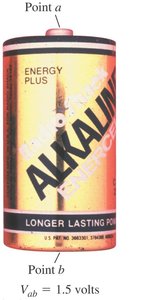
Example: The potential difference between the terminals of a battery can be measured as the voltage between point a (positive terminal) and point b (negative terminal).
Electric Potential in Uniform Electric Fields
Calculating Potential Difference
In a uniform electric field, the potential difference between two points separated by distance d is given by:
Formula: , where E is the magnitude of the electric field and d is the displacement parallel to the field.
Energy Conservation: For a positive test charge, moving with the field decreases potential energy, and kinetic energy increases.
Relationship:
Example: When a charge is released in a constant electric field, it accelerates from higher to lower potential.
Electric Potential for Point Charges
Potential Due to a Single Point Charge
An isolated point charge produces a radially symmetric electric field. The electric potential at a distance r from a point charge q is:
Formula:
Reference Point: It is customary to set the potential to zero at infinity.
Potential Difference:
Equipotential Surfaces: Spherical surfaces centered on the charge have constant potential.
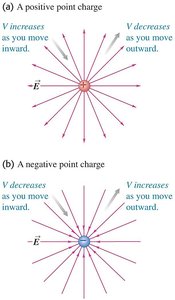
Example: The potential decreases as you move outward from a positive charge and increases as you move outward from a negative charge.
Potential Due to Multiple Point Charges
The electric potential at a point due to several point charges is the algebraic sum of the potentials from each charge (superposition principle):
Formula:
Scalar Quantity: Potential is easier to calculate than the vector electric field.
Example: For charges at different locations, calculate the distance from each charge to the point of interest and sum their contributions.
Potential Energy of Systems of Point Charges
Potential Energy for Two Charges
The potential energy of interaction between two point charges is:
Formula:
Significance: for like charges (repulsion), for opposite charges (attraction).
Potential Energy for Multiple Charges
For more than two charges, the total potential energy is the sum of the potential energies for every pair:
Formula:
Order Independence: The result does not depend on the order in which charges are brought together.
Equipotential Surfaces
Definition and Properties
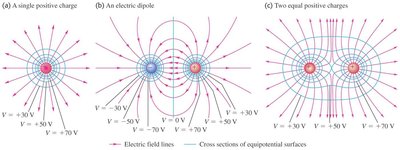
Equipotential surfaces are surfaces where every point has the same electric potential. These surfaces are always perpendicular to electric field lines.
Path Independence: Moving along an equipotential surface does not change the potential.
Perpendicularity: The angle between the electric field line and the equipotential surface is always 90°.
Example: Equipotential surfaces can be visualized for single charges, dipoles, or multiple charges.
Electric Field and Potential Near Conductors
Field Lines and Equipotential Surfaces
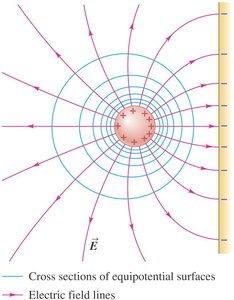
Near a conducting surface, electric field lines are perpendicular to the surface, and equipotential surfaces are parallel to the conductor. This configuration ensures that no work is required to move a charge along the surface.
Conductors: The surface of a conductor is an equipotential.
Field Lines: Electric field lines always cross equipotential surfaces at right angles.
Electron Volt
Definition and Usage
The electron volt (eV) is a unit of energy commonly used in atomic and molecular physics. It is defined as the energy gained by an electron when it moves through a potential difference of 1 volt.
Formula:
Application: Useful for describing energies of electrons, atoms, and molecules.
Potential from Continuous Charge Distributions
Methods of Calculation
For continuous charge distributions, the electric potential can be calculated by integrating over the distribution:
Method 1: Subdivide the distribution into small elements and sum their contributions:
Method 2: Use the electric field (from Gauss's law or other methods) and integrate:
Worked Example: Potential of a Charged Rod
For a rod of length l and total charge Q located along the x-axis, the potential at a point P on the y-axis a distance d from the origin is:
Charge Element: , where
Potential:
Result:
Additional info: The logarithmic result comes from integrating the potential over the length of the rod.
