 Back
BackElectric Potential and Potential Energy in Electrostatics Ch 25
Study Guide - Smart Notes
 Tailored notes based on your materials, expanded with key definitions, examples, and context.
Electric Potential Energy and Work in Electric Fields
Work Done by Electric Forces
When a charged particle moves in an electric field, the field does work on the particle, changing its potential and kinetic energy. The work done by a constant force \( \vec{F} \) over a displacement \( \Delta \vec{r} \) is given by the dot product:
Work: \( W = \vec{F} \cdot \Delta \vec{r} \)
For a force and displacement at an angle \( \theta \): \( W = Fd\cos\theta \)
In the context of electric fields, the force on a charge \( q \) is \( \vec{F} = q\vec{E} \), where \( \vec{E} \) is the electric field.
Potential Energy in a Uniform Electric Field
The change in electric potential energy \( \Delta U_{elec} \) for a charge \( q \) moving a distance \( s \) in a uniform electric field \( E \) is:
\( \Delta U_{elec} = -qE\Delta s \)
For a general position: \( U_{elec} = U_0 + qEs \)
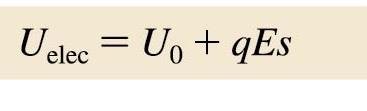
This equation shows that the potential energy depends on the charge, the electric field, and the position relative to a reference point.
Energy Conservation in Electric Fields
Electric forces are conservative, so the total mechanical energy (kinetic plus potential) is conserved:
\( E_{mech} = K_i + U_i = K_f + U_f \)
For a charge in a uniform field: \( U = qEs \)
When a charge moves under the influence of an electric field, any decrease in potential energy results in an increase in kinetic energy, and vice versa.
Electric Potential (Voltage)
Definition and Calculation
The electric potential \( V \) at a point is the potential energy per unit charge:
\( V = \frac{U}{q} \)
The potential difference between two points is \( \Delta V = V_b - V_a = -\int_a^b \vec{E} \cdot d\vec{x} \)
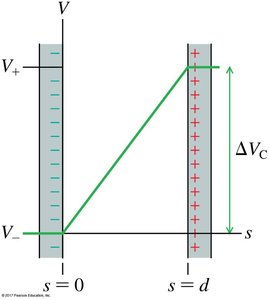
For a uniform field between parallel plates separated by distance \( d \):
\( \Delta V = Ed \)
Potential Due to Point Charges
The electric potential at a distance \( r \) from a point charge \( q \) is:
\( V = \frac{1}{4\pi\epsilon_0} \frac{q}{r} \)
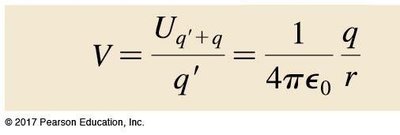
This potential decreases with distance from the charge and is positive for positive charges, negative for negative charges.
Visualizing Electric Potential
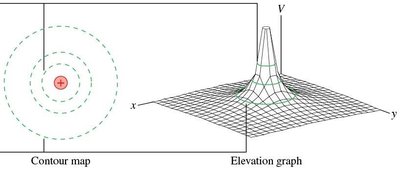
Equipotential surfaces are surfaces where the electric potential is constant. For a point charge, these are concentric spheres. The potential can also be represented as a 3D elevation graph, where height corresponds to potential value.
Potential Energy of Multiple Charges
Two Point Charges
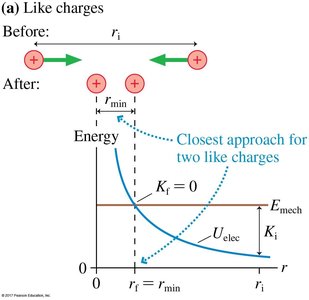
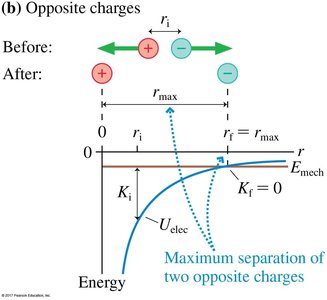
The potential energy of a system of two point charges \( q_1 \) and \( q_2 \) separated by distance \( r \) is:
\( U = \frac{1}{4\pi\epsilon_0} \frac{q_1 q_2}{r} \)
The sign of \( U \) depends on the signs of the charges:
Like charges (both positive or both negative): \( U > 0 \)
Opposite charges: \( U < 0 \)
Multiple Charges
For more than two charges, the total potential energy is the sum over all unique pairs:
\( U = \sum_{i
Electric Potential of Conductors and Capacitors
Conductors in Electrostatic Equilibrium
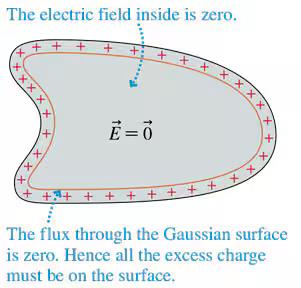
When no current flows, the electric field inside a conductor is zero, and all excess charge resides on the surface. The conductor is an equipotential, meaning the potential is the same everywhere inside and on the surface.
Capacitors
A parallel-plate capacitor consists of two plates with equal and opposite charges separated by a distance \( d \). The electric field between the plates is uniform:
\( E = \frac{\eta}{\epsilon_0} \), where \( \eta \) is the surface charge density
Potential difference: \( \Delta V = Ed \)
Summary Table: Electric Field and Potential for Common Charge Distributions
Source | Electric Field | Electric Potential |
|---|---|---|
Point Charge | \( \frac{Q}{4\pi\epsilon_0 r^2} \) | \( \frac{Q}{4\pi\epsilon_0 r} \) |
Capacitor | \( \frac{\eta}{\epsilon_0} \) (between plates) | \( \frac{\eta}{\epsilon_0} s \), \( s \) from negative plate |
Sphere (outside) | Same as point charge | Same as point charge |
Infinite Line of Charge | \( \frac{\lambda}{2\pi\epsilon_0 r} \) | \( \frac{\lambda}{2\pi\epsilon_0} \ln(r) \) (Additional info: Potential for line charge is logarithmic in r) |
Key Concepts and Applications
Electric potential energy is the energy a charge has due to its position in an electric field.
Electric potential (voltage) is the potential energy per unit charge.
Work done by the electric field is related to changes in potential energy and potential.
For multiple charges, use the superposition principle to find total potential or energy.
Conductors in equilibrium are equipotentials; all excess charge is on the surface.
