 Back
Electric Potential and Potential Energy – Study Notes (Ch. 23, Young & Freedman University Physics)
Study Guide - Smart Notes
 Tailored notes based on your materials, expanded with key definitions, examples, and context.
Electric Potential Energy
Concept of Electric Potential Energy
Electric potential energy is the energy stored in a system of charges due to their positions relative to each other. When two charges are released, they move according to the electric forces between them, converting potential energy into kinetic energy. The principle of energy conservation applies:
Energy Conservation:
Dependence on Distance: Electric potential energy between two point charges decreases as , not .
Significance of Signs: The signs of the charges and the resulting energy are crucial in determining the nature of the interaction (attractive or repulsive).
Formula for Two Point Charges:
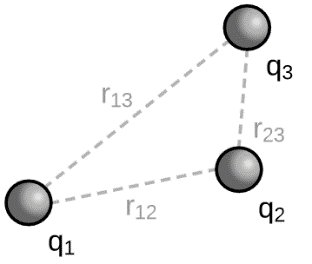
Potential Energy for a Group of Charges: The total potential energy is the sum of the potential energies for each unique pair of charges in the system.
$U_{\text{tot}} = \sum_{i
This is the energy required to assemble the system by bringing each charge in from infinity.
Example Application
Example: How far apart must a and a charge be so that their potential energy is ?
Solution: Use and solve for .
Electric Potential (Voltage)
Definition and Units
Electric potential, or simply potential, is a scalar quantity related to electric potential energy but distinct from it. It is defined as the potential energy per unit charge at a point in space.
Unit: Volt (V), where
Symbol: (used for both the quantity and its unit)
Formula:
For a group of charges, the total potential at a point is the algebraic sum of the potentials due to each charge.
Relationship Between Field, Force, Potential, and Energy
Electric Field (): The force per unit charge at a point in space.
Electric Potential (): The potential energy per unit charge at a point.
Relationship:
Field tells charges how much force to feel; potential tells charges how much energy to have.
Movement of Charges in Potential Fields
Direction of Motion
Positive charges move toward lower potential.
Negative charges move toward higher potential.
The potential difference provides the 'motivation' for charges to move, resulting in a change in their potential energy.
Example Application
Example: An electron at rest between points A (10 V) and B (0 V) will move toward the higher potential (A), since electrons are negatively charged.
Potential Due to a Point Charge
Formulas and Concepts
Potential at a Distance from a Point Charge :
Potential Difference (Voltage): The difference in potential between two points, .
Voltage: Refers to potential difference, not absolute potential.
Example Application
Example: What is the potential 0.5 m away from a charge? What about 1 m away? What is the potential difference between these points?
Work Due to Electric Force
Work and Energy Conservation
When a charge moves in an electric field, its potential energy changes, and work is done by the electric force.
The work done depends only on the initial and final positions, not the path taken (conservative force).
At infinite separation, the potential energy is defined as zero.
Work-Energy Theorem:
Relationship Between Work and Potential Difference:
Example Application
Example: A charge is moved closer to a charge. Calculate the work done by the electric force.
Relationships Between Force, Field, Energy, and Potential
Quantity | Formula |
|---|---|
Electric Force | |
Electric Field | |
Electric Potential Energy | |
Electric Potential |
Key Points:
Potential difference () is also called voltage.
Potential energy difference () corresponds to the work done.
The Electronvolt
Definition and Use
An electronvolt (eV) is the energy gained or lost by an electron moving through a potential difference of 1 volt.
Useful for expressing energies of small particles like electrons and protons.
Potential Difference with Calculus
General Definition
The potential difference between two points is given by the negative line integral of the electric field:
For a constant electric field, this reduces to .
For a distribution of charges, integration is required to find .
Electric Potential Due to Charge Distributions
Line of Charge
To find the potential at a point due to a line of charge, integrate the contributions from each infinitesimal charge element along the line.
Ring of Charge
For a ring of charge, the potential at a point on the axis of the ring is found by integrating over the ring's circumference.
Disk of Charge
The potential due to a disk of charge can be found by integrating the contributions from concentric rings making up the disk.
Equipotential Surfaces
Definition and Properties
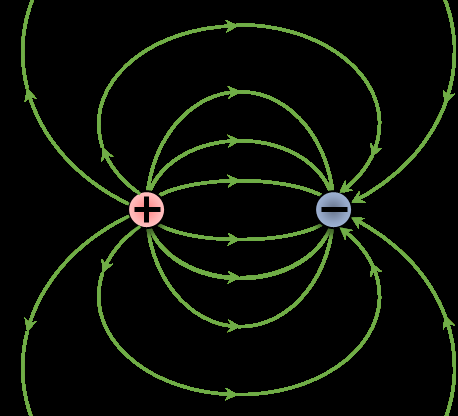
Equipotential surfaces are surfaces on which the electric potential is constant. No work is required to move a charge along an equipotential surface.
The electric field is always perpendicular to equipotential surfaces and points in the direction of decreasing potential.
Relationship between electric field and potential:
or, in vector form, .
Work along an equipotential is zero: .
Calculating Electric Field as Derivative of Potential
Using Partial Derivatives
Given a function for electric potential , the electric field components are found by taking the negative partial derivatives:
In vector notation:
The symbol indicates a partial derivative, meaning differentiation with respect to one variable while holding others constant.
Example Application
Example: If , calculate the magnitude and direction of the electric field at , .
Summary Table: Key Equations
Quantity | Equation |
|---|---|
Electric Force | |
Electric Field | |
Electric Potential Energy | |
Electric Potential | |
Work and Potential Difference | |
Electronvolt |
