Back
BackElectric Potential and Potential Energy: Study Notes (Giancoli Ch. 23)
Study Guide - Smart Notes
 Tailored notes based on your materials, expanded with key definitions, examples, and context.
Electric Potential
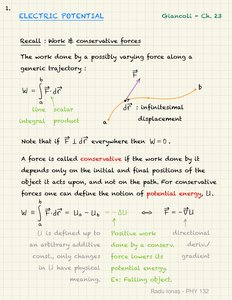
Work and Conservative Forces
The concept of work and conservative forces is fundamental in understanding electric potential. The work done by a possibly varying force along a generic trajectory is given by:
Work (W): (line integral, scalar product)
If everywhere, then .
Conservative Force: A force is called conservative if the work done by it depends only on the initial and final positions of the object, not on the path. For conservative forces, we define the notion of potential energy .
Potential energy change: (work done by conservative force lowers potential energy)
Examples: Gravity, electrostatic force
Electric Potential Energy and Electric Potential
Electrostatic Forces and Potential
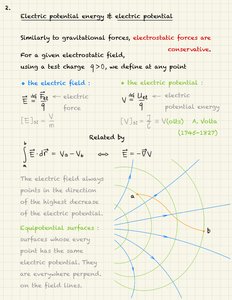
Electrostatic forces, like gravitational forces, are conservative. For a given electrostatic field, using a test charge , we define:
Electric Field (\vec{E}):
Electric Potential (V): (units: Volts, V)
Relation:
Equipotential surfaces: Surfaces where the electric potential is constant. The electric field always points in the direction of the greatest decrease of electric potential.
Conservation of Energy in Electric Fields
Motion of Charged Particles
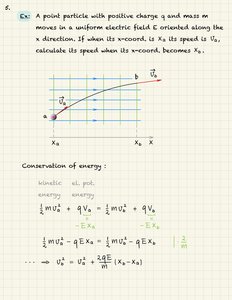
When a charged particle moves in a uniform electric field, its kinetic and potential energies change according to the conservation of energy principle:
Conservation of Energy:
For a particle of charge and mass moving from to in a uniform field :
Solving for speed:
Superposition Principle for Potentials
Adding Electric Potentials
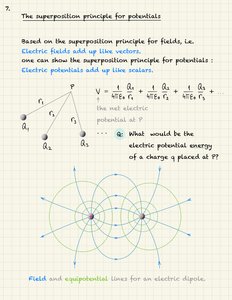
The superposition principle states that electric fields add up like vectors, and electric potentials add up like scalars:
Electric Potential at a Point:
Potentials due to multiple charges are summed algebraically.
Work Done by Electric Forces
Moving Charges in Electric Fields
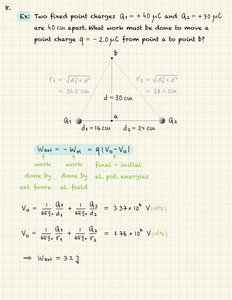
To move a charge in an electric field, work must be done against the field. For two fixed point charges and , the work to move a charge from point to point is:
Where and are the electric potentials at points and due to and .
Electric Fields in Biological Systems
Electric Fields Used by Fish
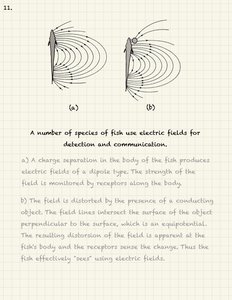
Some species of fish use electric fields for detection and communication:
A charge separation in the body produces electric fields of a dipole type.
The field is monitored by receptors along the body.
The field is distorted by the presence of a conducting object, allowing the fish to "see" using electric fields.
Electric Potential Energy of Interaction
Work to Bring Two Charges Together
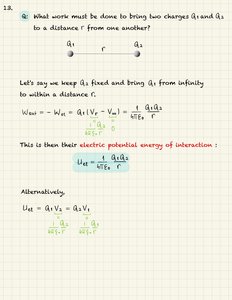
The work required to bring two charges and to a distance from one another is:
This is their electric potential energy of interaction:
Alternatively:
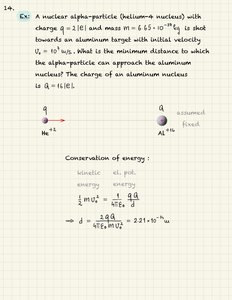
Application: Nuclear Alpha-Particle and Potential Energy
Minimum Approach Distance
When a nuclear alpha-particle (helium-4 nucleus) is shot towards an aluminum target, the minimum distance it can approach is determined by conservation of energy:
Initial kinetic energy is converted to electric potential energy as the alpha-particle approaches the nucleus.
Solving for gives the minimum approach distance.