 Back
BackElectric Potential, Capacitance, and Circuits: Study Notes for Physics 202
Study Guide - Smart Notes
 Tailored notes based on your materials, expanded with key definitions, examples, and context.
Electric Potential and Electric Field
Relationship Between Electric Field and Potential
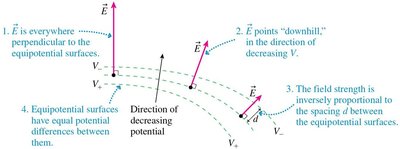
The electric field (\( \vec{E} \)) and electric potential (V) are closely related concepts in electromagnetism. The electric field is always perpendicular to equipotential surfaces and points in the direction of decreasing potential. The field strength is greatest where the potential changes most rapidly.
Equipotential surfaces: Surfaces where the electric potential is constant.
Direction of \( \vec{E} \): Points from higher to lower potential ("downhill").
Field strength: Inversely proportional to the spacing between equipotential surfaces.
Mathematical relationship: \( E \approx \frac{\Delta V}{d} \), where \( \Delta V \) is the potential difference and \( d \) is the distance between equipotentials.
Electric Potential in Biological Systems: The Heart
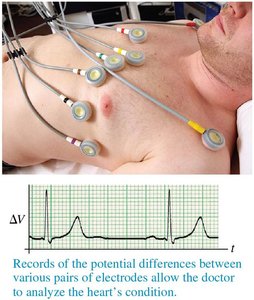
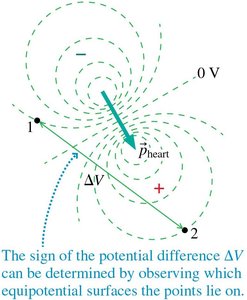
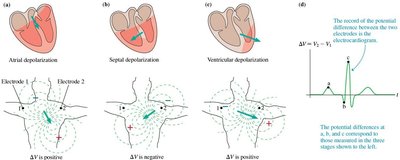
The heart generates an electric dipole during each heartbeat, creating a measurable electric field and potential throughout the body. This is the basis for electrocardiograms (ECGs), which record potential differences between electrodes placed on the body.
Dipole moment: Created by depolarization waves in cardiac tissue.
ECG: Measures how the heart's electric dipole changes over time.
Potential difference: Determined by the positions of electrodes relative to the heart's dipole and equipotential surfaces.
Electric Force, Field, Potential Energy, and Potential
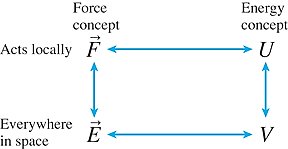
There are two main perspectives in electrostatics: force and energy. The force concept focuses on local interactions, while the energy concept considers the potential energy and potential at every point in space.
Force (\( \vec{F} \)): Acts locally on charges.
Electric field (\( \vec{E} \)): Exists everywhere in space, relates to force by \( \vec{F} = q\vec{E} \).
Potential energy (U): Energy associated with the position of a charge in an electric field.
Electric potential (V): Potential energy per unit charge.
Conductors and Electrostatic Equilibrium
Properties of Conductors in Electrostatic Equilibrium
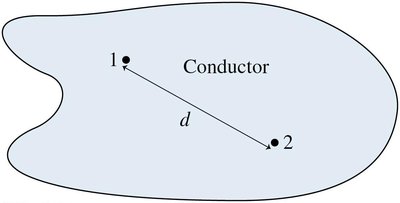
When a conductor reaches electrostatic equilibrium, several important properties hold:
Any excess charge resides on the surface.
The electric field inside the conductor is zero.
The external electric field is perpendicular to the surface.
The entire conductor is at the same potential; its surface is an equipotential.
Sources of Electric Potential
Charge Separation and Batteries
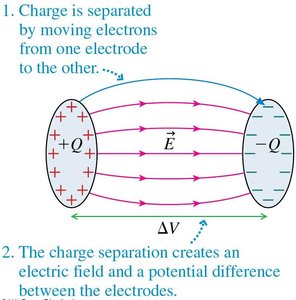
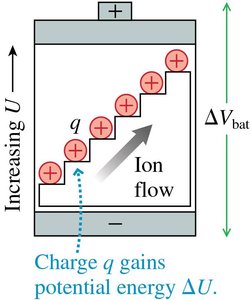
Electric potential differences are created by separating positive and negative charges. In batteries, chemical reactions separate charges, creating a potential difference between the terminals.
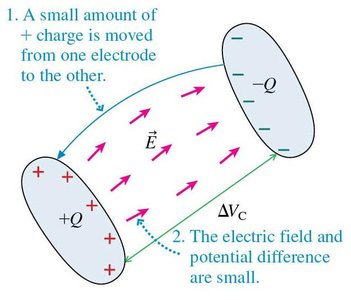
Capacitor charging: Moving electrons from one plate to another creates an electric field and potential difference.
Batteries: Use chemical energy to move ions, modeled as a "charge escalator." The electromotive force (emf, \( \mathcal{E} \)) is the work per unit charge.
Capacitance and Capacitors
Capacitors: Description and Biological Application
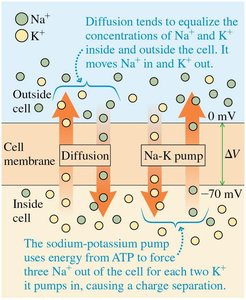
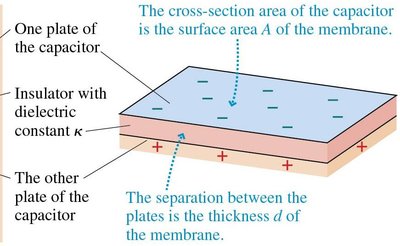
A capacitor consists of two conducting plates separated by an insulator (dielectric). It stores charge and energy. Biological membranes, such as the cell membrane, can be modeled as capacitors due to charge separation across the membrane.
Parallel-plate capacitor: Two plates of area \( A \), separated by distance \( d \).
Cell membrane: Ion pumps create a potential difference, and the membrane acts as a dielectric.
Capacitance: Definition and Formula
Capacitance (C) is a measure of a capacitor's ability to store charge per unit potential difference. For any capacitor:
\( Q = C \Delta V_C \)
Unit: farad (F), where 1 F = 1 C/V
For a parallel-plate capacitor: \( C = \kappa \epsilon_0 \frac{A}{d} \), where \( \kappa \) is the dielectric constant, \( \epsilon_0 \) is the vacuum permittivity.
Changing Plate Separation
If the plates of an isolated (not connected) capacitor are pulled apart, the charge remains constant, but the potential difference increases because capacitance decreases.
Examples of Capacitors
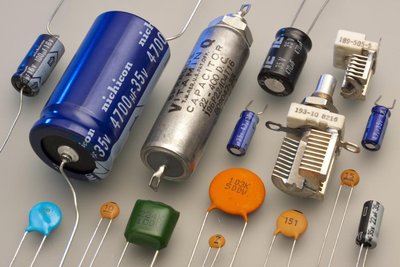
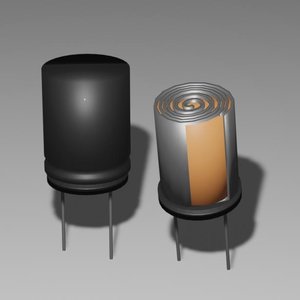
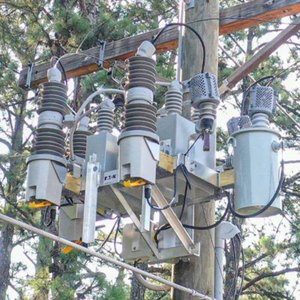
Capacitors come in various shapes and sizes, including commercial cylindrical capacitors and those used in electronics and power systems.
Applications: Camera flashes, defibrillators, power grids.


Energy Stored in a Capacitor
Formulas for Stored Energy
The energy stored in a capacitor is given by:
\( U_C = \frac{1}{2} Q^2 / C = \frac{1}{2} C \Delta V_C^2 = \frac{1}{2} Q \Delta V_C \)
Energy is stored in the electric field between the plates.
Energy density: \( u_E = \frac{U_C}{Ad} = \frac{1}{2} \epsilon_0 E^2 \)
Dielectrics
Effect of Dielectrics on Capacitance
Inserting a dielectric material between the plates increases the capacitance by reducing the electric field for a given charge. The dielectric constant \( \kappa \) quantifies this effect.
\( C_{\kappa} = \kappa C_0 \)
\( \kappa \geq 1 \); higher for materials like water, lower for air.
Material | Dielectric Constant (\( \kappa \)) |
|---|---|
Vacuum | 1 |
Air | 1.00054 |
Teflon | 2.0 |
Paper | 3.0 |
Pyrex glass | 4.8 |
Cell membrane | 9.0 |
Ethanol | 24 |
Water | 80 |
Strontium titanate | 300 |
Application: Cell Membrane as a Capacitor
Ion Pumps and Membrane Potential
Ion pumps in cell membranes actively transport ions, creating a potential difference across the membrane. The sodium-potassium pump is a key example, maintaining a resting potential of about -70 mV in neurons.
Capacitance of the Cell Membrane
The cell membrane can be modeled as a parallel-plate capacitor with area \( A \), thickness \( d \), and dielectric constant \( \kappa \):
\( C_{mem} \approx \kappa \epsilon_0 \frac{A}{d} \)
Summary Table: Key Equations
Quantity | Equation | Description |
|---|---|---|
Electric field and potential | Field strength from potential difference | |
Capacitance (parallel-plate) | Capacitance with dielectric | |
Stored energy | Energy in a charged capacitor | |
Energy density | Energy per unit volume in field |
Additional info: These notes cover core concepts from chapters on electric potential, capacitance, and biological applications, with a focus on both physical and physiological systems. The included images reinforce the physical models and biological relevance of the material.
