 Back
BackElectric Potential, Capacitance, and Circuits: Study Notes for Physics 202
Study Guide - Smart Notes
 Tailored notes based on your materials, expanded with key definitions, examples, and context.
Electric Potential and Electric Field
Relationship Between Electric Field (\(\vec{E}\)) and Electric Potential (\(V\))
The electric field and electric potential are fundamental concepts in electromagnetism. The electric field describes the force per unit charge at a point in space, while the electric potential describes the energy per unit charge.
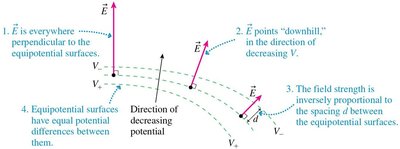
Perpendicularity: The electric field vectors are always perpendicular to equipotential surfaces.
Direction: The electric field points in the direction of decreasing potential ("downhill"), which is the direction of the steepest descent of potential.
Field Strength: The strength of the electric field is inversely proportional to the spacing between equipotential surfaces; closer surfaces indicate a stronger field.
Equipotential Surfaces: Equipotential surfaces have equal potential differences between them.
Formula: For a uniform field, the magnitude of the electric field is given by:
where \(\Delta V\) is the potential difference between adjacent equipotential lines and \(d\) is their spacing.
Electric Potential in Biological Systems
Equipotential Surfaces of the Heart: Electric Dipole Model
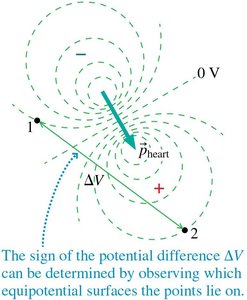
The heart generates an electric dipole during each heartbeat, which creates a dipole electric field and potential throughout the body. This is the basis for electrocardiogram (ECG) measurements.
Dipole Moment: The heart's dipole moment moves during a heartbeat, creating changing electric fields and potentials.
Potential Distribution: The potential is highest near the positive pole and lowest near the negative pole; it is zero on the surface perpendicular to the dipole axis passing through the midpoint.
Electrocardiograms (ECG)
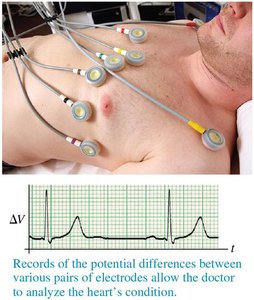
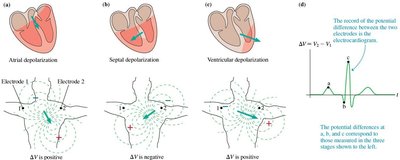
An ECG uses electrodes to measure the potential difference across the heart, providing information about its electrical activity.
Electrodes: Multiple electrodes are placed on the body to record potential differences.
Signal Interpretation: The recorded signal reflects the heart's electric dipole changes during a heartbeat.
Electric Force, Field, Potential Energy, and Potential
Conceptual Relationships
Electric force, field, potential energy, and potential are interconnected concepts in physics.
Force (\(\vec{F}\)): Acts locally on charges.
Electric Field (\(\vec{E}\)): Exists everywhere in space and determines the force on a charge.
Potential Energy (\(U\)): Energy concept related to the work done by the electric force.
Electric Potential (\(V\)): Energy per unit charge, related to potential energy.
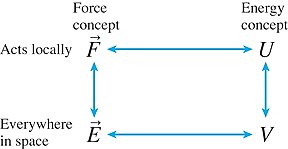
Key Equations:
Conductors in Electrostatic Equilibrium
Properties of Conductors
When a conductor is in electrostatic equilibrium, several important properties hold:
Surface Charge: Any excess charge resides on the surface.
Zero Internal Field: The electric field inside the conductor is zero.
Perpendicular Field: The external electric field is perpendicular to the surface.
Equipotential Surface: The entire conductor is at the same potential; its surface is an equipotential.
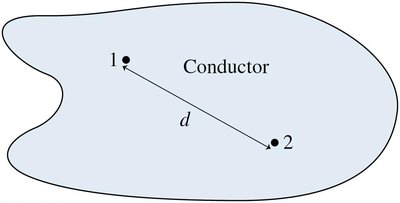
Equation: (since \(E = 0\) inside the conductor)
Sources of Electric Potential
Charge Separation and Batteries
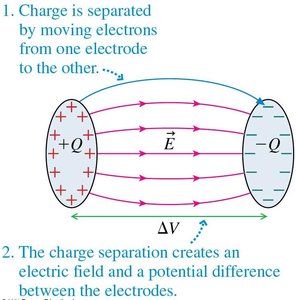
Electric potential differences are created by separating positive and negative charges, such as in capacitors and batteries.
Capacitor: Charge separation creates an electric field and potential difference between electrodes.
Batteries: Chemical reactions separate charges, creating a potential difference (emf).
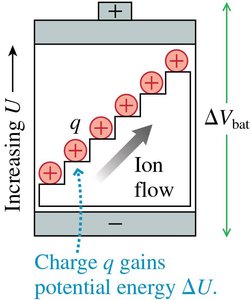
Equation: (ideal battery)
Capacitors and Capacitance
Capacitor Structure and Function
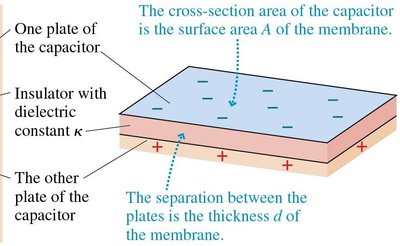
A capacitor consists of two conducting plates separated by an insulator. It stores charge and energy.
Parallel-Plate Capacitor: The cell membrane can be modeled as a parallel-plate capacitor.
Capacitance: The ability to store charge per unit potential difference.
Key Equations:
\(\epsilon_0 = 8.85419 \times 10^{-12} \frac{C^2}{N \cdot m^2}\) (vacuum permittivity)
Capacitor Charging and Plate Separation
When the plates of a capacitor are pulled apart (without connection to a battery), the charge remains constant, but the potential difference increases.

Commercial Capacitors and Applications
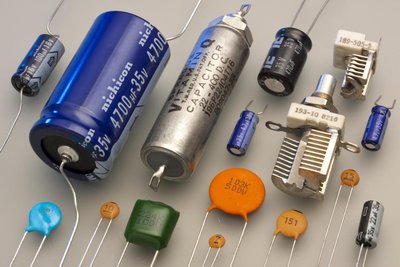
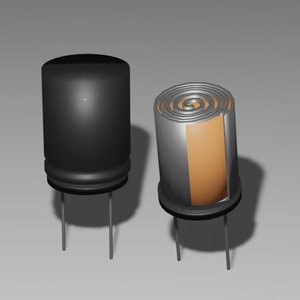
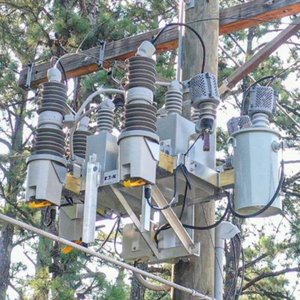
Capacitors are used in various devices, including camera flashes and defibrillators, to store and release energy rapidly.


Energy Stored in a Capacitor
Energy Calculation
The energy stored in a capacitor is the work required to move charges onto the plates.
Formula:
Energy Density:
Dielectrics and Capacitance
Dielectric Materials
Dielectrics are insulating materials placed between capacitor plates, increasing capacitance by reducing the electric field.
Dielectric Constant (\(\kappa\)):
Table of Dielectric Constants:
Material | Dielectric Constant (K) |
|---|---|
Vacuum | 1 |
Air | 1.00054 |
Teflon | 2.0 |
Paper | 3.0 |
Pyrex glass | 4.8 |
Cell membrane | 9.0 |
Ethanol | 24 |
Water | 80 |
Strontium titanate | 300 |
Cell Membrane as a Capacitor
Biological Application
The cell membrane acts as a capacitor, with ion pumps creating charge separation and a potential difference.
Model: The membrane is modeled as a parallel-plate capacitor with dielectric constant \(\kappa\).
Capacitance:
Nernst Potential:
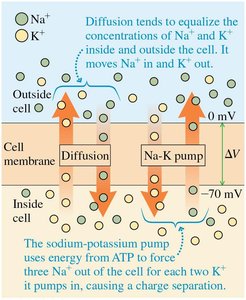
Electric Current and Circuits
Electric Current
Electric current is the flow of charged particles, quantified as the rate of charge flow.
Formula:
Unit: Ampere (A), where 1 A = 1 C/s
Direction: Defined as the direction positive charges would move.
Electric Circuits
An electric circuit is a closed loop allowing continuous charge flow. Devices such as batteries, lightbulbs, and wires are connected to form circuits.
Closed Path: Required for current to flow.
Open Circuit: No current flows if the path is interrupted.
Resistance and Ohm's Law
Resistance
Resistance is the opposition to charge flow in a material, caused by collisions between electrons and ions.
Ohm's Law: or
Unit: Ohm (\(\Omega\)), 1 \(\Omega\) = 1 V/A
Resistivity: where \(\rho\) is resistivity, \(L\) is length, \(A\) is cross-sectional area.
Kirchhoff's Laws and Circuit Analysis
Kirchhoff's Loop Law (Voltage Law)
The sum of all potential differences around a closed loop is zero, reflecting conservation of energy.
Kirchhoff's Junction Law (Current Law)
The sum of currents entering a junction equals the sum of currents leaving, reflecting conservation of charge.
Series and Parallel Connections
Resistors in Series
Current: Same through all devices.
Voltage: Shared between devices.
Equivalent Resistance:
Resistors in Parallel
Voltage: Same across all devices.
Current: Shared between devices.
Equivalent Resistance:
RC Circuits
Charging and Discharging Capacitors
RC circuits combine resistors and capacitors. The current and charge change over time according to exponential laws.
Current (Charging/Discharging):
Time Constant:
Charge (Charging):
Charge (Discharging):
Applications in Biology: Neurons and Cell Membranes
Cell Membranes as RC Circuits
Cell membranes have resistance, capacitance, and emf, and can be modeled as RC circuits. The time constant determines the speed of electrical signaling.
Action Potential: A spike in membrane potential corresponds to nerve cell firing.
Propagation: Action potentials propagate as waves along the axon.
Magnetic Forces and Fields
Properties of Magnets
Magnets have north and south poles, exert long-range forces, and create magnetic fields.
Magnetic Field (\(\vec{B}\)): Exists at all points in space, is a vector, and exerts forces on magnetic poles.
Field Lines: Magnetic field lines are tangential to the field vectors, point away from north and toward south, and form closed loops.
Magnetic Field of Current-Carrying Wires
Electric currents generate magnetic fields. The direction is given by the right-hand rule.
Magnitude:
\(\mu_0\): Vacuum permeability,
Magnetic Field of Loops and Solenoids
Loop:
Solenoid:
Magnetic Force on Moving Charges and Wires
On a Particle:
On a Wire:
Direction: Right-hand rule (different versions for positive and negative charges).
Magnetic Dipole Moment
Definition:
Direction: Perpendicular to loop, matches field at center.
Circular Motion in Magnetic Fields
Radius:
Cyclotron Frequency:
Application: Mass Spectrometer
Mass spectrometers use cyclotron motion to determine ion masses and concentrations.
Additional info: These notes expand on the original lecture content, providing definitions, formulas, and context for each topic. All included images are directly relevant to the adjacent explanations.
