 Back
BackElectric Potential, Capacitance, and DC Circuits: Study Notes
Study Guide - Smart Notes
 Tailored notes based on your materials, expanded with key definitions, examples, and context.
Electric Potential Energy and Electric Potential
Electric Potential Energy Between Point Charges
Electric potential energy (U) is the energy stored due to the position of two point charges in an electric field. The potential energy between two point charges q_1 and q_2 separated by a distance r is given by:
k_e is Coulomb's constant:
The sign of U depends on the signs of the charges.
Potential energy is defined as zero when the charges are infinitely far apart.
Electric Potential for Point Charges
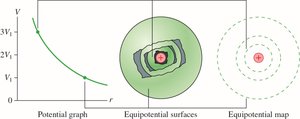
Electric potential (V) at a point in space due to a point charge is the potential energy per unit charge. For a point charge q at a distance r:
Electric potential is a scalar quantity.
For multiple point charges, add the potentials from each charge algebraically (scalar addition).
Electric potential is negative for negative charges.
Electric Potential Energy: Conceptual Questions
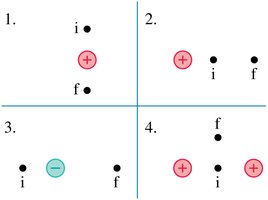
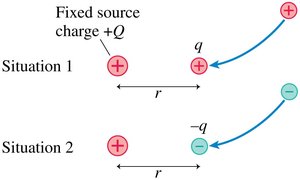
If two charges are the same sign, their potential energy is positive; work must be done against the electric force to bring them together.
If two charges are opposite in sign, their potential energy is negative; work is done by the field as they come together.
Particles speed up when moving in the direction that decreases their potential energy.
Analogy to Gravity
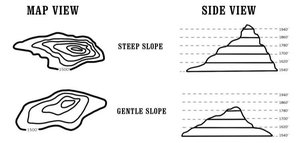
Electric potential can be visualized like gravitational potential:
Potential lines from a positive charge resemble a mountain (high potential).
Potential lines from a negative charge resemble a valley (low potential).
Conservation of Energy in Electric Fields
Energy Conservation for Charged Particles
When a charged particle moves in an electric field, the total mechanical energy (kinetic + potential) is conserved if only electrostatic forces do work:
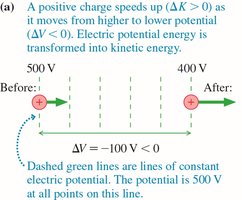
As a positive charge moves from higher to lower potential, it gains kinetic energy.
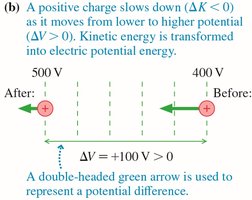
As a positive charge moves from lower to higher potential, it loses kinetic energy.
Electric Potential and Field in a Parallel Plate Capacitor
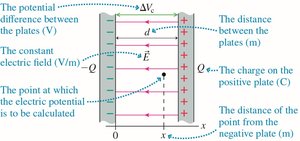
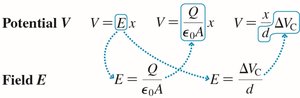
In a parallel plate capacitor, the electric field is uniform between the plates, and the potential difference is related to the field and plate separation:
E is the electric field (V/m), d is the separation between plates (m), ΔV is the potential difference (V).
Capacitance and Capacitors
Definition of Capacitance
Capacitance (C) is a measure of an object's ability to store electric charge per unit potential difference:
The SI unit of capacitance is the farad (F):
Capacitors store energy in the electric field between their plates.
Parallel-Plate Capacitor
The capacitance of a parallel-plate capacitor is given by:
A is the area of one plate (m²), d is the separation between plates (m), ε₀ is the permittivity of free space ().
Charging a Capacitor
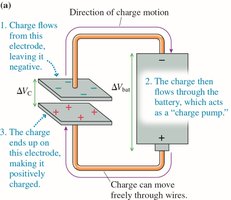
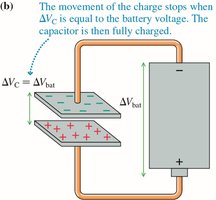
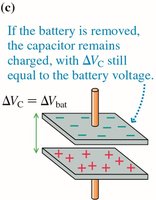
When a capacitor is connected to a battery, charge flows until the potential difference across the capacitor equals the battery voltage.
Dielectrics and Capacitance
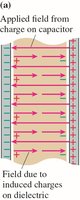
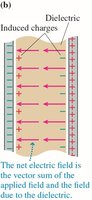
Inserting a dielectric material between the plates increases the capacitance by a factor called the dielectric constant (κ):
Dielectrics reduce the effective electric field and allow more charge to be stored for the same voltage.
Medical Application: Defibrillator
A defibrillator uses a large capacitor to store and quickly release energy to restore normal heart rhythm during fibrillation.

Electric Current, Resistance, and Circuits
Definition of Electric Current
Electric current (I) is the rate at which charge flows through a conductor:
Measured in amperes (A):

Potential Difference and Batteries
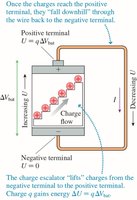
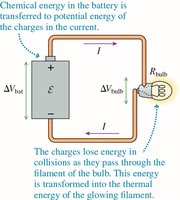
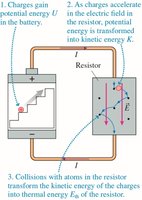
A battery provides a constant potential difference (voltage) across a circuit, driving current from the positive to the negative terminal.
Resistance and Ohm's Law
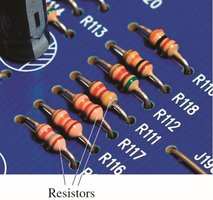
Resistance (R) quantifies how much a material opposes the flow of electric current:
Measured in ohms (Ω):
Ohm's Law:

Resistivity
The resistance of a wire depends on its material, length, and cross-sectional area:
ρ is the resistivity of the material (Ω·m), L is the length (m), A is the cross-sectional area (m²).
Energy and Power in Electric Circuits
Power in Electric Circuits
Power (P) is the rate at which energy is transferred or converted:
Measured in watts (W):
Direct Current (DC) and Alternating Current (AC)
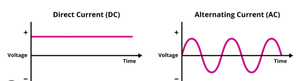
Direct Current (DC) vs Alternating Current (AC)
DC: Current flows in one direction only (e.g., batteries).
AC: Current reverses direction periodically (e.g., household power).
AC Voltage, Current, and Power
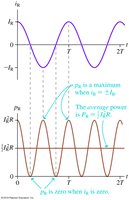
AC voltage and current vary sinusoidally with time.
Root mean square (rms) values are used for average power calculations:
DC Circuits: Kirchhoff’s Laws and Circuit Analysis
Circuit Elements and Diagrams
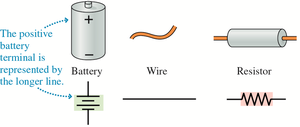
Common circuit elements include batteries, wires, and resistors. Circuit diagrams use standard symbols to represent these components.
Kirchhoff’s Laws
Junction Law: The total current entering a junction equals the total current leaving (conservation of charge).
Loop Law: The sum of the potential differences around any closed loop is zero (conservation of energy).
Series and Parallel Circuits
Series:
Parallel:
Bulb Brightness in Circuits
In series, bulbs share the same current; brightness depends on resistance.
In parallel, bulbs share the same voltage; brightness depends on power .
Measuring Current and Voltage
Ammeters (measure current) are connected in series and should have low resistance.
Voltmeters (measure voltage) are connected in parallel and should have high resistance.
Summary Table: Key Formulas
Quantity | Formula | SI Unit |
|---|---|---|
Electric Potential Energy | Joule (J) | |
Electric Potential | Volt (V) | |
Capacitance | Farad (F) | |
Ohm's Law | Volt (V) | |
Power | Watt (W) | |
Series Resistance | Ohm (Ω) | |
Parallel Resistance | Ohm (Ω) |
