 Back
BackWeek 3 Lec. 3
Study Guide - Smart Notes
 Tailored notes based on your materials, expanded with key definitions, examples, and context.
Electric Potential and Electric Field
Electric Potential Outside and Inside a Charged Sphere
The electric potential V at a point in space due to a charged object is a measure of the potential energy per unit charge at that point. For a uniformly charged insulating sphere of radius a and total charge Q:
Outside the Sphere (r > a): The electric field is radial and given by Gauss's law:
The potential at a distance r from the center (taking V = 0 at infinity):
At the Surface (r = a):
Inside the Sphere (r < a): The electric field is:
The potential at a point inside is:
Key Point: The potential is continuous at the surface and decreases smoothly from the center outward.
Electric Potential and Electric Field Relationship
Finding E from V
The electric field E is related to the electric potential V by the negative gradient:
In one dimension:
In three dimensions: , ,
Example: If , then:
Note: Electric potential is a scalar field, while the electric field is a vector field.
Capacitance
Definition and Basic Properties
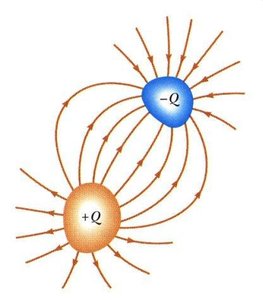
Capacitance (C) is the ability of a system to store electric charge per unit potential difference. For two conductors with equal and opposite charges:
The SI unit is the farad (F), where .
Capacitance depends only on the geometry and the medium between the conductors.
Parallel Plate Capacitor
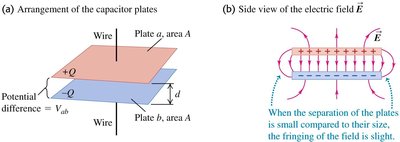
A parallel plate capacitor consists of two plates of area A separated by distance d:
Where is the vacuum permittivity.
The electric field between the plates is uniform if .
Cylindrical Capacitor
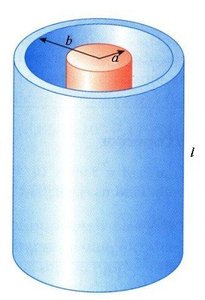
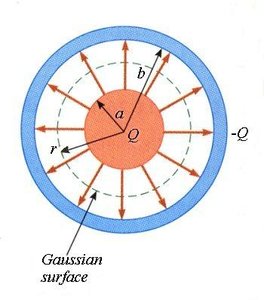
For a cylindrical capacitor with inner radius a, outer radius b, and length l:
Derived using Gauss's law and integrating the electric field between the cylinders.
Dielectrics
Role and Effect of Dielectrics
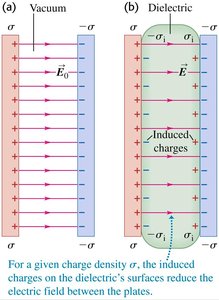
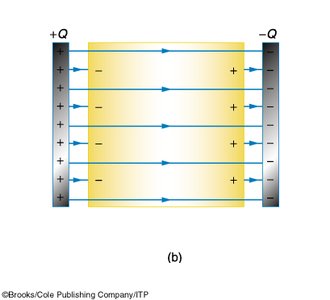
Dielectrics are insulating materials that increase the capacitance of a capacitor by reducing the effective electric field. When a dielectric is inserted between the plates:
The capacitance increases by a factor called the dielectric constant ():
Where is the capacitance without the dielectric.
The electric field inside the capacitor is reduced:
Combinations of Capacitors
Parallel and Series Configurations
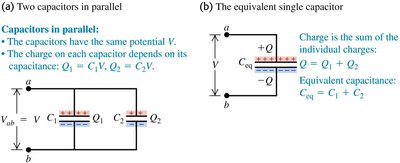
Parallel: The equivalent capacitance is the sum of individual capacitances:
Voltage across each capacitor is the same.
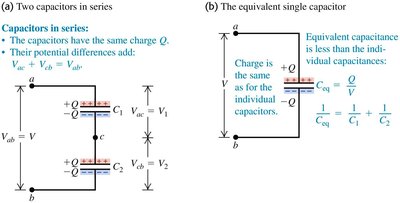
Series: The reciprocal of the equivalent capacitance is the sum of reciprocals:
Charge on each capacitor is the same.
Energy Storage in Capacitors
Energy Stored
The energy U stored in a capacitor is given by:
This energy is stored in the electric field between the plates.
Summary Table: Capacitance Formulas
Capacitor Type | Capacitance Formula |
|---|---|
Parallel Plate | |
Cylindrical | |
With Dielectric | |
Parallel Combination | |
Series Combination |
Additional info: The notes above include expanded explanations, definitions, and examples to ensure completeness and clarity for exam preparation. All images included are directly relevant to the adjacent explanations and reinforce the concepts discussed.
