 Back
BackElectric Potential, Capacitors, and Energy Storage: Study Notes for College Physics II
Study Guide - Smart Notes
 Tailored notes based on your materials, expanded with key definitions, examples, and context.
Electric Potential Energy and Potential Difference
Electric Potential Energy
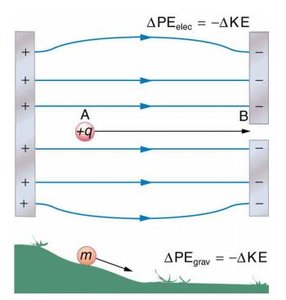
Electric potential energy is the energy a charged particle possesses due to its position in an electric field. The work done by an electric force when moving a charge q from point A to point B is equal to the negative change in electric potential energy:
Formula:
Key Point: The loss in electric potential energy becomes an increase in kinetic energy.
Example: Moving a charge between two plates in a uniform electric field.
Electric Potential
The electric potential V at any point in an electric field is defined as the electric potential energy per unit charge:
Formula:
Unit: Volt (V), where
Key Point: Electric potential is often referred to simply as "potential."
Potential Difference (Voltage)
The potential difference between two points, often called voltage, is the change in potential energy per unit charge:
Formula:
Key Point: Voltage is what drives current in circuits.
The Electron Volt Unit
The electron volt (eV) is a unit of energy commonly used in atomic and nuclear physics:
Definition:
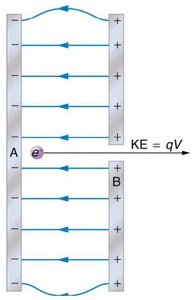
Key Point: It is the energy change when an electron moves through a potential difference of 1 volt.
Example: An electron accelerated by a 5000 V potential difference gains 5000 eV of energy.
Conservation of Energy in Electric Fields
For conservative forces like the electrostatic force, mechanical energy (kinetic + potential) is conserved:
Formula:
Key Point: A decrease in electric potential energy results in an increase in kinetic energy.
Electric Potential in a Uniform Electric Field
Work and Potential Difference
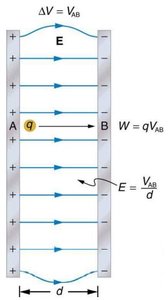
In a uniform electric field E, the work done to move a charge q across a distance d is:
Formula:
Potential Difference:
Electric Field:
Electric Potential Due to a Point Charge
Point Charge Potential
The electric potential V at a distance r from a point charge Q is:
Formula:
Key Point: The potential decreases with distance from the charge.
Equipotential Lines and Surfaces
Equipotential Lines
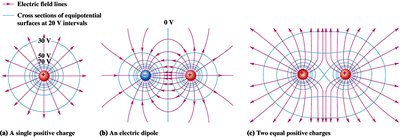
Equipotential lines connect points of equal electric potential. In three dimensions, these are called equipotential surfaces:
Key Point: Equipotential lines are always perpendicular to electric field lines.
Work: No work is required to move a charge along an equipotential line.
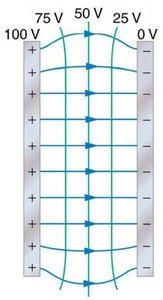
Equipotentials and Conductors
In static conditions, the surface of a conductor is always an equipotential surface:
Key Point: The electric field just outside a conductor is perpendicular to the surface.
Grounding: Connecting a conductor to the earth fixes its potential at zero volts.
Capacitors and Dielectrics
Capacitors: Structure and Function
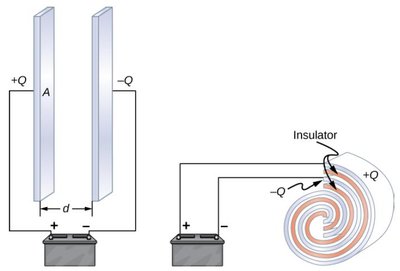
A capacitor is a device used to store electric charge and energy. It consists of two conductors separated by an insulator or vacuum:
Key Point: When connected to a battery, equal and opposite charges accumulate on the plates.
Stored Charge: The capacitor remains electrically neutral overall, but stores a charge Q.
Capacitance
Capacitance C is the amount of charge stored per volt:
Formula:
Unit: Farad (F), where
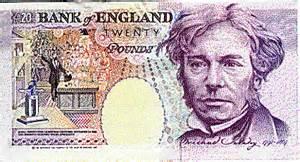
Historical Note: Named after Michael Faraday.
Capacitance of a Parallel Plate Capacitor
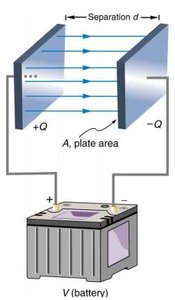
The capacitance of two parallel plates of area A separated by distance d is:
Formula:
Key Point: is the permittivity of free space.
Capacitors and Dielectrics
Placing a dielectric (insulating material) between the plates increases capacitance by a factor k (dielectric constant):
Formula:
Key Point: Dielectrics also increase the maximum voltage the capacitor can withstand (dielectric strength).
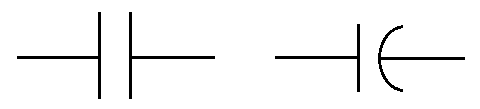
Symbols and Types of Capacitors
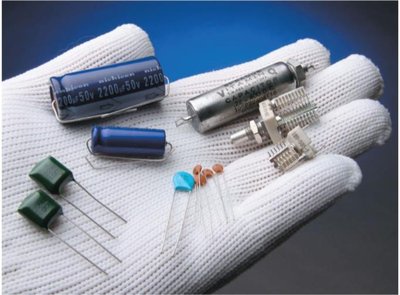
Capacitors are represented in circuit diagrams by specific symbols. Real capacitors come in various forms and are often combined to achieve desired capacitance values:
Key Point: Capacitors can be connected in series or parallel.
Capacitors in Series and Parallel
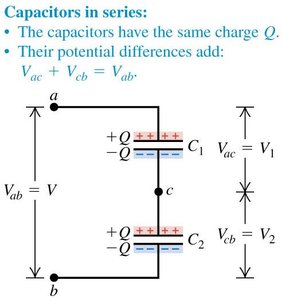
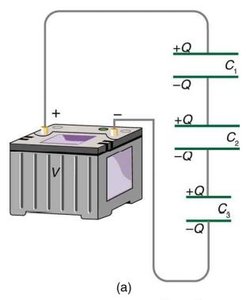
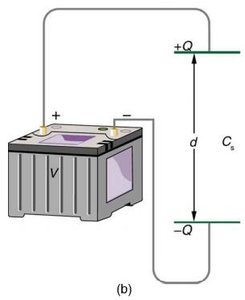
Capacitors in Series
When capacitors are connected in series:
Key Point: They have the same charge, but their voltages add up.
Formula for Two Capacitors:
General Formula:
Capacitors in Parallel
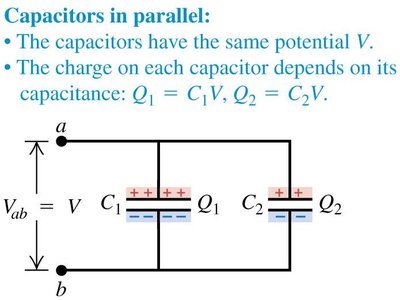
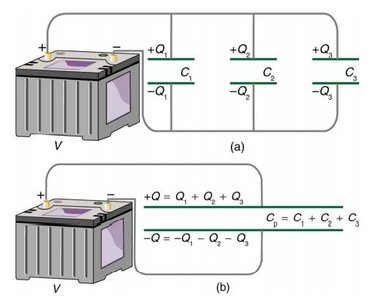
When capacitors are connected in parallel:
Key Point: They have the same voltage, but their charges add up.
Formula:
Energy Stored in Capacitors
Energy Storage
The energy stored in a capacitor can be expressed in three equivalent ways:
Formulas:
Key Point: Energy is stored in the electric field between the plates.
Practice Exercises: Capacitor Networks
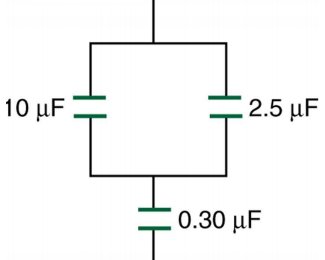
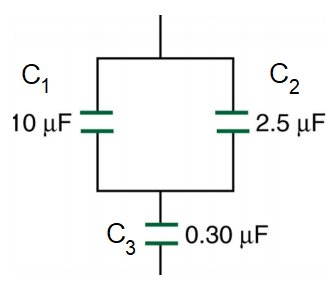
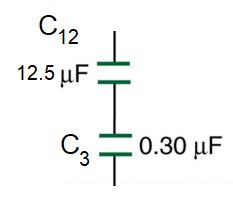
Capacitor Combination Example 1
Finding the total capacitance for a network of capacitors:
Step 1: Identify which capacitors are in series and which are in parallel.
Step 2: Combine parallel capacitors first, then series.
Example: C1 and C2 in parallel, then combined with C3 in series.
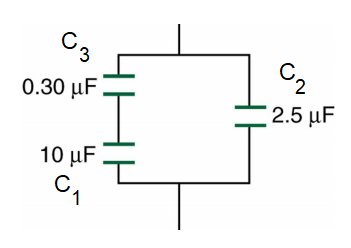
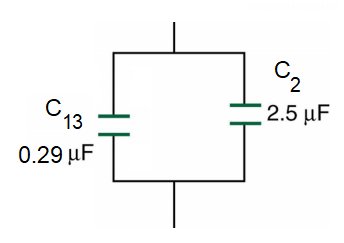
Capacitor Combination Example 2
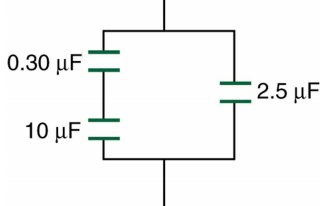
Another example with different arrangement:
Step 1: Combine series capacitors first, then parallel.
Example: C1 and C3 in series, then combined with C2 in parallel.
Summary Table: Dielectric Constants and Strengths
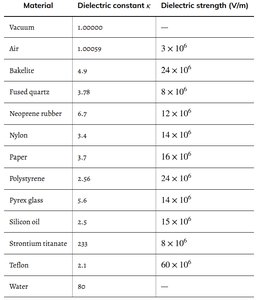
Dielectric materials are characterized by their dielectric constant and dielectric strength, which affect the performance of capacitors:
Material | Dielectric constant k | Dielectric strength (V/m) |
|---|---|---|
Vacuum | 1.00000 | — |
Air | 1.00059 | 3 × 10⁶ |
Bakelite | 4.9 | 24 × 106 |
Fused quartz | 3.78 | 8 × 10⁶ |
Neoprene rubber | 6.7 | 12 × 106 |
Nylon | 3.4 | 14 × 106 |
Paper | 3.7 | 16 × 106 |
Polystyrene | 2.56 | 24 × 106 |
Pyrex glass | 5.6 | 14 × 106 |
Silicon oil | 2.5 | 15 × 106 |
Strontium titanate | 233 | 8 × 10⁶ |
Teflon | 2.1 | 60 × 106 |
Water | 80 | — |
Additional info:
These notes cover the fundamental concepts of electric potential, capacitors, and energy storage, including practical examples and exercises relevant to college-level physics. The included images and table reinforce key concepts and provide visual context for understanding electric fields, equipotential lines, and capacitor networks.
