 Back
BackElectric Potential: Concepts, Calculations, and Applications
Study Guide - Smart Notes
 Tailored notes based on your materials, expanded with key definitions, examples, and context.
Electric Potential and Potential Energy
Introduction to Electric Potential
Electric potential is a fundamental concept in electrostatics, describing the potential energy per unit charge at a point in space due to electric forces. It is analogous to gravitational potential in mechanics and is essential for understanding energy transfer in electric fields.
Electric Potential Energy (U): The energy a charge possesses due to its position in an electric field.
Electric Potential (V): Defined as , where is a test charge.
Potential Difference (Voltage): The difference in electric potential between two points, often measured in volts (V).
Work and Potential Energy in Electric Fields
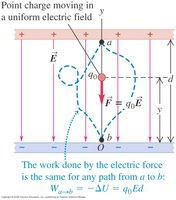
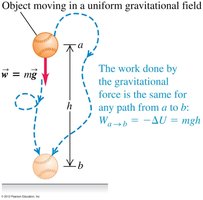
The work done by electric forces is closely related to changes in potential energy. In a uniform electric field, the work required to move a charge is independent of the path taken.
Work Done by Electric Force:
Relationship to Potential Energy:
Uniform Electric Field:
Behavior of Charges in Electric Fields
The direction of movement relative to the electric field affects the change in potential energy for both positive and negative charges.
Positive Charge: Moving in the direction of the field decreases potential energy; moving opposite increases it.
Negative Charge: Moving in the direction of the field increases potential energy; moving opposite decreases it.
Electric Potential Energy of Point Charges
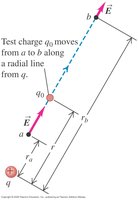
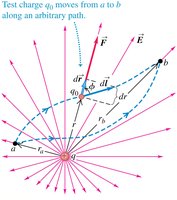
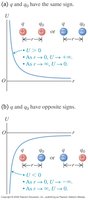
The potential energy between two point charges depends on their magnitudes, signs, and separation distance.
Formula:
Significance: The sign of depends on whether the charges are like or unlike.
Electric Potential of Multiple Charges
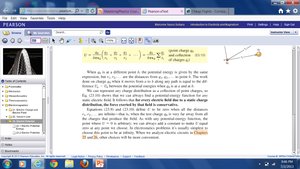
The total electric potential at a point due to several charges is the algebraic sum of the potentials from each charge.
Superposition Principle:
Potential Energy of a System: $U_{total} = \sum_{i
Electric Potential Difference and Voltage
The potential difference between two points is related to the work done by or against the electric force.
Definition:
Interpretation: The work done by the electric force when a unit charge moves from to .
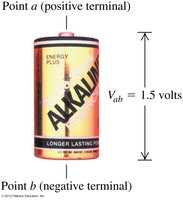
Voltage: The potential difference between the terminals of a battery or other device.
Calculating Electric Potential
From Electric Field:
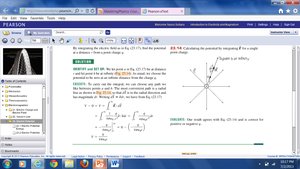
By Integration: Used for continuous charge distributions or varying fields.
Electric Potential of Conductors and Charge Distributions
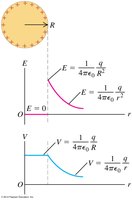
Charged Conducting Sphere: (outside), (inside) (on surface), (outside)
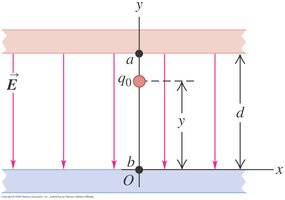
Parallel Plates:
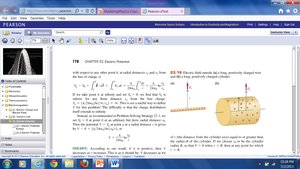
Line Charge: Potential varies logarithmically with distance.
Equipotential Surfaces and Field Lines
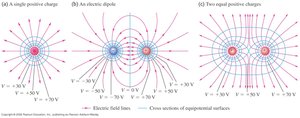
Equipotential surfaces are regions where the electric potential is constant. They are always perpendicular to electric field lines.
Properties:
Field lines and equipotential surfaces are mutually perpendicular.
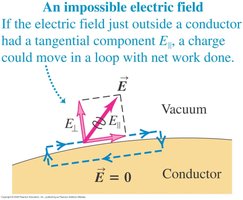
The surface of a conductor is an equipotential.
The electric field just outside a conductor is perpendicular to the surface.
Potential Gradient and Applications
The electric field is related to the spatial rate of change of electric potential, known as the potential gradient.
Formula:
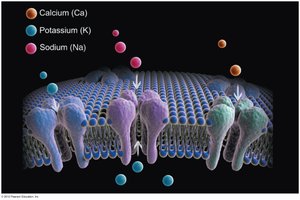
Biological Example: The potential gradient across a cell membrane drives ion flow.
Summary Table: Electric Potential and Potential Energy
Concept | Formula | Key Points |
|---|---|---|
Electric Potential (V) | Potential energy per unit charge | |
Potential Difference (Voltage) | Work per unit charge between two points | |
Potential Energy (U) of Two Charges | Depends on charge signs and separation | |
Work Done by Electric Force | Path-independent in electrostatics | |
Electric Field from Potential | Field points in direction of decreasing potential |
Example Problems and Applications
Calculating Potential at Points: Use superposition for multiple charges.
Potential Energy of Charge Distributions: Integrate over all pairs of charges.
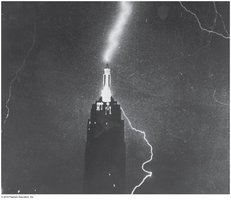
Applications: Batteries, capacitors, biological membranes, lightning rods.
Additional info:
Potential energy approaches zero as charges move infinitely far apart.
Potential at the center of a triangle of charges depends on the algebraic sum of potentials from each charge.
Corona discharge occurs when high electric fields ionize air, relevant in laser printers and lightning rods.
