 Back
BackElectric Potential: Concepts, Properties, and Applications
Study Guide - Smart Notes
 Tailored notes based on your materials, expanded with key definitions, examples, and context.
Electric Potential and Potential Energy
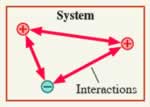
Electric Potential Energy
Electric potential energy is the energy stored due to the interaction of charged particles via the electric force. It is analogous to gravitational potential energy, but arises from electric interactions rather than gravitational ones.
Definition: The energy a charge possesses due to its position in an electric field.
Interaction Energy: Potential energy is always associated with interactions between charges.
Example: Two like charges have higher potential energy when close together due to repulsion.
Electric Potential
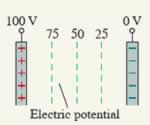
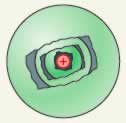
Electric potential, denoted by V, is a scalar quantity that exists everywhere in space and is created by source charges. It determines the potential energy of other charges placed in its vicinity.
Definition: The electric potential at a point is the potential energy per unit charge at that point.
Units: Measured in volts (V).
Properties:
Exists everywhere in space.
Is a scalar quantity.
Causes charges to have potential energy.
Formula:
Important Potentials and Charge Distributions
Potentials of Common Charge Distributions
Calculating electric potential for various charge distributions is fundamental in physics. The most common cases include point charges, charged spheres, rings of charge, and parallel-plate capacitors.
Point Charge:
Charged Sphere: Similar to point charge outside the sphere; inside, potential is constant.
Ring of Charge: Potential calculated using integration.
Parallel-Plate Capacitor: , where E is the electric field and d is the separation.
Continuous Distributions: Calculated by integrating over the charge distribution.
Visualizing Electric Potential
Equipotential Surfaces
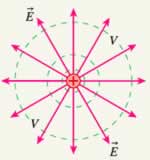
Equipotential surfaces are mathematical surfaces where the electric potential is constant at every point. They help visualize how potential varies in space and are always perpendicular to electric field lines.
Definition: Surfaces of constant electric potential.
Properties:
Electric field lines are perpendicular to equipotential surfaces.
Closer equipotentials indicate a stronger electric field.
Example: Spherical equipotential surfaces around a point charge.
Electric Potential and Energy Conservation
Charged Particles in Electric Potential
A charged particle q in an electric potential V has electric potential energy U = qV. When a particle moves through a potential difference, it accelerates, and mechanical energy is conserved.
Energy Conservation:
Potential Difference: Causes acceleration of charges.
Electric Potential and Electric Field Relationship
Connection Between Electric Field and Potential
The electric field and electric potential are two perspectives on how source charges affect space. Knowing one allows calculation of the other.
Electric Field from Potential:
Potential from Electric Field:
Field Direction: Electric field points in the direction of decreasing potential.
Field Strength: Stronger where equipotentials are closer together.
Properties of Conductors in Electrostatic Equilibrium
Conductors and Equipotential
Conductors in electrostatic equilibrium exhibit unique properties, many of which can be derived from Gauss's law.
Excess Charge: Resides on the surface.
Interior Field: Zero inside the conductor.
Exterior Field: Perpendicular to the surface.
Equipotential: The entire conductor is at the same potential.
Work and emf: Work must be done to separate charges; the work per charge is called emf, measured in volts.
Sources of Electric Potential
Creating Potential Difference
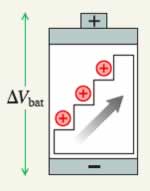
A potential difference, or voltage, is created by separating positive and negative charges. Devices such as batteries use chemical reactions to 'lift' charges from one terminal to another, modeled as a charge escalator.
Emf: The work done per charge to separate charges.
Battery Model: Chemical reactions provide the energy to move charges.
Importance of Energy in Electricity
Electric Energy in Devices
Electric energy is essential for powering devices such as lights, computers, and music players. Understanding electric energy and its connection to electric forces and fields is foundational for studying electric circuits and energy transfer.
Energy Transformation: Electric circuits transform and transfer energy from sources to devices.
Applications: Lighting, computing, and audio devices all rely on electric energy.
Summary Table: Key Concepts of Electric Potential
Concept | Definition | Formula |
|---|---|---|
Electric Potential Energy | Energy due to charge interactions | |
Electric Potential | Potential energy per unit charge | (point charge) |
Equipotential Surface | Surface of constant potential | -- |
Electric Field | Force per unit charge | |
Emf | Work per charge to separate charges | Measured in volts |
Additional info: Academic context and formulas have been expanded for completeness and clarity.
